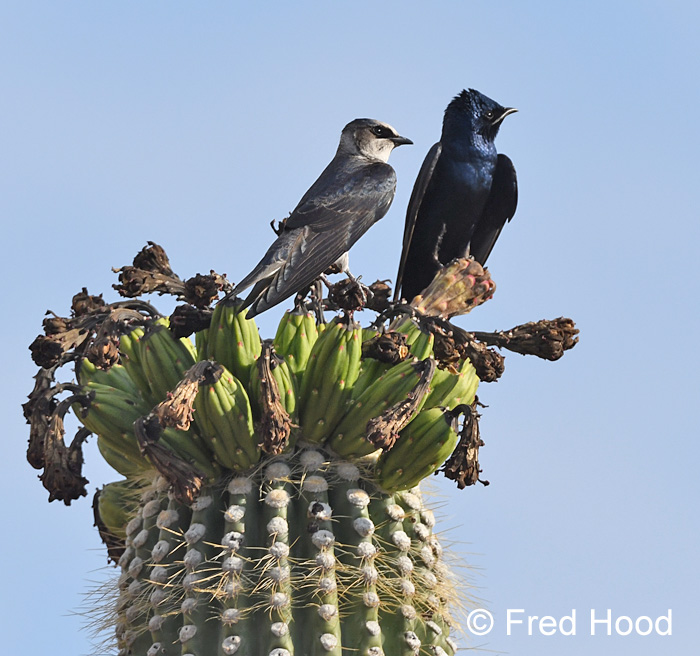
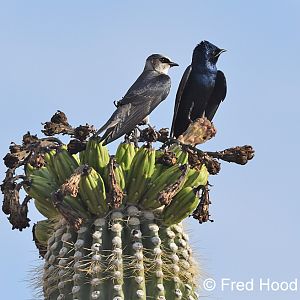
@Arizona Docent Purple Martins are a very unique species in that they nest almost exclusively in man-made bird houses. They are a colonial species so there have to be lots of these bird houses together. Outside of the American southwest, a natural nesting site has never been recorded as native Americans were putting up bird houses made of gourds for this species when the European settlers arrived, and probably had been doing so for a millennia before this. Purple Martins love to eat wasps, that's why the native Americans kept them around villages.
The European settlers quickly began to do the same, putting up houses for martins. The houses require extensive maintenance, birds other than martin have to be driven out if they attempt to nest there, and pretty much all other cavity nesting birds dominate over martins. Also, if the birds are nesting in a cold climate, they actually arrive before insects begin to emerge, meaning they have to be fed to keep them alive. But keeping away wasps and other pest insects was worth it. Until recently. Now that this isn't much of a priority for most people. Purple Martins are declining at an extremely quick rate because no one cares enough to put up houses anymore. Here in Wisconsin, there are maybe 25 colonies in the whole state. Most are at state parks or national wildlife refuges, maintained by the naturalists who work there. Very few are privately maintained. The number is going down too, as private martin keepers move or die and the birds die off as the new resident doesn't care about the birds.
The exception to this is in southern Arizona and surrounding areas, where some martins live in cavities in saguaros. But even in Arizona they prefer man-made boxes whenever possible.
@birdsandbats Interesting information. It is perhaps ironic that in my area they appear to mainly natural cavities, but their numbers are small. I have wondered whether we will eventually lose the species as a breeder.
@Great Argus I hadn't heard of them nesting in tree cavities in California. I'll have to look into that. If the numbers as low as you say than maybe you should try putting up a martin house and see what happens. Annoyingly, the species will only nest in houses that already have other martins nesting in them, which means you have to make the birds think there are already martins in the house. There are various methods of doing this, but the most effective is to fill all the cavities with nesting material and play a recording of martin calls for about an hour every morning. Even then it doesn't always work.
@birdsandbats Yes, they breed in tree holes at two or three known locations in my county, all at fair elevation. I've seen them at one site in person. Unfortunately I don't think putting up a Martin box will work where I live, they don't often drop into the valley and the starlings would almost certainly claim the box first.