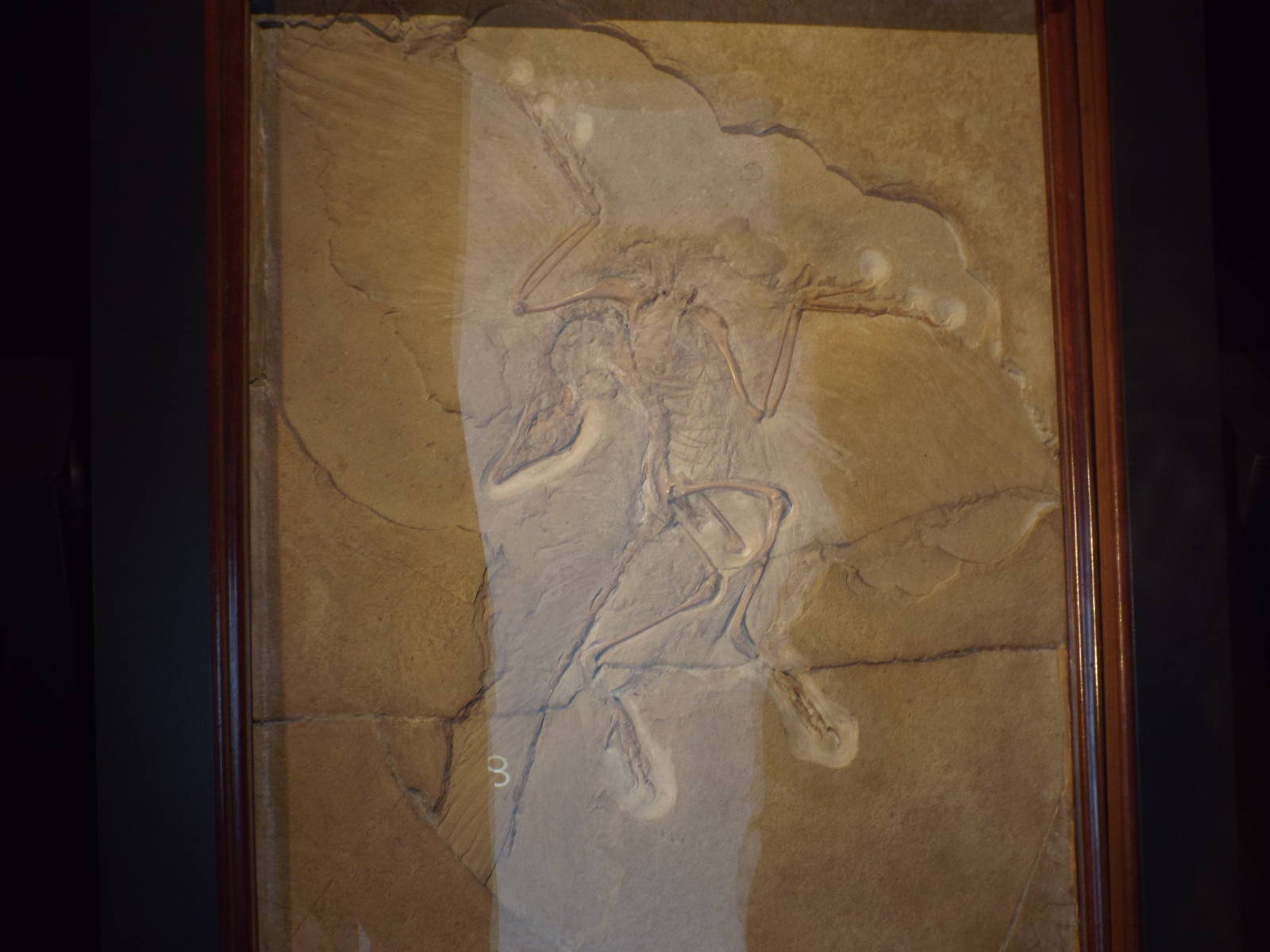
One of the most famous and significant discoveries of all time, this specimen is still the most complete representative of the genus known, and was the third to be discovered after the ?Feather? and ?London Specimen? a decade previously.
One of the most famous and significant discoveries of all time, this specimen is still the most complete representative of the genus known, and was the third to be discovered after the “Feather” and “London Specimen” a decade previously.
If Berlin follow the same policy as the BMNH, this could well be a cast. I frequently looked lovingly at the cast in London, not realising that the original was thought too valuable to display. It was only put on show briefly to demonstrate that Fred Hoyle's suggestion that it was a forgery was totally bonkers - the real one has several large metallic dendrites which exactly match on the part and counterpart, so it has not been forged or manipulated in any way.
If Berlin follow the same policy as the BMNH, this could well be a cast. I frequently looked lovingly at the cast in London, not realising that the original was thought too valuable to display. It was only put on show briefly to demonstrate that Fred Hoyle's suggestion that it was a forgery was totally bonkers - the real one has several large metallic dendrites which exactly match on the part and counterpart, so it has not been forged or manipulated in any way.
To my extreme satisfaction, since 2007 (when the museum renovation was completed) the original Berlin Specimen has been on-display at the Museum für Naturkunde, and not a cast in fact, as noted in my Berlin trip report thread, for a few months in 2011 the Berlin Specimen was actually joined on-display by the original Feather Specimen for a special exhibition. Sadly the latter fossil has since gone off-display once again.
Thank you for an interesting reply. Having seen those dendrites in the London specimen, the question sprang into my mind: but of course most fossils from Solnhofen do not have them.