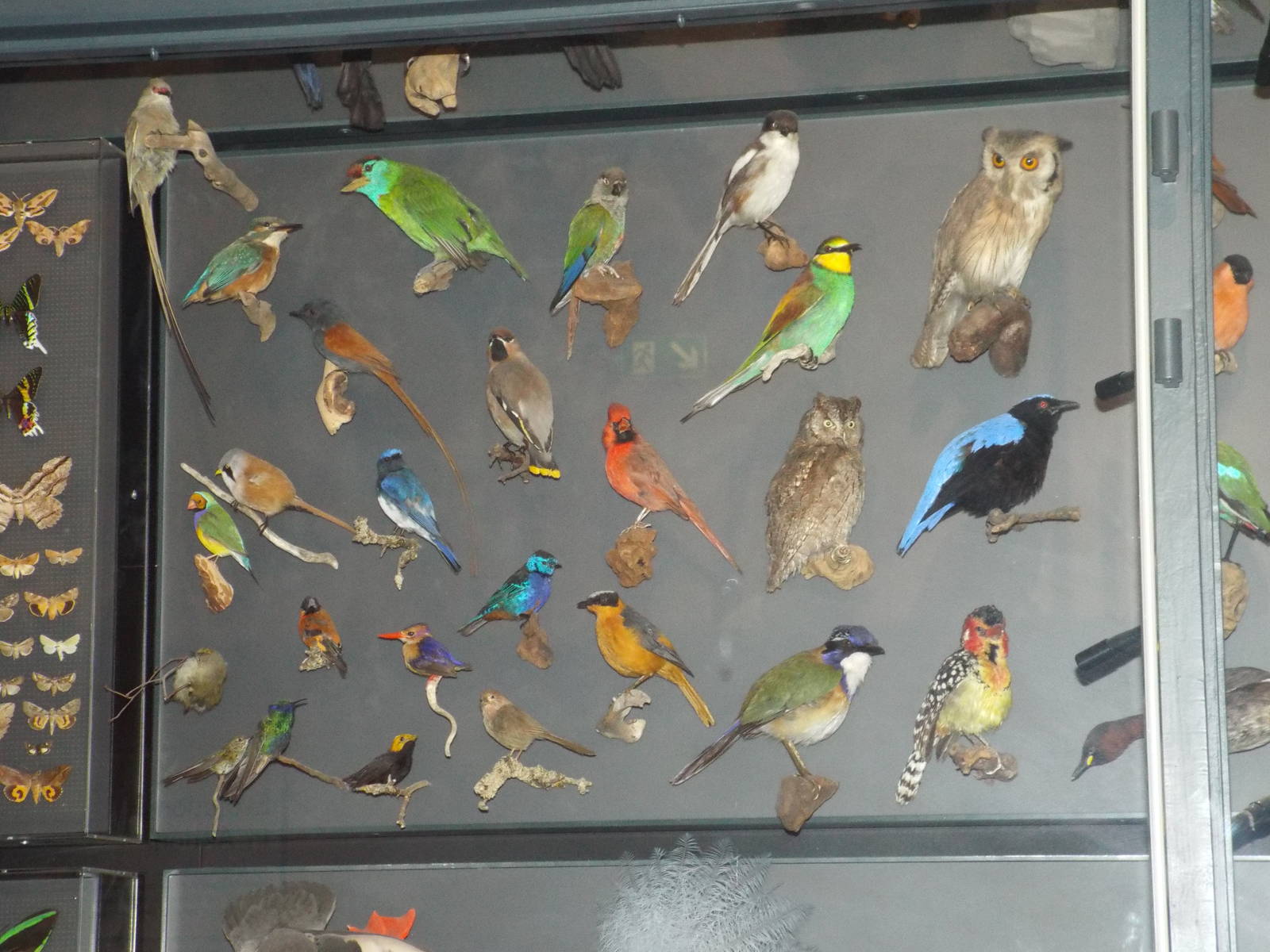
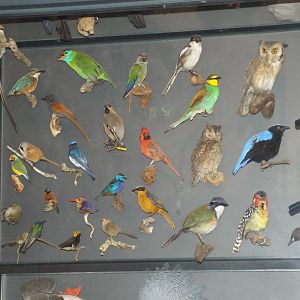
Top:
Blue-naped or Red-faced Mousebird, Common (European) Kingfisher, Pyrrhura Parakeet sp (probably Green-cheeked, but not easy with old and often faded specimens), Fiscal Shrike sp, Blue-throated Barbet, European Bee-eater, White-faced Owl.
Middle:
male Gouldian Finch, male Bearded Tit, African Paradise-flycatcher, male Blue-and-White Flycatcher, Bohemian Waxwing, male Northern (Virginia) Cardinal, Scops/Megascops Owl sp., male Asian Fairy Bluebird.
Only partially visible:
male Eurasian Bullfinch, Hooded Pitta, Little Grebe, Crowned Pigeon sp (crown only, bottom).
Not sure what to make of the "fluffball" in lower left corner or the small black-headed reddish-orange bird directly next to it.
The brightly marked insects: Two uranid moths (Urania leilus and Chrysiridia sp) and the upper corner of a male birdwing butterfly's wing (Ornithoptera sp).
When I first saw this photo Lonchura (munia/mannikin) was also my gut reaction for that specimen, but looking closer there are a few problems. None of the somewhat similar Lonchura species have a black tail, the wing pattern (standard wing-panel) doesn't match any Lonchura and it just looks too red. Finally, if looking closely it appears to have a fairly long primary extension (at first glance easily mistaken for the tail), which definitely excludes members of this genus.
It may be an old, faded ("foxed" if using taxonomic terminology) Red Siskin, but can't say for certain based on this photo.