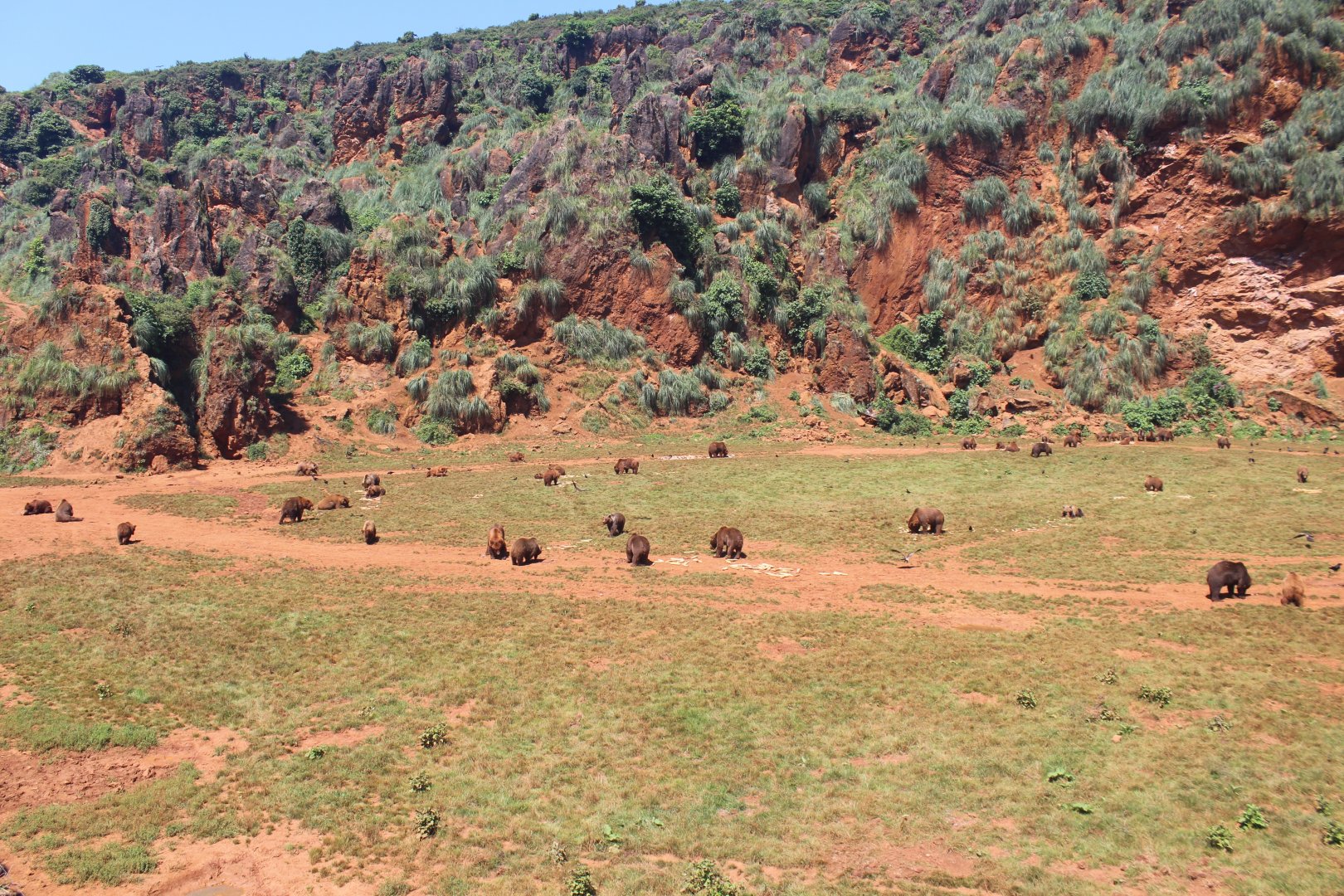
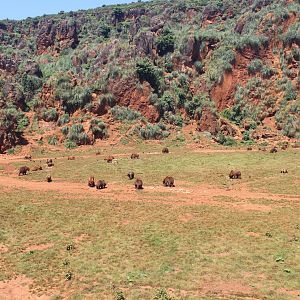
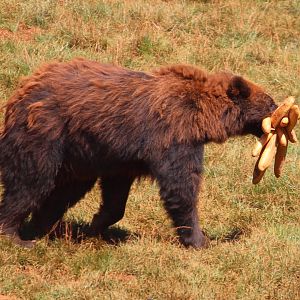
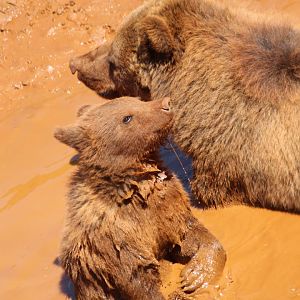
We counted somewhere between 50 and 60 bears here; this may well be an under-estimate. A huge number of wild kites, too, attempting to pinch the bears' food.
Where the hell do all of those bears come from? Breeding? Rescued animals? I can recall visiting a drive-through South Dakota wildlife park in 2015 that had at least 50 American Black Bears (and many taking an interest in my vehicle) but seeing that number of Brown Bears is somehow much more impressive.
@Ashleigh.N Very easy - by car. It’s close to Santander, and straightforward to find. I’m sure it is reachable by public transport, but would assume this to be complicated. And the zoo itself would be very hard to see without a car - I believe there are something like 20 miles of pathway there....
@snowleopard They will almost certainly be the Iberian subspecies of the Eurasian brown bear, the Cantabrian brown bear , Ursus arctos pyrenaicus.
I think that many of them are likely to be rescue animals as there is quite a lot of human / bear conflict in Northern Spain and illegal hunting does occur which can result in orphaned cubs.
@Onychorhynchus coronatus I hate to tell you that you are wrong. Some of these bears came from different places when the park first opened, in 1989 to be precise. Since that date, several rescued animals have been brought into the exhibit, but again, the wild Spanish brown bear population isn't purely Cantabrian, since as far as I know some of the wild animals arrived from other European areas (Though I could be wrong on this one). Despite all of this, I don't discard the idea of one or more of these bears being Cantabrians.
@SivatheriumGuy I don't think I am wrong actually so lets not throw that word around so casually. With regards to the wild population I have been to Asturias and Cantabria and seen the bears in the wild and captivity. Furthermore, I know people involved in their conservation.
While there is occasional dispersal of the brown bear from the French Pyrenees into Spanish territory there are simply not enough of them for this to be a regular occurence. The two growing yet still threatened sub-populations of the Cantabrian brown bear in Asturias and Cantabria form the vast majority of native bears within Spain.
@Onychorhynchus coronatus Sorry if I sounded rude when it came to saying that you are wrong, it wasn't the intention. I'm not an expert when it comes to the wild animals, but I'm 100% sure that the bears in Cabarceno aren't pure Cantabrians.
@SivatheriumGuy Don't worry, I'm familiar with the Spanish way of talking as I lived there for a while.
I'm not an expert on the Cantabrian brown bear either but as I said I know some people who are involved in their in-situ conservation who I would consider to be experts.
I don't think these are 100 % genetically pure Cantabrian brown bears (there has always been dispersal from the brown bears from across the Pyrenees and breeding between the two populations anyway) but I would say that the majority of these animals are of Cantabrian stock.
@Onychorhynchus coronatus I don't want to be rude again, but what makes you think that the bears are from Cantabrian stock? I've been informed that the original animals that came to the park arrive from different American and European stocks.