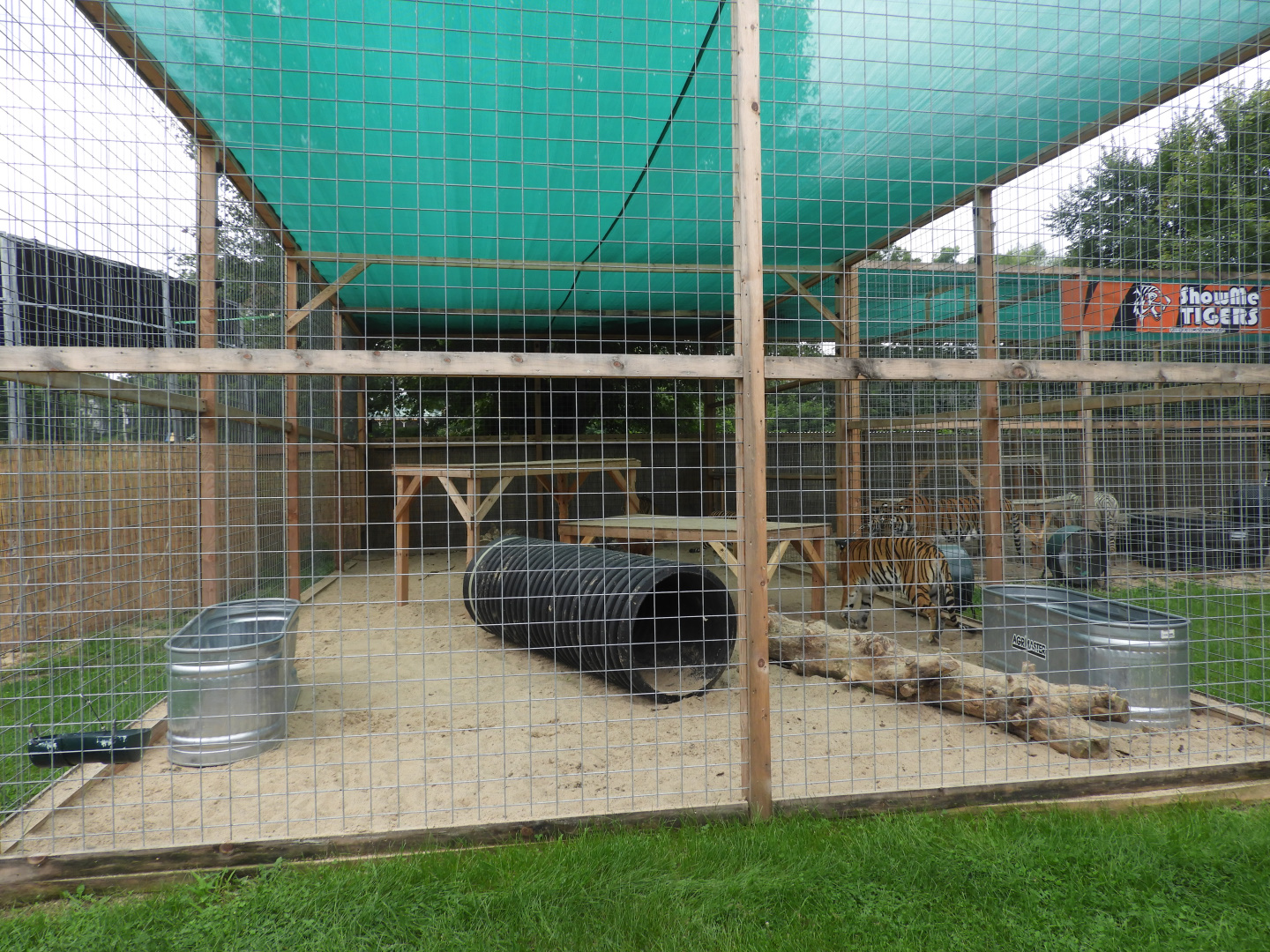
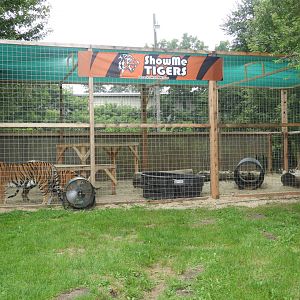
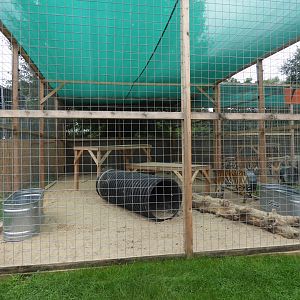
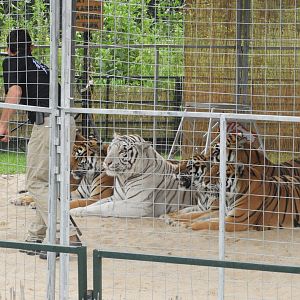
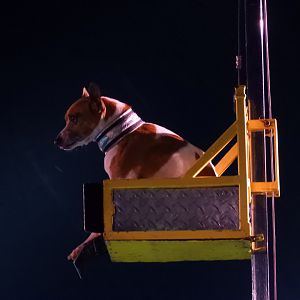
@birdsandbats I'm not sure how you can consider this "suitable." Even if there are other parts to the enclosure, these Tigers have no room to exercise at all. There's no open space and it's very overly furnished. They also have no access to grass or any other plants. Maybe there are plants in the behind-the-scenes area, but I doubt it. Not to mention that they're also trained for a show. Just because you've seen worse, doesn't make this enclosure good. This is by no means acceptable and the fact that you consider it as such baffles me.
@red river hog What's the problem with the show? It's great enrichment and exercise, and the "tricks" they do are do different than what any other zoo may train Tigers to do for regular vet checkups. The combined space of all their area is roughly the same as the average Tiger exhibit, though I agree it is a bit overly furnished - then again they get exercise during the show.
@birdsandbats I don't really find it good for the animals to be trained in a show and used for human entertainment. Many animal shows aren't ethical in the methods they use to train the animals. I imagine there's not protected contact either, which could be very dangerous to the trainers.
@birdsandbats We've already clashed on this subject a few times I believe, but here we go again. Tiger shows are inherently unethical in many, many ways. Firstly, many tigers have their teeth and claws pulled out to minimise risk for trainers - however, this procedure is incredibly painful and can have serious repercussions on the tigers' nutrition in particular, since the absence of canines leads to an inability to tear meat.
Secondly, tigers are solitary animals. If they are forced to perform in a show together, this can lead to fights, or if not, high levels of anxiety and stress in the animals, often resulting either in excessive aggression (the consequences of which can of course be fatal for whoever is involved) and/or stereotypical behaviour.
Thirdly, the training the tigers undergo for the tricks is very different to that conducted for veterinary checkups. For most checkups on big cats, the cats are anaesthetised and brought to the veterinary clinic on the zoo's premises. Otherwise, so that the teeth in particular can be checked without going through the entire procedure, they train the tigers without hurting the tigers and not causing significantly raised stress levels. In contrast, tiger shows often train their tigers with violence and punishment. The proof of this lies in the fact that the shows often force the tigers to jump through flaming rings. Tigers are inherently afraid of fire, so for the tiger to jump through the ring, it must be more afraid of punishment by the trainer than the fire.
Lastly, when the tigers perform they have no privacy. While in most decent exhibits, the tigers can hide from visitors, in shows this is not an option - they are faced with a large, often loud crowd. This invariably causes anxiety levels to raise significantly.
@Amur leopardThe Tigers here had their teeth and claws. I would love to see research proving the Tiger is a solitary animal, as well. Not doubting you but given the research that's been coming out of American Black Bears recently I think we may need to rethink much about what we know of large carnivores.
There were no flaming rings here, all the tricks were pretty standard target training stuff. Sitting in a certain spot, standing on hind legs, ect.