Doing a presentation on Island fauna, thought I might as well share some edits I made. Actually, can someone help my with some examples of island dwarfism? I'm making a page on that too
I'm working on it (Check the post description), but there aren't as many examples (So far I have Asian water buffalo vs Lowland anoa and Common hippopotamus vs Malagasy dwarf hippopotamus. But, to be fair, I haven't researched it as much)
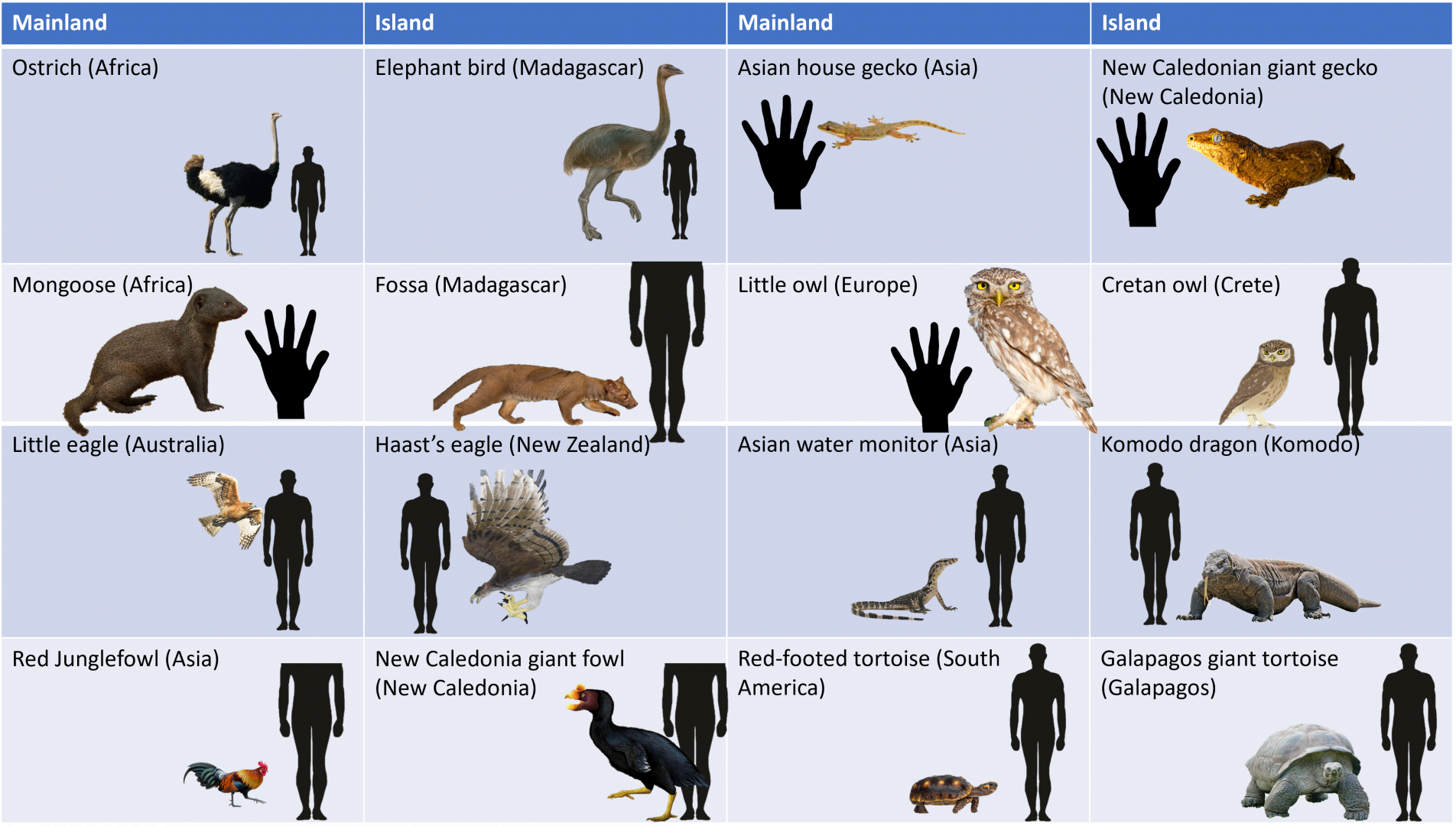
I'm not sure I understand the intent between connecting the mainland and island species on the chart. Are you suggesting that the latter evolved from the former? Because if so your chart is really wrong. If not, then why the connections - especially between taxa which are very clearly not ancestors / descendants (e.g. Junglefowl and Sylviornis, or Ostrich and Aepyornis)? The only examples of actual descendant species on the chart are Little Eagle to Haast's Eagle, and probably the Little Owl to Cretan Owl.
Additionally, Komodo Dragons are now well established from fossil evidence to have originated in Australia - their current Indonesian distribution is relictual.
The various insular giant tortoises are now also thought most likely to have already been giant when reaching their respective archipelagos. The closest living relative of the Galapagos Tortoises is the Chaco Tortoise, but their separation pre-dates the existence of the Galapagos Islands by many millions of years, and giant tortoises of this clade are known from fossil deposits on the South American mainland.
It's a mix of convergent evolution and just similar species. Red-footed tortoise being a closer mainland relative, and the water monitor just being a similar species that lives in the same area.
My main point in the Island gigantism slide is the fact that animals are able to grow so big because there aren't large predators and they can grow bigger without becoming a target. Giving the Perentie as an example wouldn't work as well, because they're one of the biggest predators in Australia. Asian water monitors are hunted by Tigers, Panthers and leopards, so they're a bit of a better example
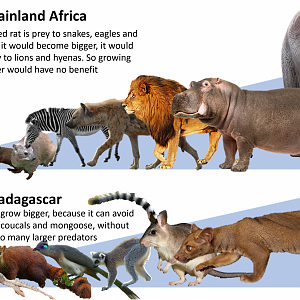
Text from the slide:
•Because there are no large predators on most islands, other animals can grow a lot larger than they can on the mainland
•For example: The White-tailed rat on mainland Africa is small and has to avoid predators such as mongoose, snakes, hawks and everything else. The Madagascar giant rat, in comparison, lives up to its name as a giant. There aren’t any large predators on Madagascar, so it can grow bigger without becoming a target to, for example, lions or hyenas. The Madagascar giant rat becoming bigger actually helps it, as it is too big to be hunted by the smaller mongoose species on Madagascar
"Here is another one, Homo floresiensis compared to mainland humans of the time. I'll keep sharing them with you as I think of them and research them."
I actually want to stay away from ancient humans, as well as dinosaurs etc. Preferably current or recently extinct.
The main rule being that either the mainland example or the island example is still alive
Ok, I've got another example for an Insular dwarfism chart. Channel Islands dwarf mammoth (Mammuthus exilis) compared to the mainland Colombian mammoth (Mammuthus columbi).