KevinB

Expedition Congo - Woodland savannas

  • Media owner KevinB
  • Date added
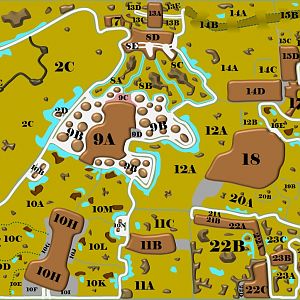
Third and final part of my project on the fauna of the Democratic Republic of the Congo (DRC). This part focuses on the woodland savannas and dry forest-savanna mosaics of the northern and southern DRC. See below for species list, see my personal thread for the full discussion.
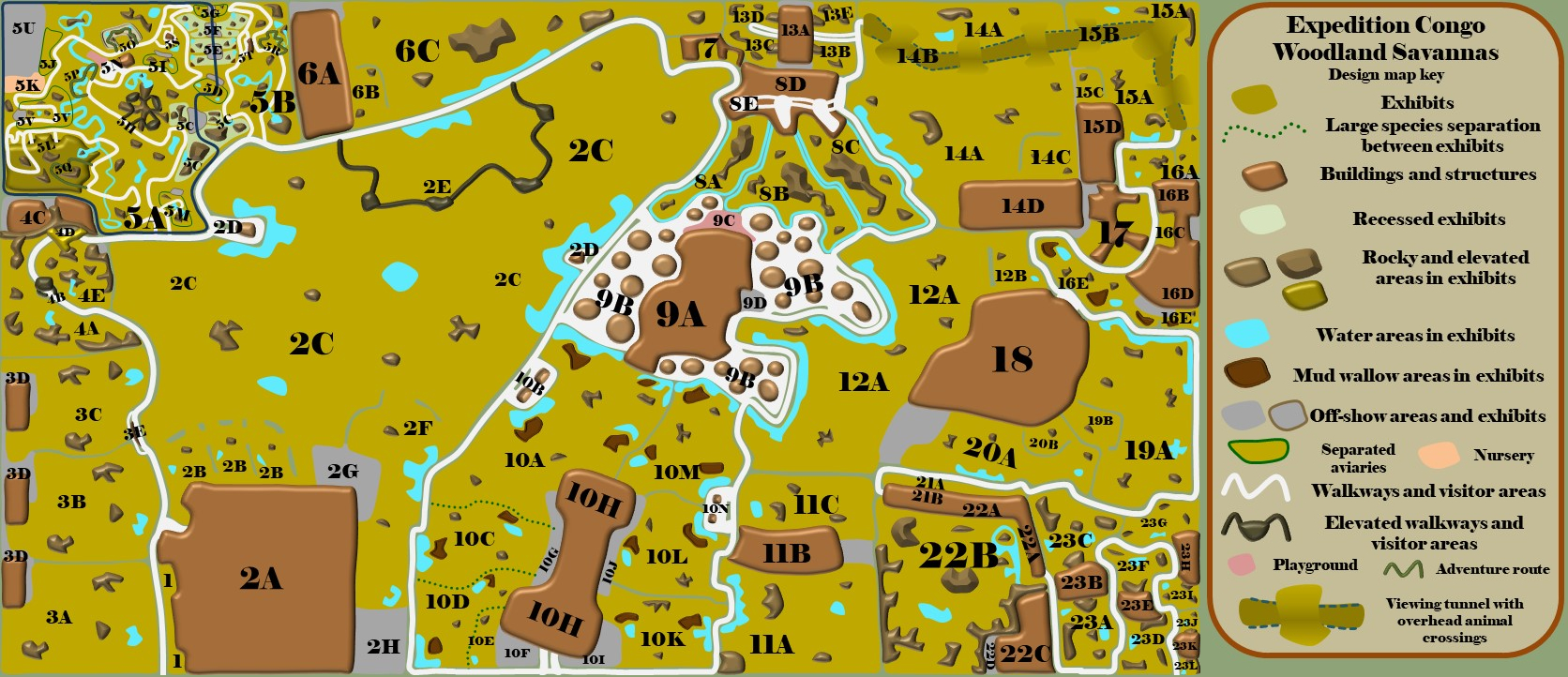
Expedition Congo - Woodland savannas

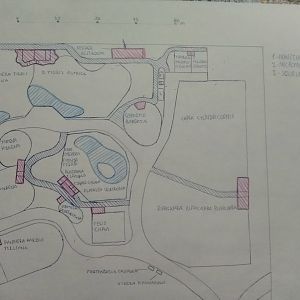
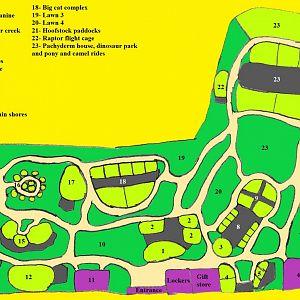
The numbers and number/letter combinations in the list below correspond to numbers on the map. In this species list dotted lists represent the different species housed in a mixed exhibit and striped lists represent species housed in different exhibits within a complex, such as an aviary block or a row of aquariums. For the colors and shapes on the map I added a map key to the design map.

1) Garamba Aviaries (With indoor aviaries within the Garamba Savanna House)

- Piapiac (Ptilostomus afer)
- Black-bellied bustard (Lissotis melanogaster) and Blue-bellied roller (Coracias cyanogaster)
- African grey hornbill (Lophoceros nasutus)
- Emin's Shrike (Lanius gubernator)
- Orange-breasted bushshrike or Sulphur-breasted bushshrike (Chlorophoneus sulfureopectus)
- Yellow-billed oxpecker (Buphagus africanus langi)
- Grey-headed bushshrike (Malaconotus blanchoti)
- Eastern plantain-eater or Eastern grey plantain-eater (Crinifer zonurus)
- Dusky babbler (Turdoides tenebrosa)
- Common buttonquail, Kurrichane buttonquail, Small buttonquail or Andalusian hemipode (Turnix sylvaticus) and Red-headed lovebird (Agapornis pullarius)​

2) Garamba Savanna

2A – Garamba Savanna House with indoor paddocks and stalls and indoor viewing area

2B – Holding and separation paddocks, on-show

2C – Main paddock

2D – Garamba National Park Ranger stations education and viewing areas

2E – Viewing bridge (area contained within not accessible to giraffes)

2F – Secondary paddock

2G – Off-show separation and holding yards

2H – Off-show service area​

Garamba Savanna species list:
  • Kordofan giraffe (Giraffa camelopardalis antiquorum)
  • Giant eland or Lord Derby eland (Taurotragus derbianus gigas)
  • Roan antelope (Hippotragus equinus langheldi)
  • Lelwel hartebeest or Jackson’s hartebeest (Alcelaphus buselaphus lelwel)
  • Uganda kob or Ugandan kob (Kobus thomasi or K. kob thomasi)
  • Bohor reedbuck (Redunca redunca)

3) Southeast African cheetah (Acinonyx jubatus jubatus)
[Cheetah is now considered extinct in the DRC. Southern subspecies is regionally extinct in the DRC according to IUCN Red List, present in southern regions until second half of 20th century, with Upemba NP being last stronghold, some sources still mentioning Upemba as part of cheetah range. Rumors of occasional sightings, populations still exist in neighboring countries.]

3A – Breeding female exhibit

3B – Breeding male or coalition of breeding males exhibit

3C – Breeding female exhibit

3D – Holding buildings, holding pens and corridors and pens connecting exhibits

3E – Interactive cheetah educational and interpretative area, including running course and cheetah anatomy and conservation displays​

4) African leopard (Panthera pardus pardus)

4A – First African leopard exhibit

4B – Elevated leopard viewing area

4C – Leopard holding building and off-show area

4D – Leopard overpass bridge for connection and transfer between exhibits

4E – Second African leopard exhibit​

5) Woodland Savannas Ecodisplay and Woodland Savannas Walk-through aviary

5A – Woodland Savannas Ecodisplay semi-arid tropical greenhouse, with free-roaming species

5B – Woodland Savannas Walk-through aviary, with free-roaming species​

List of free-roaming species in 5A and 5B
  • Marungu helmeted guineafowl (Numida meleagris marungensis)
  • Coqui francolin (Peliperdix coqui or Campocolinus coqui)
  • Heuglin's spurfowl or Heuglin’s francolin (Pternistis icterorhynchus)
  • Shelley's francolin (Scleroptila shelleyi)
  • African comb duck or Knob-billed duck (Sarkidiornis melanotos)
  • Brown-chested lapwing (Vanellus superciliosus)
  • White-crested turaco (Tauraco leucolophus)
  • Ross's turaco or Lady Ross's turaco (Musophaga rossae)
  • Grey Go-away-bird or Grey lourie (Corythaixoides concolor)
  • Lesser blue-eared starling or Lesser blue-eared glossy starling (Lamprotornis chloropterus elisabeth)
  • Miombo rock thrush (Monticola angolensis)
  • Miombo scrub robin (Cercotrichas barbata)
  • Snowy-crowned robin-chat (Cossypha niveicapilla)
  • Bronze-tailed starling or Bronze-tailed glossy starling (Lamprotornis chalcurus)
  • Violet-backed starling, Plum-colored starling or Amethyst starling (Cinnyricinclus leucogaster verreauxi)
  • Vieillot's black weaver (Ploceus nigerrimus nigerrimus or P. nigerrimus)
  • Black-winged red bishop (Euplectes hordeaceus)
  • African green pigeon (Treron calvus)
  • Speckled pigeon (Columba guinea)
  • Red-throated bee-eater (Merops bulocki)
  • Böhm's bee-eater (Merops boehmi)
  • Miombo pied barbet (Tricholaema frontata)
5C – Zambian klipspringer (Oreotragus centralis or O. oreotragus centralis) and Yellow-spotted rock hyrax or Yellow-spotted bush hyrax (Heterohyrax brucei chapini), indoor and outdoor exhibits and off-show area

5D – Speke's hinge-back tortoise, Savanna hinge-back tortoise or Speke’s hinged tortoise (Kinixys spekii), indoor and outdoor exhibits and off-show area

5E – Aardvark (Orycteropus afer), indoor and outdoor exhibits and off-show area

5F – Central Oribi (Ourebia ourebi hastata or O. hastata), indoor and outdoor exhibits and off-show area

5G – Denham's bustard, Stanley bustard or Stanley's bustard (Neotis denhami) and Black coucal (Centropus grillii) aviaries, indoor and outdoor, and off-show area

5H – Large rocky outcropping and elevated viewing area

5I – Striped ground squirrel (Euxerus erythropus) and Straw-colored fruit bat (Eidolon helvum)

5J – Viewable acclimatization and separation aviaries

5K – Avian nursery

5L – Nocturama and Rodent Rowe

Species list for Nocturama (Nocturnal exhibits) and Rat Rowe with diurnal or (semi-)nocturnal rodent exhibits

- Senegal bushbaby, Senegal galago, Lesser galago or Lesser bush baby (Galago senegalensis)
- Mohol bushbaby (Galago moholi
- Bunyoro rabbit or Central African rabbit (Poelagus marjorita)
- Southern springhare or South African springhare (Pedetes capensis)
- African striped weasel (Poecilogale albinucha)
- Angolan fruit bat, Angolan rousette or Silky bat (Myonycteris angolensis)
- Kellen's African dormouse (Graphiurus kelleni)
- Fiery-necked nightjar (Caprimulgus pectoralis shelleyi)
- Pearl-spotted owlet (Glaucidium perlatum)
- Emin's gerbil or Emin's tateril (Taterillus emini)
- Silvery mole-rat, Silvery blesmol or Silky mole-rat (Heliophobius argenteocinereus)
- Mechow's mole-rat (Fukomys mechowii)
- Natal multimammate mouse (Mastomys natalensis)
- Typical striped grass mouse (Lemniscomys striatus luluae)​

5M – Sunbird and Butterfly walk-through exhibit
  • Western violet-backed sunbird or Longuemare's sunbird (Anthreptes longuemarei)
  • Western Miombo sunbird (Cinnyris gertrudis)
  • Anchieta's sunbird (Anthreptes anchietae)
  • Splendid sunbird (Cinnyris coccinigastrus)
  • Gaudy commodore (Precis octavia octavia)
  • Yellow pansy (Junonia hierta)
  • African swallowtail, Mocker swallowtail or Flying handkerchief (Papilio dardanus dardanus)
  • Blue-spangled emperor, Guderian's Charaxes or Blue-spangled Charaxes (Charaxes guderiana guderiana)
5N – Resting area with seating areas, small playground, restrooms and food and drink vending machines

5O – Dry season creek bed adventure trail

5P – Wet season creek adventure trail

5Q – Rocky hill adventure trail

5R – Outdoor adventure trail

5S – Indoor education area

5T – Outdoor education area

5U – Off-show area with technical room, storage areas, food and enrichment prep rooms and off-show aviaries

5V – Quail and passerine walk-through aviary
  • Harlequin quail (Coturnix delegorguei delegorguei)
  • Black-chinned quailfinch or Red-billed quailfinch (Ortygospiza gabonensis fuscata or O. atricollis fuscata)
  • Locust finch (Paludipasser locustella)
  • Grey-headed oliveback or White-cheeked oliveback ((Nesocharis capistrata))
  • Black-crowned waxbill (Estrilda nonnula)
  • Dybowski's twinspot (Euschistospiza dybowskii)
  • Red-throated twinspot or Peters's twinspot (Hypargos niveoguttatus)
  • Red-cheeked cordon-bleu or red-cheeked cordonbleu (Uraeginthus bengalus)
  • African firefinch, Dark firefinch or Blue-billed firefinch (Lagonosticta rubricata)
  • Northern yellow white-eye or African yellow white-eye (Zosterops senegalensis kasaicus)
  • Red-winged pytilia (Pytilia phoenicoptera)
  • Exclamatory paradise whydah or Uelle paradise whydah (Vidua interjecta)

6) Southern lion (Panthera leo melanochaita, from population formerly classified separately as Southwest African lion or Katanga lion, Panthera leo bleyenberghi)

6A – Lion house with large communal indoor exhibit, viewable to the public, and holding and separation dens

6B – Lion outdoor separation exhibit

6C – Main lion outdoor exhibit​

7) Small mammal building and exhibits

- Common slender mongoose, Black-tipped mongoose or Black-tailed mongoose (Herpestes sanguineus)
- Common dwarf mongoose (Helogale parvula)
- Congo rope squirrel (Funisciurus congicus)
- Gambian sun squirrel (Heliosciurus gambianus)
- Short-snouted elephant shrew or Short-snouted sengi (Elephantulus brachyrhynchus)​

8) Savanna Monkeys

8A – Malbrouck (Chlorocebus cynosuros) island

8B – Kinda baboon (Papio kindae) island

8C – Eastern Patas monkey (Erythrocebus patas pyrrhonotus) island

8D – Savanna monkey house – With “Rat Rowe” – Rodent exhibits

8E – Roof-top monkey viewing and education areas and access/exit routes​

9) The Watering Holes Building

9A – The Watering Holes Building

Ground floor/First floor:
Outdoor:Terraces with eating areas under shade structures and eating areas with umbrellas.
Indoor: Self-service restaurant area, kitchen and food storage, indoor eating areas, toilets/restrooms.​

Second floor: Indoor eating areas, indoor play area and toilets/restrooms.

Third floor: Education rooms and toilets/restrooms. Staff offices and meeting rooms, staff restrooms.

Fourth floor: Museum area with natural history and human history displays, Terrariums, and terrarium nursery, panoramic viewing windows.

Herp exhibits

- Black-necked spitting cobra (Naja nigricollis)
- Black mamba (Dendroaspis polylepis)
- Puff adder (Bitis arietans arietans)
- Rhombic night adder, Demon night adder, Cape night adder, African night adder or Cape viper (Causus rhombeatus)
- Savannah monitor or Bosc’s monitor (Varanus exanthematicus)
- Flap-necked chameleon (Chamaeleo dilepis)
- Common agama, Red-headed rock agama or Rainbow agama (Agama agama)
- Finch’s agama (Agama finchi)
- African five-lined skink or Rainbow mabuya (Trachylepis quinquetaeniata)
- Falk's blue-headed tree agama (Acanthocercus cyanocephalus
- Two-spotted assassin bug (Platymeris biguttatus)
- Common spiny flower mantis (Pseudocreobotra wahlbergii)

9B – The Watering Holes Terraces, with eating areas covered by shade structures and eating areas with umbrellas

9C – Playground area

9D – Off-show areas for deliveries and waste disposal​

10) Rhinoceros Conservation Center with Southern white rhinoceros or Southern square-lipped rhinoceros (Ceratotherium simum simum) [Southern white rhinoceros used as stand-in for the functionally extinct Northern white rhinoceros C. s. cottoni, the last known population of this subspecies was found in Garamba NP, northeastern DRC, against border with South Sudan, where they were last seen in 2006 and last signs of their presence in 2007] and South-central black rhinoceros or South-central hook-lipped rhinoceros (Diceros bicornis minor) [Formerly found in southeastern DRC, now regionally extinct in that part of Africa, but still found further south]

10A – Southern white rhinoceros, main paddock

10B – Southern white rhinoceros viewing and education area with mock-up ranger and poacher camps

10C – Southern white rhinoceros, second paddock

10D – Southern white rhinoceros, third paddock

10E – Separation paddock for bachelor/surplus male antelopes [Varying species composition] housed with Southern white rhinoceros herd

10F – Southern white rhinoceros off-show service area

10G – Southern white rhinoceros off-show paddocks connecting publicly viewable paddocks

10H – Southern white rhinoceros, South-central black rhinoceros and Bachelor/Surplus male antelopes house

10I – South-central black rhinoceros off-show service area

10J – South-central black rhinoceros off-show paddocks connecting publicly viewable paddocks

10K – South-central black rhinoceros, first paddock

10L – South-central black rhinoceros, second paddock

10M – South-central black rhinoceros, third paddock

10N – South-central black rhinoceros viewing and education area with mock-up ranger and poacher camps​

11) Spotted hyena (Crocuta crocuta)

11A – First and main spotted hyena exhibit

11B – Spotted hyena house – With spotted hyena dens and separate spare large carnivore indoor dens

11C – Second spotted hyena exhibit – Or spare large carnivore exhibit​

12) Zambian sable antelope (Hippotragus niger kirkii), Puku (Kobus vardonii) and Sharpe's grysbok or Northern grysbok (Raphicerus sharpei)

12A – Main exhibit

12B – Separation paddock​

13) Caracal (Caracal caracal) and Serval (Leptailurus serval) exhibits

13A – Caracal and Serval house with indoor exhibits with viewing windows and off-show indoor dens

13B – First Caracal exhibit

13C – Second Caracal exhibit

13D – First Serval exhibit

13E – Second Serval exhibit​

14) African wild dog, African painted dog or African hunting dog (Lycaon pictus) [Probably extirpated from the DRC since the 1990’s, most recent sighting in 1986 in Upemba National Park]

14A – Main exhibit

14B – Recessed viewing tunnel with viewing windows and overhead crossing areas with earth mounds for the African wild dogs

14C – Separation pen

14D – African wild dog hog, with indoor den with viewing window and off-show indoor dens​

15) Side-striped jackal (Lupulella adusta)

15A – Main exhibit

15B – Recessed viewing tunnel with viewing windows and overhead crossing areas with earth mounds for the Side-striped jackals

15C – Separation pen

15D – Side-striped jackal, with indoor den with viewing window and off-show indoor dens​

16) Southern warthog (Phacochoerus africanus sundevallii) , Cape porcupine or South African porcupine (Hystrix africaeaustralis) and Banded mongoose (Mungos mungo)

16A – Cape porcupine exhibits [With access for banded mongoose]

16B – Southern warthog, Cape porcupine and Banded mongoose house – Cape porcupine and Banded mongoose indoor housing, with viewing windows for main dens

16C – Banded mongoose exhibit [With connections to Cape porcupine and Southern warthog exhibits for access as desired or possible]

16D – Southern warthog, Cape porcupine and Banded mongoose house – Southern warthog indoor housing, with viewing windows for main dens

16E – Southern warthog exhibits [With access for Banded mongoose]​

17) Small and medium predator building and exhibits

- Central African honey badger (Mellivora capensis cottoni)
- Angolan genet or Miombo genet (Genetta angolensis)
- Striped polecat, African polecat, Zorilla, Zorille, Zoril, Cape polecat or African skunk (Ictonyx striatus)
- Pousargues's mongoose or African tropical savannah mongoose (Dologale dybowskii)

18) Katanga Antelope House with communal and individual stalls per species, visitor area, keeper areas and off-show service area including an off-show spare paddock

19) Zambezi greater kudu or Southern greater kudu (Tragelaphus strepsiceros strepsiceros, Strepsiceros zambesiensis or Strepsiceros strepsiceros zambesiensis) and Common duiker, Grey duiker or Bush duiker (Sylvicapra grimmia splendidula)

19A – Main exhibit

19B – Separation paddock, viewable at a distance​

20) Chobe bushbuck (Tragelaphus ornatus or T. scriptus ornatus) and Red-flanked duiker (Cephalophus rufilatus)

20A – Main exhibit

20B – Separation paddock, viewable at a distance​

21) Katanga Aviaries

21A – Outdoor aviaries

21B – Indoor aviaries and keeper areas for the Katanga aviaries, in structure built in complex with and right next to the covered viewing area for the ground hornbill/marabou/pied crow/vulture aviary, with that viewing area also serving as the viewing area for the indoor aviaries, through viewing windows​

- Meyer's parrot (Poicephalus meyeri matschiei)
- Southern white-faced owl or Southern white-faced scops owl (Ptilopsis granti)
- African scops owl (Otus senegalensis senegalensis)
- Crested barbet (Trachyphonus vaillantii)
- Anchieta's barbet (Stactolaema anchietae)
- Arrow-marked babbler (Turdoides jardineii)
- Gorgeous bushshrike or Four-coloured bushshrike (Telophorus viridis)
- Souza's shrike (Lanius souzae)
- Bronze-winged courser or Violet-tipped courser (Rhinoptilus chalcopterus)
- Pale-billed hornbill (Lophoceros pallidirostris)​

22) Ground hornbill, Marabou, Pied crow and Vulture aviary

22A – Covered viewing area, also doubling as a viewing area for the indoor aviaries for the Katanga Aviaries, number 21

22B – Main aviary

22C – Ground hornbill, Kite, Marabou, Pied crow and Vulture house with indoor aviaries with viewing windows and off-show indoor aviaries

22D) – Off-show separation aviaries​

Species list
  • Abyssinian ground hornbill or Northern ground hornbill (Bucorvus abyssinicus)
  • Yellow-billed kite (Milvus aegyptius parasitus)
  • Marabou (Leptoptilos crumenifer)
  • Pied crow (Corvus albus)
  • White-headed vulture (Trigonoceps occipitalis)
  • Lappet-faced vulture or Nubian vulture (Torgos tracheliotos)
  • Hooded vulture (Necrosyrtes monachus)
  • African white-backed vulture (Gyps africanus)
23) Raptor aviaries

23A – Martial eagle (Polemaetus bellicosus)

23B – Martial eagle and bateleur mews, on-show with viewing window and off-show

23C – Bateleur (Terathopius ecaudatus)

23D – Wahlberg’s eagle (Hieraaetus wahlbergi)

23E – Wahlberg’s eagle and Augur buzzard mews, on-show with viewing window and off-show

23F – Augur buzzard (Buteo augur)

23G – Secretary bird (Sagittarius serpentarius) and Lilac-breasted roller (Coracias caudatus)

23H – Secretary bird, Lilac-breasted roller and African harrier-hawk mews, on-show with viewing window and off-show

23I – African harrier-hawk or Gymnogene (Polyboroides typus)

23J – Grasshopper buzzard (Butastur rufipennis)

23K – Grasshopper buzzard and African pygmy falcon mews, on-show with viewing window and off-show

23L – African pygmy falcon (Polihierax semitorquatus)​
 
@amur leopard @Mr Gharial

Thank you very much for your very kind comments.

I think maybe I crammed in a bit too much for one design/project and put a bit too much detail for the size, perhaps even more so than before something which I'm going to try to address for future projects, but I am still fairly happy with how this project ended up, as I at times really struggled with this one.

I wouldn't ever claim the "best contribution" or "looks like a real zoo map" things myself, but I nonetheless very much appreciate your nice comments, and I'm glad to have given you some enjoyment.
 
Just noticed I make a few mistakes/forgot to make a few corrections in the species list, for which I apologize.

Under 5L I forgot to change "Rat Rowe" into "Rodent Rowe".

Under number 8 I forgot to remove "Rat Rowe", as that exhibit was moved to a different area at some point during the design process.

Under 14 and 15 I wrote hog instead of house, or forgot to add a word entirely.

I forgot to add kite to the title under number 21, as I added the kite as a species there close to the completion of the list.

I need to be more careful with proofreading and am going to try to do so if I do any future projects.
 

Media information

Category
Fantasy Zoos
Added by
KevinB
Date added
View count
2,819
Comment count
5
Rating
0.00 star(s) 0 ratings

Image metadata

Filename
Expedition Congo Woodland savannas with key.jpg
File size
1.2 MB
Dimensions
1672px x 722px

Share this media

Back
Top