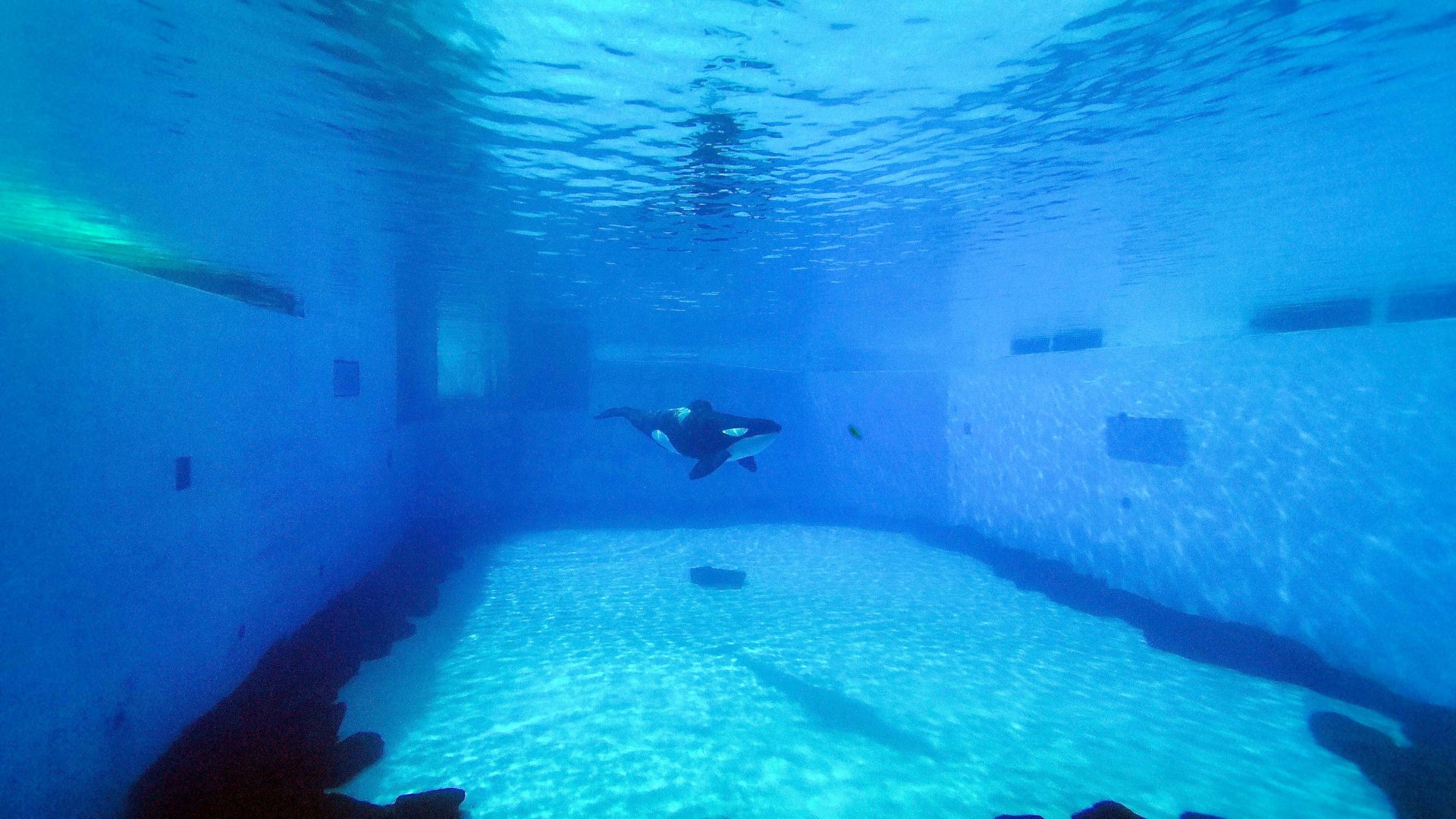
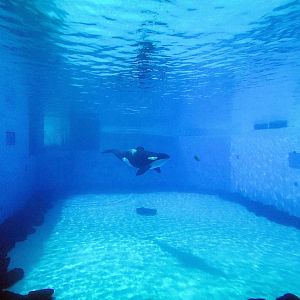
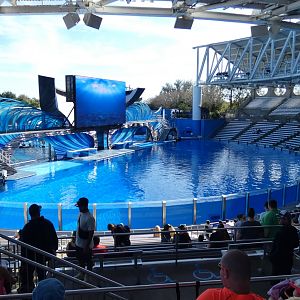
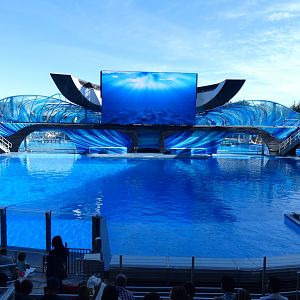
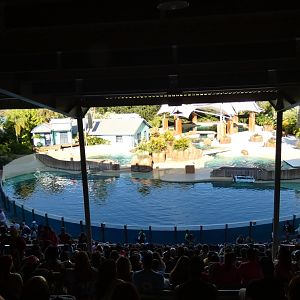
This is why I think most of the defense of SeaWorld is more about opposing the AR activists than actually believing its right. If a primate or big cat, or really any other animal, was in a comparable enclosure to this, Zoochatters would lose their minds, and rightfully so. But this is ok?
@Atrox1214 In comparison to a primate, or big cat enclosure, what's not okay about this? Last I checked, those two groups aren't known to be fully aquatic.
@Moebelle any form of enrichment? Some shade maybe? You think any other animal in a bare enclosure with 4 barren concrete walls would go over well? Look at Cincinnati zoo's big cat house pictures. The indoor exhibits are barren concrete with a log to claw on and the reviews are absolutely scathing.
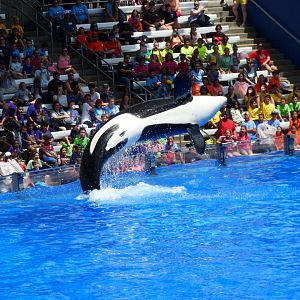
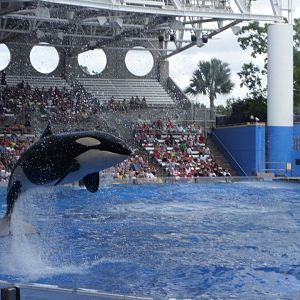
@Atrox1214 Their enrichment comes from the behaviors, time with trainers and any EED's they're given. Makaio here was doing a Dine With Shamu session. The orcas themselves even store food within the bottom rocks and come back for them at another time. From what I've seen, Tilikum played with simulated seaweed more than the others. In SD, I witnessed Keet toss a giant ball back and forth with a trainer, and the pods were given kelp to play with. Come to think of it, of all the zoos I've been to I've never seen any other species be more enriched and kept busy.
This enclosure was once full of mock rock walls, but all they did was serve as an aesthetic and take away more room for swimming, and I somehow doubt it would still pass as acceptable to critics. I wasnt aware shade was a form of enrichment, but just to throw it out there, one of the pools is completely covered.
Even though, again, I don't see the comparison, big cat 'bedrooms' available to keeper eyes only are often barren and dull to make for a cleaner environment. Even San Diego Safari Park's behind the scenes area for their lions looks comparable to a 'prison' (as most do). Cincy's indoor big cat enclosures are private/away from public eye, so I don't know what reviews you could be referring to.
I personally am very disappointed in the current structural status of all Shamu Stadiums and still wish the Blue World Project was never canceled. My issue has always been related to the size of the complex (approx. 6 million gallons, which is not a small number depending on who you ask) but it's never crossed my mind to compare the needs of a mostly open ocean animal to those from a jungle or savanna.
@Moebelle My mistake, I was thinking of Henry Doorly Zoo's big cat enclosures, which are criticized quite heavily. But still, at the end of the day, you feel a barren tank with four bare concrete walls is adequate?
They come from the ocean, which is largely barren. You see them swimming in an empty water column. How's this any worse? As Moebelle said, their enrichment comes from other places than putting stuff in their walls.
Ingesting foreign objects was also a leading cause of death in zoological cetaceans (according to a document by Marineland of the Pacific in the 60s) back before proper safety was around. But even today, Kolmården Zoo has attempted "permanent" enrichment with their dolphins and it led to the death of Nephele, because she swallowed part of it.
Now SeaWorld was attempting and making real effort to replace these pools with the Blue World Project, which would span over an acre and a half (bigger by far than even Chimelong's main pool) and have a wave pool, much greater depth and more enrichment.
BUT as we know, the haters couldn't let this happen, they needed the whales to remain in their 1980s pools, and will do so unless SeaWorld changes leadership completely, and starts breeding again. At least now SeaWorld is adding live fish as enrichment, and I saw last summer that SWO has a wave pool in their dolphin cove, and when the waves were active was also when the toys were thrown in (enrichment like toys is more fun when it's not there all the time, as any pet owner can attest to). They wanted to do that for the killer whales too, but weren't allowed.