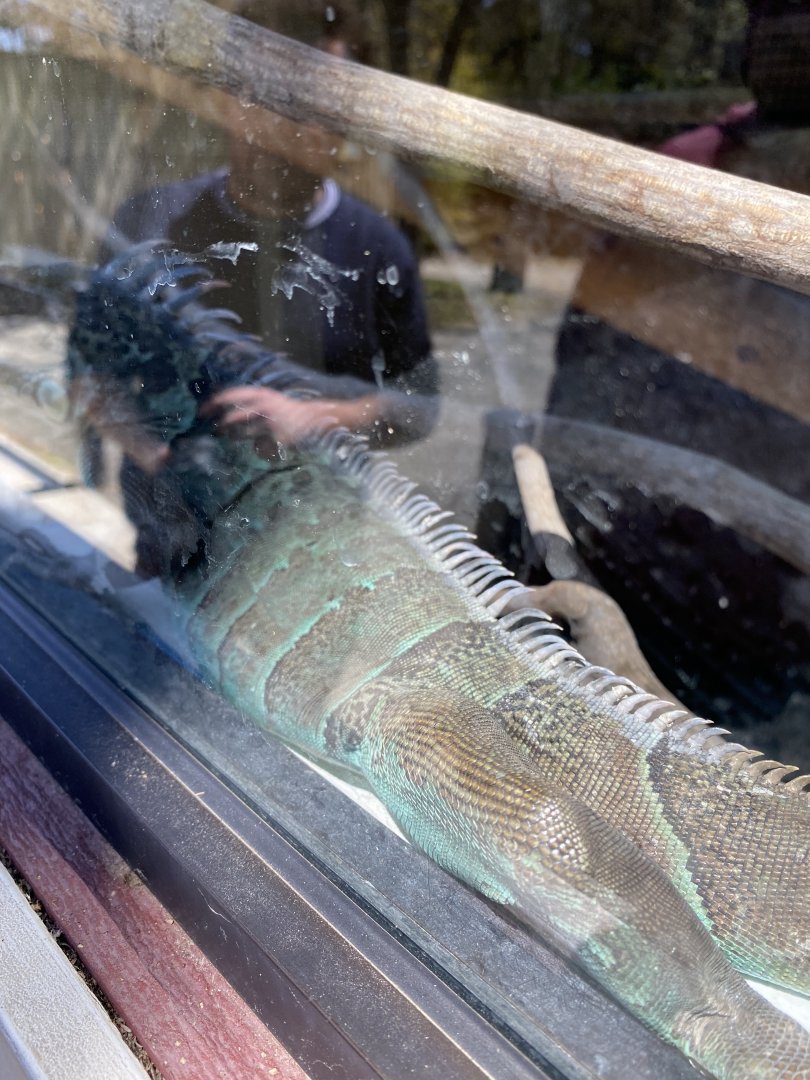
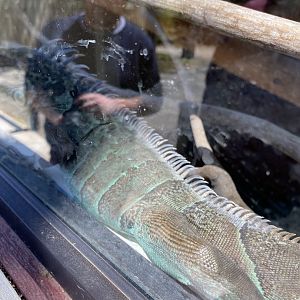
@birdsandbats Going back to at least 2006 there have been genetic studies that indicate Iguana iguana is a species complex rather than a single monotypic species as many sources have held it as. A few papers published between 2018-2021 have more definitively shown there to be deep divergences between populations. Right now, we seem to be looking at at least four species with five taxa species across them:
-Iguana iguana found across mainland South America
-I. rhinolopha found throughout Central America
-I. melanoderma (Saban Black Iguana) found on Saba and Montserrat, possibly also Venezuela and St. Thomas
-I. insularis found throughout most of St. Vincent and the Grenadines, Grenada, and St. Lucia
I. i. insularis across most of their range
I. i. sanctaluciae endemic to St. Lucia
The Curacao populations along with some of the remote populations within mainland South America are needing further investigation as well.
Unfortunately, I do not know where this leaves the status of the introduced populations in Puerto Rico, the Virgin Islands, Hawaii, Fiji, and the mainland U.S. I think the majority of the iguanas that have been historically brought to the U.S have been from mainland South America, but not exclusively. Iguanaland keeps and breeds Saban Black Iguana for instance. Saban Black Iguanas apparently are believed to be the animals in Puerto Rico and the Virgin Islands, however I have never seen any iguanas from PR that aren't the typical green coloration and I've always been under the impression that these were introduced from Central America.
many of the introduced populations are likely to be general admixture of Iguana iguana and Iguana rhinolopha.
The main issue with the published research so far is that it has focused on the island endemic taxa- repeated results have shown that these all form a clade with South American Iguana iguana populations, with Central American 'Iguana rhinolopha' populations being an outgroup of this clade. All these studies therefore raise I.rhinolopha to species status, in order to show the validity of their own taxa. I'm yet to see a paper that focuses on I.rhinolopha itself, or that estimates divergence times between the taxa.
While I understand the need to focus on the threatened island populations (especially those threatened by introduced populations of I. iguana/rhinolopha), the lack of clarity in the literature brought about by this lack of detail on results pertaining to Central American green iguanas is frustrating, to say the least.
@Swampy would you happen to have any idea as to whether the current captive lines for green iguana are iguana or rhinolopha or all an admix of the two?