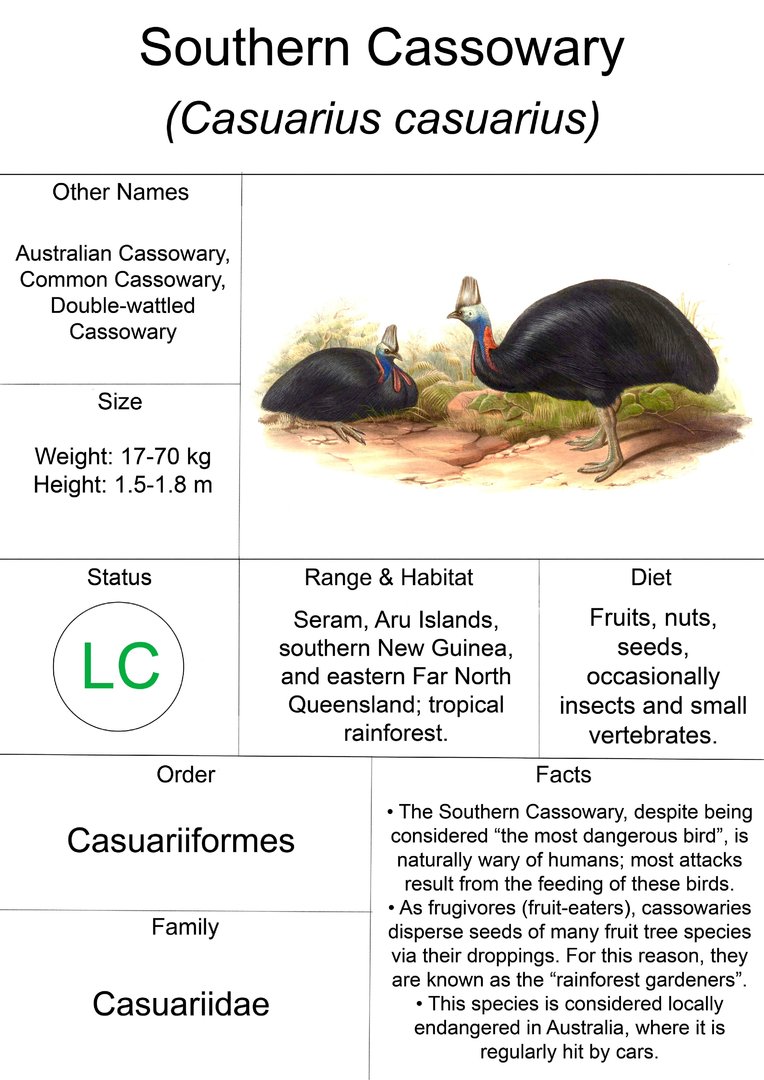
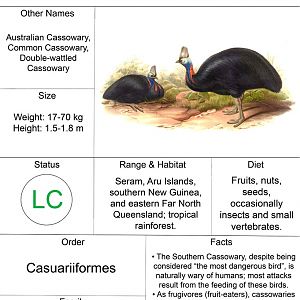
The Southern Cassowary is one of my favorite bird species, since it’s one of the few birds most people would recognize as the dinosaurs they are. Note however, that cassowaries are not, in fact, any closer to non-avian dinosaurs (e.g. the cassowary-crested Corythoraptor) than to any other living bird; rather, crown-group (modern) birds (Neornithes or the Linnaean Aves) form an exclusive monophyletic group nested within the larger clade Dinosauria.
The Southern Cassowary’s reputation as the “world’s deadliest bird” is misleading, if somewhat justifiable. As capable as cassowaries are of harming a person, “cassowaries do not attack indiscriminately”, according to an article (How Dangerous Are Cassowaries, Really?) by paleontologist Darren Naish. Citing a 1999 survey of cassowary attacks, Naish notes that, as stated in the factsheet, hand-feeding of the birds (which makes them associate Humans with food) is the main reason incidents occur. A cassowary may act defensively when people get too close to their nests or when a Domestic Dog (a predator of cassowaries) is present. Additionally, “injuries resulting from cassowary attacks are most likely to occur if the person is crouching or is lying or has fallen on the ground.” Indeed, this was the case for both of the two fatalities (one in Queensland involving a 16-year old who tripped and fell while hunting a cassowary with a dog, and the other involving a 75-year old private keeper in Florida who tripped and fell trying to collect an egg) and was humorously alluded to in a Clint’s Reptiles video (