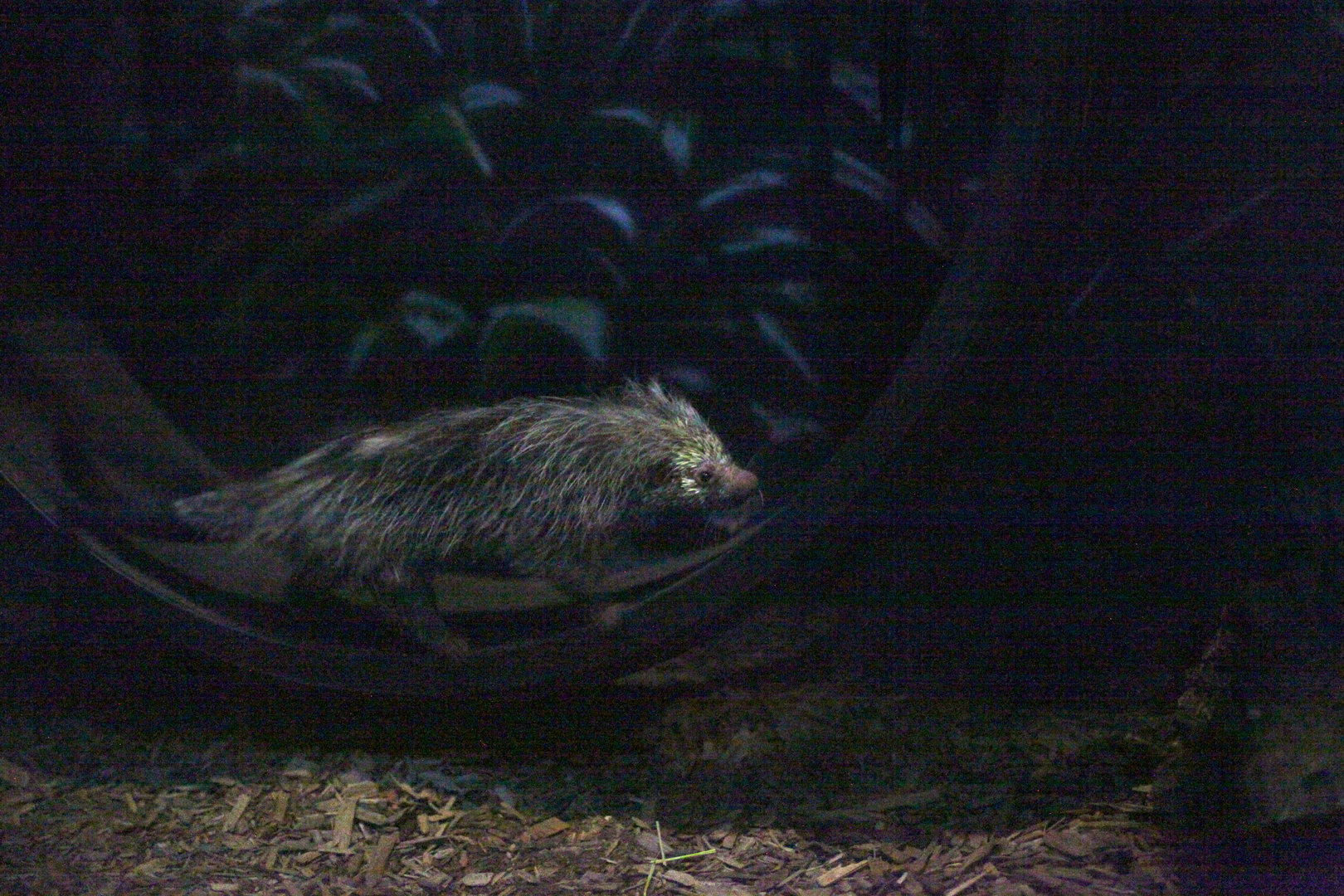
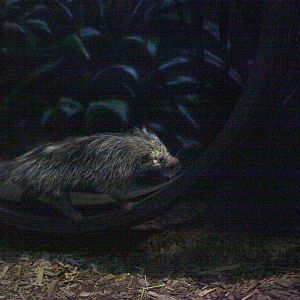
Absolutely no idea what species this is in Audubon Zoo, no sign and would not get off the wheel in the nocturnal house so apologies for the terrible photograph. Any ID appreciated!
Are you sure about that? I know the zoo has them in a different enclosure but this individual looks very different to C. prehensilis I've seen before - the tail is much shorter and dark, and the pattern on the quills is different, lacking the black and white banding. I'm no expert but I've seen a few C. prehensilis and quite a few photos but this individual looks very different.
@Dormitator I guess it could be a Black-tailed Dwarf Porcupine (Coendou melanurus), but when I visited last year they did not have the species and its a rarity here in the US. I'm not even aware of any accredited US facility keeping them, but it would be great if they're starting to!
@SusScrofa that's interesting, looks much more similar to my eyes. Not aware of any here in Europe though the private trade may have some. Hopefully someone can confirm exactly what it is at some point.
Could it just be a young/juvenile prehensilis? Judging from online photos, a lot of young Brazilian porcupines have the same general appearance of all-yellow quills on the face and few or no body quills.
Their inspection from June lists a Mexican hairy dwarf, Sphiggurus mexicanus. That could be wrong, of course, but it's definitely something listed separately from their prehensile-tailed. Other porcupine species have started showing up the last 2-3 years, mostly outside the AZA. Could be a confiscation/rehomed pet?
@TinoPup Aren't the mexicanus porcupines imported into the US actually melanurus? I recall there being a conversation about that in a different thread.
@Coelacanth18 The coloration of the hairs doesn't match real well though for young Prehensile-tailed, even with the bad lighting. It looks coarser than juvenile Prehensile-tailed too.
The body shape and overall appearance looks more like Sphiggurus to me than Coendou; a fair handful have been popping up the last couple of years so quite possible.
@Great Argus Yes, I thought maybe this could be an older juvenile that had more typical adult color and some beginning spine growth. But if Audubon had a similar-looking species listed on a USDA inspection that's probably a simpler answer.