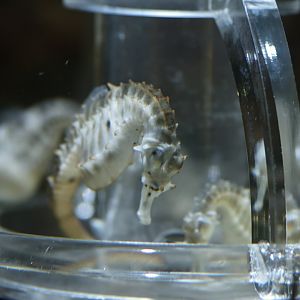
Half-grown pot-bellied seahorses, Hippocampus abdominalis, which have been trained to use this feeding station. I was curious because I had never seen one before, but I have found that they are available commercially.
The most important food for seahorses, and their relatives, are small shrimp, especially Mysis species. Seahorses enjoy hunting live shrimps, but they are difficult to collect or to culture. Frozen Mysis are readily available; however they are hard for seahorses to find as they do not move, until they have learned to look in the feeder.
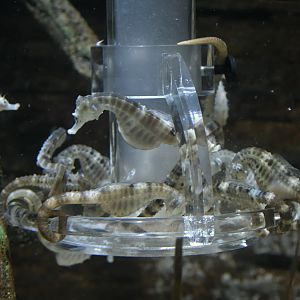
It is clamped with the top of the central tube above the water, and defrosted Mysis is spooned into this open end. The shrimps sink until they reach a cone at the bottom, which directs them through slots into the feeding dish (which is rather like a lab Petri dish). There is a separate ring around this dish which the seahorses can hold with their tails while they feed. This ring can be moved up or down, depending on the size of the animals. In this photo, I think the food had just arrived and the party was quiet wild, so a few shimps were floating away - there were a couple of small gobies or blennies to clean up any that the seahorses missed.
There were no adults on show, but this looks like one brood to me - perhaps from another Centre.
Correction: The sign over this tank explains that these are Hippocampus reidi (longsnout seahorses). I don't know how I made that mistakebecause I got it right in my text post. The sign also said that they were bred at Weymouth SLC