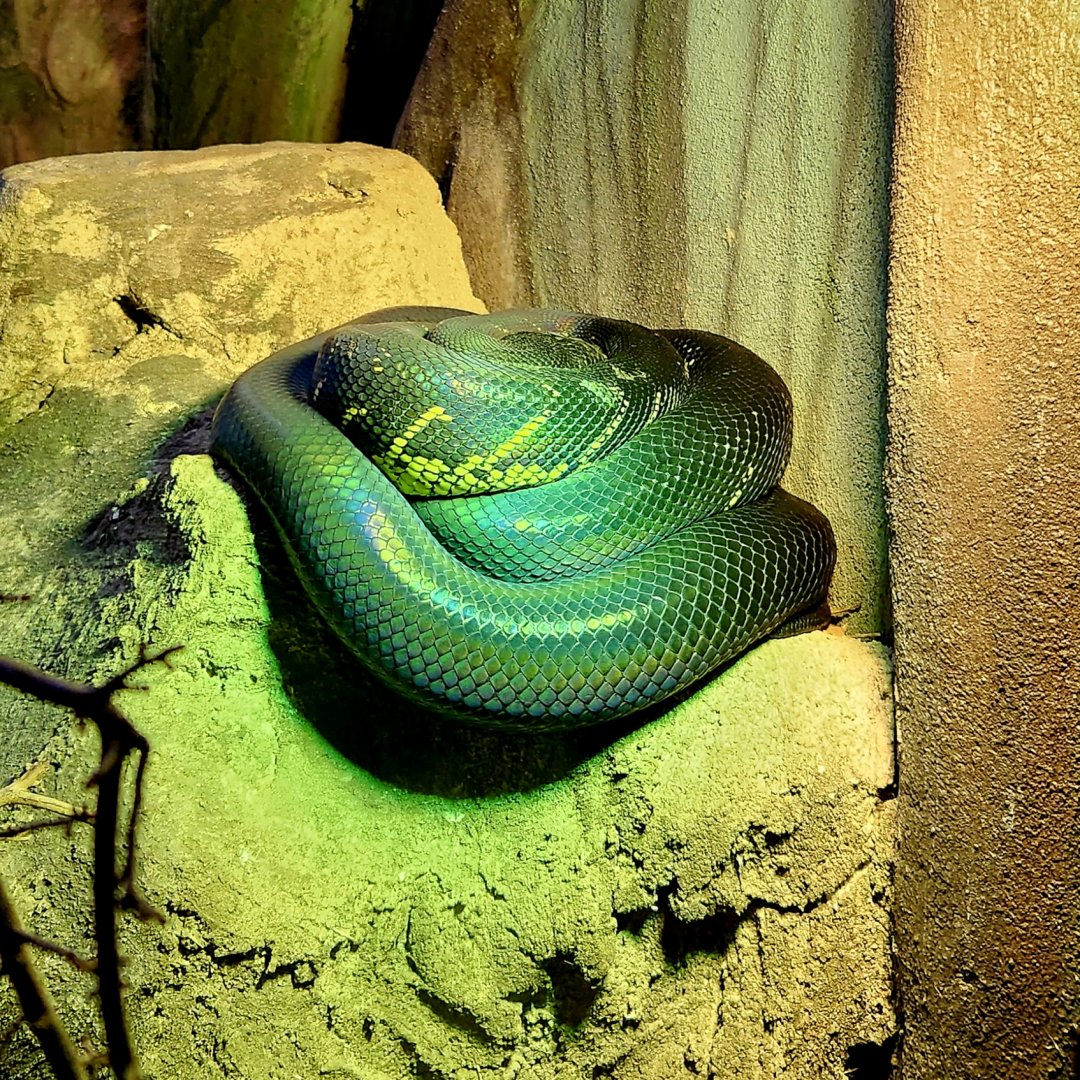
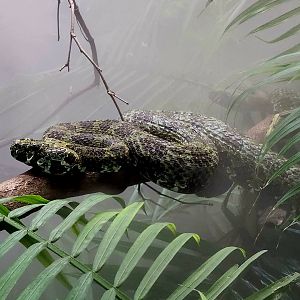
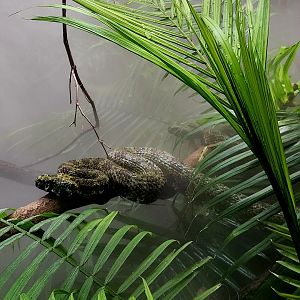
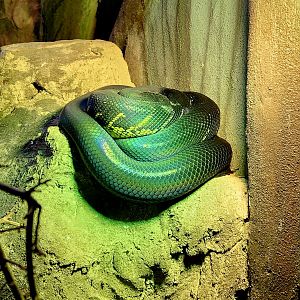
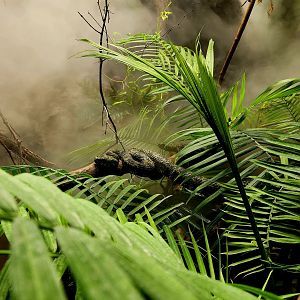
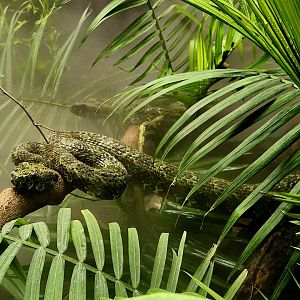
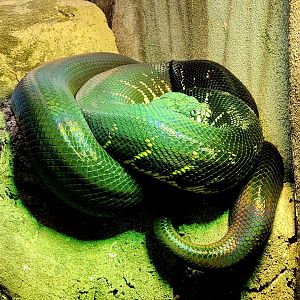
One of my favorite snakes, visually. Its basking light doesn't quite do justice here, but you can see at least some of that incredible iridescence in the scales.
It's a shame they aren't more common in captivity; from what I've read they are quite difficult to breed.
@Coelacanth18 I'll always consider Corallus batesii my favorite snake, but Boelen's are a very close second. I wrote a good bit about them in the Reptilandia walk-through, but it goes well beyond just the visuals. The way they move and interact with everything around them is very slow and methodical, it's truly unlike any other snake. There's a pic of them that shows the iridescence a little better, it should be of one basking earlier in the morning
They're a weird story in captivity. They used to be a few thousand dollars a piece, coming in as "farm-bred" babies from West Papua. In the past few years, that number has shot up to around $6,000 to $8,000 minimum for one of those same babies, due largely to one big-name seller suddenly hiking the price up. You're correct in that they're extremely difficult to breed as well - prior to maybe 2020, one clutch globally every 2-3 years was roughly the success rate. Recently that's gone up to at least 1 per year, although very few people have been able to replicate their success (there are only 2 that come to mind, one in the US and one in Europe). Nobody's really sure why, but my guess is it has something to do with males needing to get extremely cold in order to produce viable sperm. A fair number of people have had locks and gotten infertile eggs, so the females don't seem to have as many issues on the reproductive side - and it seems like the males at least have some desire to breed, so perhaps they can't produce sperm?
While I'm at it, if you're into Boelen's, the curator of Reptilandia (Ari Flagle) is essentially one of the only people doing field work with them. He travels to West Papua once or twice a year, staying with local tribes and walking up on wild boeleni - there's even a set of photos he took of a female watching her babies hatch in the nest. He's got a book on it, Serpents in the Clouds, and is working on a new one currently
That's awesome to hear re: their curator! I'm gonna check out that book as well, it sounds like a fascinating read.
The reproductive issue is a interesting obstacle, thanks for the information. I've heard of temperature cues being important for breeding other herps as well, so wouldn't be surprising if that's the case.