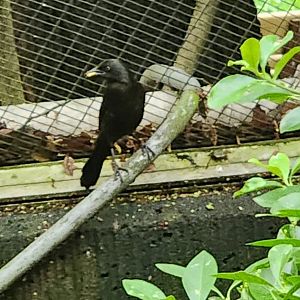
@Summer Tanager On the inside. Common Grackle are one of the species inside the aviary and I definitely did seen them, but the ones I've seen in the wild and captivity always have had a more iridescent color, while this one was basically jet black.
I see what you mean - you're exactly right, this one appears to have little or no iridescence. I can't fully explain that, but I can't think of any other bird species that it could be unless it's a female Rusty Blackbird (Euphagus carolinus). One of the things that has always baffled me about a lot of the North American blackbirds is that they have a strange molting pattern that you don't see (or notice) in a lot of other birds. When they molt in the fall, their feathers have dull and often buffy tips to them that wear away over the course of the winter. The pattern is most evident in the non-related European Starling that has gray "spots" on it in the fall and winter, which are the gray tips to their new contour feathers that they gain during their late summer molt. Those spots wear away and are preened away over the course of the winter and the iridescent portions of the feathers are exposed by the spring breeding season. The same phenomenon occurs in the New World blackbirds, and it's why fall meadowlarks, Red-winged Blackbirds, and especially Rusty Blackbirds have a beige or slightly tan appearance. I believe that the same thing happens in grackles except that instead of the feather tips being beige, tan, or gray, the newly molted feathers have tips that lack iridescence. That wears away of the winter and we see iridescent grackles usually by mid-February. My guess is that this is a Common Grackle (or possibly a female Rusty Blackbird) that has experienced delayed feather wear - perhaps its an artifact of being in captivity. That's the only possible explanation that I have. Common Grackles are duller in the fall than they are in the spring, but I don't pay much attention to the progression of feather wear and increased iridescence. Plus, there's a lot of individual variation in the rate at which this occurs.