Colombia - Chocó, Colombian Cordilleras and Cauca and Magdalena Valleys - List of exhibits and species
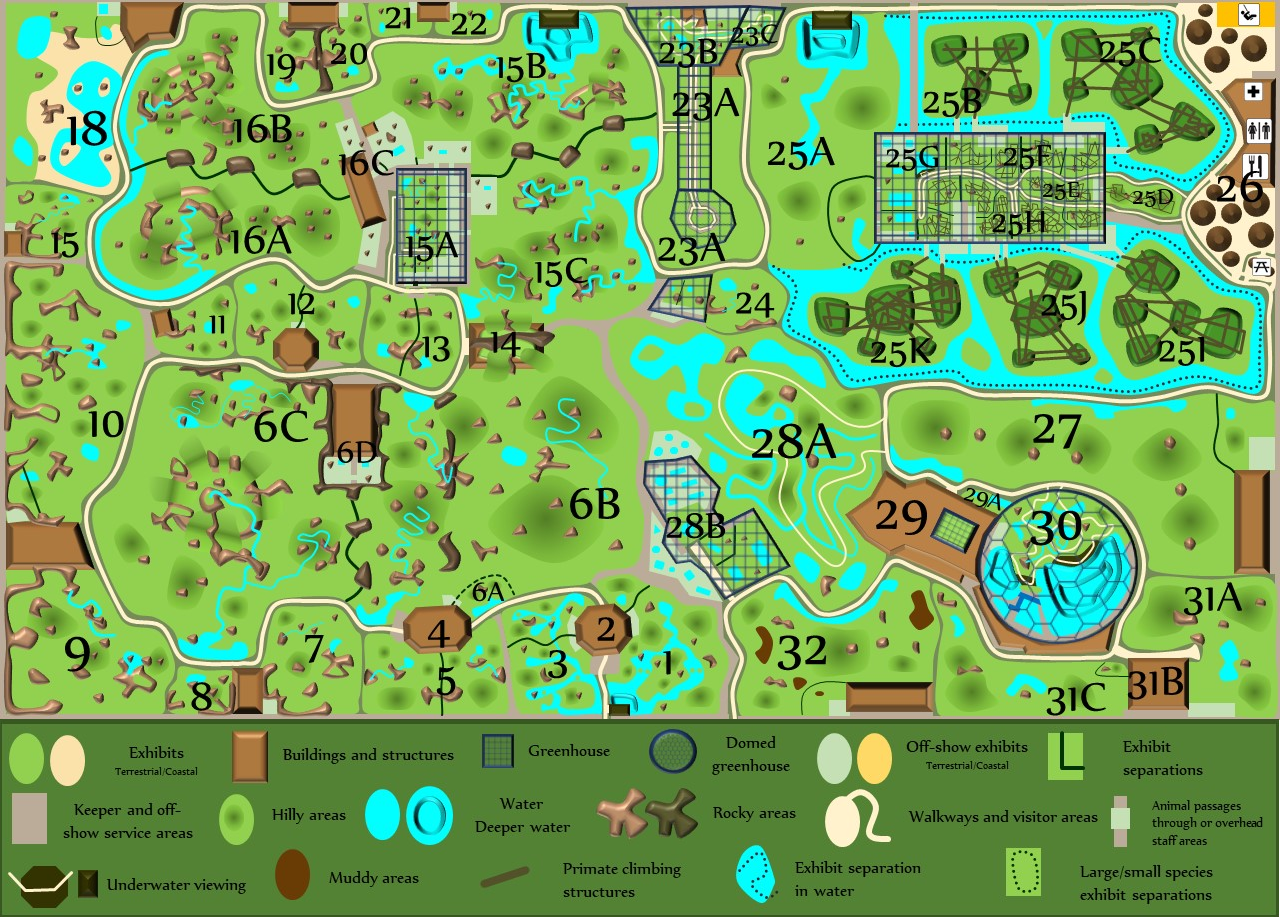
Species lists of mixed exhibits are done with dotted lists, lists of exhibits within a building are done with a list with a dash and an indentation.
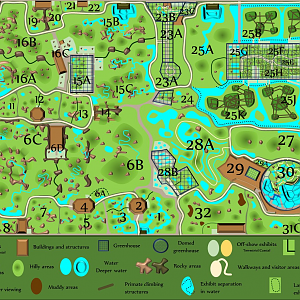
1 Bush dog (Speothos venaticus), exhibit with covered underwater viewing area
2 Bush dog and Crab-eating raccoon dog house with indoor viewing areas
3 Crab-eating raccoon (Procyon cancrivorus)
4 Tayra (Eira barbara)
5 Tayra and White-nosed coati house with indoor viewing area
6 Spectacled bear (Tremarctos ornatus) and White-nosed coati (Nasua narica)
6A Separation exhibit for white-nosed coatis
6A White-nosed coati retreat and separation exhibit, not accessible to Spectacled bears
6B First bear and coati exhibit
6C Second bear and coati exhibit
6D Spectacled bear holding building and off-show yards
15A Jaguar and Jaguarundi greenhouse, holding exhibits, keeper areas and bridges for jaguarundis to outdoor exhibit
15B First jaguar exhibit
15C Second jaguar exhibit
16 Cougar (Puma concolor)
16A First cougar exhibit
16B Second cougar exhibit with underwater viewing area
16C Cougar holding and off-show big cat exhibit connectable to both cougar and jaguar facilities
17 Crested caracara (Caracara plancus)
18 Eastern brown pelican (Pelecanus occidentalis carolinensis)
Blue dacnis or turquoise honeycreeper (Dacnis cayana)
Thick-billed euphonia (Euphonia laniirostris)
23C Butterfly hall
Lebeau's Silk Moth (Rothschildia lebeau)
Malachite (Siproeta stelenes)
Julia Heliconian (Dryas iulia)
Peleides blue morpho (Morpho peleides/M. helenor peleides)
Red Postman (Heliconius erato)
Sara Longwing (Heliconius sara)
Zebra Longwing (Heliconius charithonia)
Heliconius sapho
Doris Longwing (Heliconius doris)
Starry Night Cracker (Hamadryas laodamia)
Ismenius Tiger (Heliconius ismenius)
Monarch butterfly (Danaus plexippus)
Thoas swallowtail (Papilio thoas)
Forest Giant Owl (Caligo eurilochus)
Crested bobwhite (Colinus cristatus)
Red-legged honeycreeper (Cyanerpes cyaneus)
24 Macaw aviary
Yellow-knobbed curassow (Crax daubentoni)
Great green macaw (Ara ambiguus)
Blue-and-yellow macaw (Ara ararauna)
Green-winged macaw (Ara chloropterus)
Yellow-crowned amazon (Amazona ochrocephala)
Muscovy duck (Cairina moschata)
25 Capybara (Hydrochoerus hydrochaeris) [Capybara Hydrochoerus hydrochaeris as stand-in for Isthmian capybara, H. isthmius or H. h. isthmius, Central American and Colombian capybara population considered by multiple sources separate (sub)species], South American tapir (Tapirus terrestris) and primates
25A Tapir and capybara – With access to lower areas around primate islands
25B White-faced capuchin (Cebus capucinus) outdoor
25C Common woolly monkey, Brown woolly monkey, or Humboldt's woolly monkey (Lagothrix lagothricha) outdoor
25D Cotton-top tamarin indoor
25E Cotton-top tamarin outdoor
25F White-faced capuchin (Cebus capucinus) and Common woolly monkey, Brown woolly monkey, or Humboldt's woolly monkey (Lagothrix lagothricha) indoor
25G Tapir and capybara indoor
25H Colombian spider monkey (Ateles fusciceps rufiventris), Colombian red howler or Venezuelan red howler (Alouatta seniculus) and Colombian brown spider monkey (Ateles hybridus) indoor
25I Colombian spider monkey (Ateles fusciceps rufiventris) outdoor
25J Colombian red howler or Venezuelan red howler (Alouatta seniculus) outdoor
25K Colombian brown spider monkey (Ateles hybridus) outdoor
26 Cauca Café with visitor facilities: terraces with covered eating areas, picnic area, small playground, restrooms, first aid, changing room
Since posting this design I have noticed I forgot one item, the elevated parts of the monkey islands, in the legend, and that I switched the numbers 4 and 5 in my previous comment.
I have now posted a description of the different exhibits in my speculative zoo design thread.
I have somewhat mixed feelings about how this project turned out. The design map didn't totally turn out as I wanted it and came off better before I processed it, parts of the finished version I just don't think I did that well on. I tried a few things that did not work out very well. And then I also made a couple errors, as noted above.
I also think that, like has also been the case for previous projects, I just tried to fit in as much as possible and made the project too big and cluttered. However I cannot and will not change the project anymore at this point and therefore will present it as it is. I am also not hugely happy with my descriptions, but I cannot really do much to change them right now.
I have for the time being not definitely decided whether I will be doing any future speculative zoo design projects or continue to engage with this part of the hobby. I do really enjoy doing it, but it also costs a lot of time and a good bit of my energy that I generally have to careful spending. If I do continue doing these I will probably have to rethink things a fair bit and make some major changes. Both the drawings and the descriptions will need a major looking at if I do decide to continue doing this part of the zoo hobby.
If anyone has any tips or ideas that could help me for future projects, please post them.
Wow - this is very complete and thorough! Great representation of all of the South American animal groups (down to the subspecies) and of course I loved all of the birds! Well done!