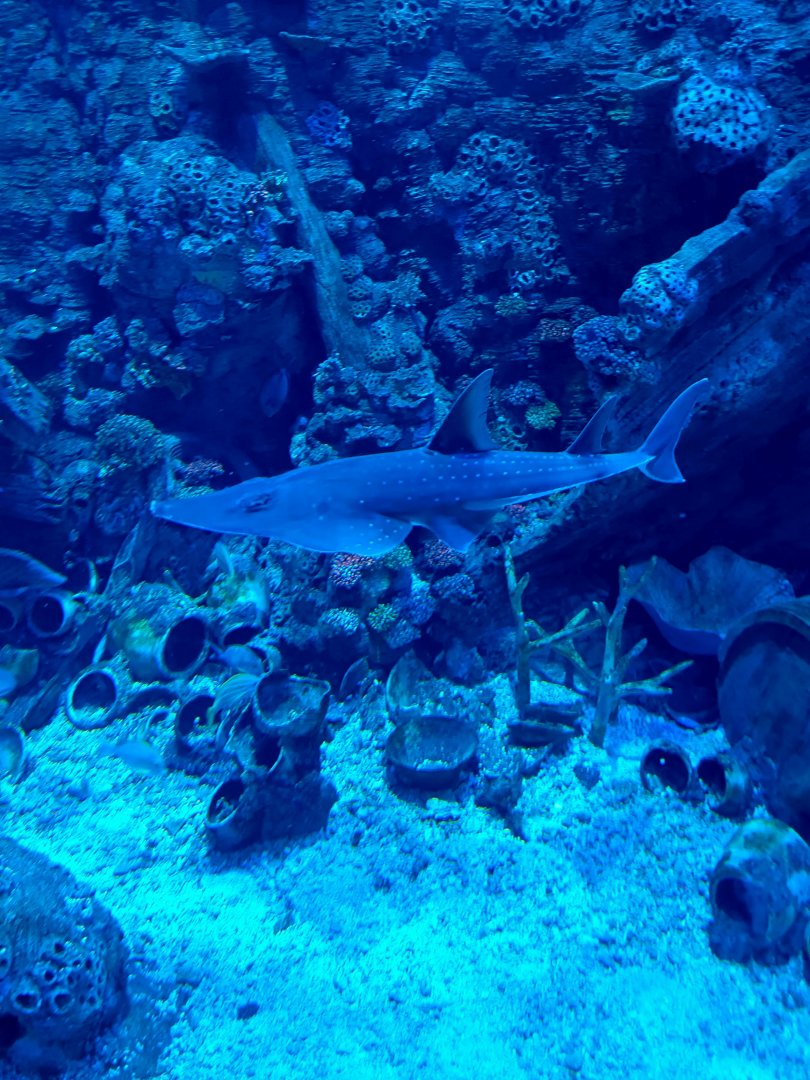
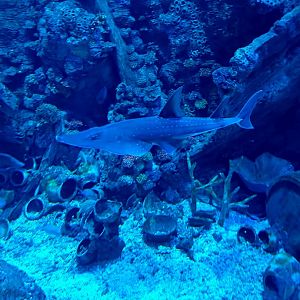
As pointed out by Rizz Carlton before, it's a Broadnose Wedgefish. None of the wedgefishes that are kept in Indonesian aquaria are Rhynchobatus djiddensis.
@Caribbean Flamingo that species have white-spots that are predominantly found in their fins and along the side of their body. R. springeri have spots throughout much of their body.
@Rizz Carlton That means BXSea might be the first in Indonesia to keep them then, or has other aquarias like SWA, JAQS and Pangandaran kept them before?
@FargusnoSpringeri appears to be much common in Indonesian aquaria that we though, using my usual physical description of the species.
Aquarium Indonesia (Pangandaran) have them. Pierre de Chabannes photograph an springeri in SeaWorld Ancol (Around 2017). Actual R. australiae appears to be rare. I'm aware that SeaWorld Ancol appears to have one before the springeri (Via de Chabannes's old gallery). I don't recall which species Jakarta Aquarium used to have.
Actually, you posted an picture of rhynchobatus after your trip in 12/2023. It looks neither like an springeri nor even an australiae (Which have smaller spots and numerous of them on their fins and along their body), this might be some different species that I'm not really aware of.
(BXSea Aquarium - White-spotted Wedgefish (Rhynchobatus australiae) - ZooChat)
@Fargusno most likely not, from the photo of the male haplotype on the internet, the species appears to be more smoother and paler in coloration (Lack of spots).
@Fargusno it's very difficult to determine which species it is, especially rays and their relatives, in captivity. Not to mention that Indonesian aquaria aren't very good/transparent with their taxonomy which further makes it extra difficult to properly identify a (sub)species and their purity. Knowing how they originate should help.
For example, both Jakarta Aquarium and BXSea each have an himantura species that is basically a unknown species (Their notably tiny spots and the large gap between them aren't corellate with pictures and description of most known himantura species). Me and a ZooChat friend never really able to pinpoint which species they are, even after consulting experts.