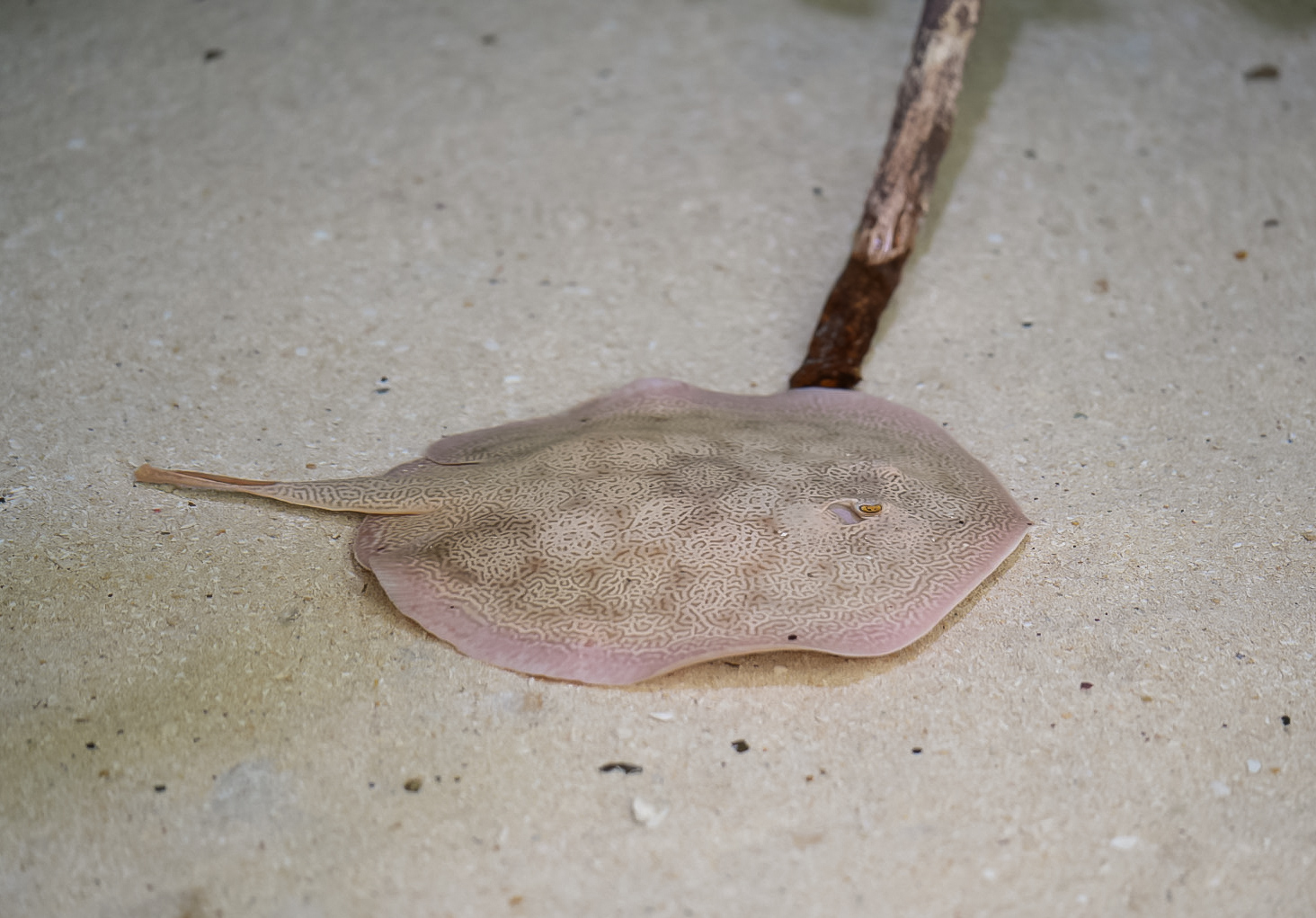
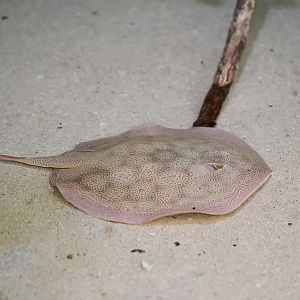
At the Point Defiance Zoo in their "Stingray Beach", previously i was told it could be a juvenile Himantura australis, but the stubby tail makes me think otherwise (however, I have no idea what a juvenile Himantura looks like)
@Local_Shark The juvenile was pretty active today, you get to see a good look at the pattern. It has a light pink color to the rim of the body which is actually really cool, but I have no idea if it's a Himantura or not like they told me
@Northwest_FIsh_Keeping uhhh…man, if that’s a Himantura, it would certainly be the strangest I’ve ever seen. Typically baby Himanturas look like clones of their parents, smaller but with the same whiplike tail and coloration. They also have almost completely uniform discs, their pelvic fins don’t stick out quite so visibly. This one would have to literally be an infant; I think what it actually is would be a stingaree or round stingray (Urolophidae), as they have pinkish edges of their disc and stubby tails with more prominent pelvic fins at the back of their discs. But I can’t say 100% for sure haha…very strange!
@Local_Shark@Great Argus yeah the volunteers i asked last time were pretty puzzled, this guy isn't in their volunteer book apparently so I think they were just going off the Himantura that's in the large tank.
That's interesting, I never knew U. halleri could be tropical but you're right, it matches up pretty well. I'll have to try and talk to an aquarist next time to see what they say
@Northwest_FIsh_KeepingUrobatis halleri is often sold in the aquarium trade and acclimated to tropical tanks. It’s not supposed to be able to live in the actual tropics, but it’s an extremely hardy species and has adapted well to such exhibits at Shark Reef Aquarium and Discovery Cube Orange County. The latter institution, in fact, was actually told they were receiving Cortez/spotted round stingrays (U. maculatus) - but in a common misidentification, received U. halleri individuals instead. The two species look similar and have overlapping ranges, with some of that being subtropical.
I’m not exactly sure if this particular individual is from the American round ray family (Urotrygonidae) or stingaree family (Urolophidae) as I originally thought, as they’re either closely related or convergently evolved and thus look quite similar. But it’s definitely one of the two. Personally, I don’t actually think it is a normal halleri as I’ve never seen one with both light coloration and reticulate patterns like that - my current suspicion is that it may be a hybrid, possibly of a halleri and a yellow stingray (U. jamaicensis). Those species are commonly in the aquarium trade together and might be able to interbreed and hybridize as their cousins the river stingrays can.
@Northwest_FIsh_Keeping and I now can confirm that this is probably a reticulated/bullseye round stingray (Urobatis concentricus)! It may well be the only member of this species in captivity anywhere in the US, and possibly even the world as apparently Zootierliste didn’t even have the species in their archive.
@Local_Shark I think that one might still be a Haller's, at least from the pictures I saw on Google. The Bullseye has a lot of striping around the body and not many spots or pink rim, i will double check with my friend but they might have 3 species in that exhibit (The Blue Spotted Ribbontails, the Hallers, and the Bullseye). Which ironically the Ribbontails and Bullseye were kept in the old stingray touch tank so they could be the same individuals, but I never once saw the Bullseye in that tank either so it looks like it might be comfortable after all these years, i will have to stop by sometime this week and look for him