@Loong Meng Onn
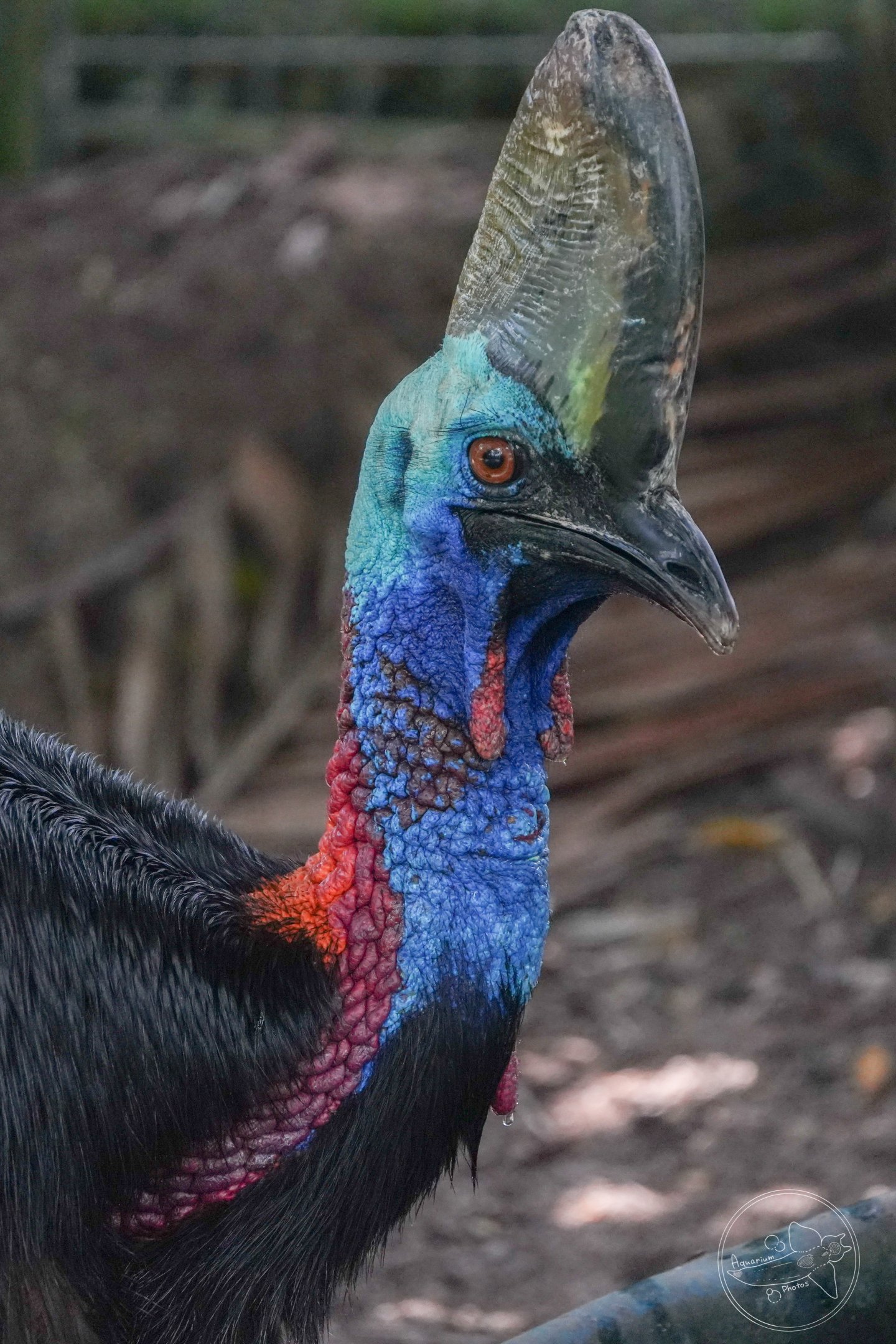
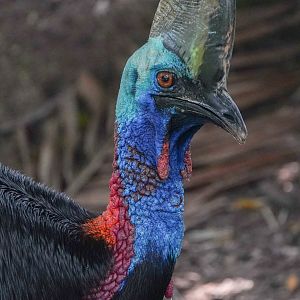
Thanks. I was a bit curiuos because it also has a small "single wattle" by its neck, along with two small wattles by its throat. Just a young animal?
Definitely not a young bird, given the tall casque and the full coloration. Either an unusual subspecies or possibly a hybrid - the wattle placement is atypical for Southern, at least most of them.
@Great Argus I don't believe any subspecies are currently recognised for Southern - ZTL recognises some but I am not aware of any other taxonomic sources that recognise subspecies. It's very possible subspecies formerly existed, but the distinctions between them have been blurred by prehistoric transportation of cassowaries by humans - I believe I've heard young and immature birds were used as guard animals by indigenous Australians and Papuans (once mature and difficult to handle, the birds were released), and there was extensive trade of live cassowary eggs for this purpose, both within Australia and Papua, and across the Torres Strait, so any subspecies that may have existed introgressed into each other to the point of indistinguishability.
Regardless, the wattle locations in the pictured bird is strange for a Southern. Intrigued as to what this ends up being.
@DaLilFishie Yeah I should have said phenotype/variant, cassowary taxonomy has been complicated in the past. Lot of forms previously recognized that turned out questionable.
I'm rather wondering if this shows a hybrid, Southern/Northern I know are at least suspected to hybridize in the wild, with many odd forms believed to represent such birds.
That is a very interesting photo. I'm familiar with the southern (double-wattled) cassowary since there is a pair at my home zoo in Los Angeles. I know that the male has smaller wattles than the female, but I've never seen any that small! I'm wondering if what appears to be the third little wattle on the neck is actually just an oversized reddish growth like the ones on the right side.
I've never heard of hybrids of Southern/Northern Cassowaries, but are possible in Malaysian zoos, since I know at least 2 zoos (G2G Animal Garden / Zoo Melaka) that hold both species.
In both zoos, the Northern Cassowary is not signed, but is in a neighboring enclosure split by a fence. I heard from staff that they were once just considered as "Cassowary" and kept together, so hybrids may occur in captivity.
I was curious about the identity of this bird, so I asked opinions from a specialist from a cassowary conservation team in Australia.
Here's the reply:
"The cassowary in your photo looks most like a Southern Cassowary so is probably just a variation. The number of wattles is usually two, but we have seen individuals with none or one and even where one has split into two to give the appearance of three"
So it's a unique-loking Southern Cassowary!
I didn’t realize there could be such a wide range of variation among cassowaries, and it makes me even more fascinated by this beautiful bird.
@Loong Meng Onn
Thank you.
Yes, it is clearly signed "Southern Cassowary".
But the issue is that these signs are sometimes unreliable in Malaysian zoos, since some zoos have Southern Cassowary signed "Northern Cassowary" and vice versa.