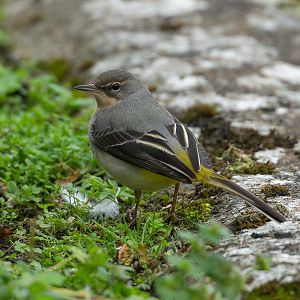
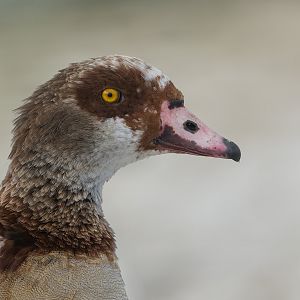
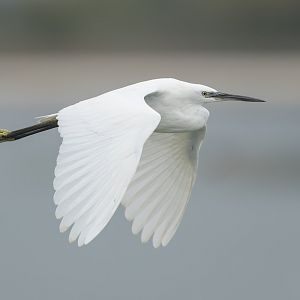
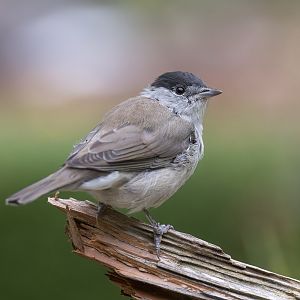
@captain alligator Indeed, they all come from vagrants of some sort originally but are now breeding and living wild with the other (Shelducks) and geese and I like to see and photograph them anyway when they are around. Farmoor is an interesting place for wild established vagrants...see also the Snow Geese!
@captain alligator
Invasive is debatable. Egyptian geese originally occurred wild in Europe, but were then driven to extinction. So (in parts of Europe) more rewilded than invasive.
They never occurred naturally in Great Britain, of course. But the fact that animal species are spreading northward when they find better conditions due to climate change and cities is not actually invasive.
@Cyathea The UK government does classify them as invasive but I don't think there's an active programme to wipe them out. They are like a larger Shelduck I guess (who are also quite aggressive to other birds) but I do like them
I must admit that I have never studied the primary sources. The information can be found in various online sources. I just checked Wikipedia again: depending on which language you look it up in, they were present in Hungary until the 17th/19th century.
And yes, I know that some people and authorities classify them as invasive. But whether they actually have a harmful effect on native fauna is a matter of debate. And the spread of a bird species originating from southeastern Europe to the northwest due to increasingly favorable climatic conditions is not actually invasive, but rather a normal process.
@Cyathea, I believe you are slightly mistaken. The Egyptian goose is native to Africa, where it is widespread south of the Sahara and along the Nile Valley, but the species and its presence in Europe results from human introductions as an ornamental species for various collections and urban parks.
The Egyptian goose has never been native to Europe, with Anserobranta tarabukini from the early Late Miocene of Moldova solely representing this genus in the continent (link below). British populations date back to the 17th century, and were the first introductions outside its native range. Here they were popular among estates and parks before subsequently escaping and forming established self-sustaining feral populations (with the first stemming from the menagerie in St James’s Park in London). However, these individuals did not spread widely and are not known to have expanded into other countries across the Channel. It was in the Netherlands, where they were only recorded breeding as of 1967, that the European population originates. Consequently, after decades of being ignored, they have established in the United Kingdom, France, the Netherlands, Belgium, Germany, Sweden, Cyprus and Denmark.
Similarly, your point regarding “rewilding” really does not align with the current consensus, as the species is listed as an Invasive Alien Species of European Union concern. According to the European Commission’s brochure, the direct opposite of what you suggest is stated, and “…a rapid eradication of any newly emerging populations and the management of established populations [is necessary to] prevent the species from becoming a wider problem across the EU”. This is wishful thinking, despite being such a beautiful species. I hope my comment will clear things up.
“I few centuries ago they lived from Hungary on south and eastward.
I must admit that I have never studied the primary sources. The information can be found in various online sources. I just checked Wikipedia again: depending on which language you look it up in, they were present in Hungary until the 17th/19th century.”
This information you reference is according to contemporary eye-witnesses, and as mentioned on the page itself “…its historical ranges in these places is incompletely known.”
@Dr. Loxodonta
I don't want to offend you, but this EU regulation, especifically the selection of species, is complete nonsense. Its genesis is based much more on economic considerations promoted by intensive lobbying than on scientific knowledge. This law is far from reflecting scientific consensus; on the contrary, it has been heavily criticized. And a law does not say anything about the historical distribution area either.
I think it is in the nature of things that historical distribution data is even less accurate than current data and is essentially based on eyewitness accounts. But does that invalidate it? If so, you would also have to deny the medieval distribution of the bald ibis in Central Europe.
As I said, I have only read the sources on the internet myself, but these refer to various books, including some quite reputable ones, and scientific papers.
I cannot understand why you doubt this.
I also cannot understand the reference to the Miocene genus Anserobranta. Not only does the Egyptian goose belong to a different genus (Alopochen), but as far as I can see, the paper does not discuss the Holocene fauna of Europe.
However, I have been to short in my description of the direction of spread.
To be more specific: If the historical population in Hungary still existed, it would spread northwestward along the Danube and Rhine rivers and end in England. This reminds me of the Eurasian collared dove, which spread in a very similar way (although not along waterways, of course).
In fact, the population did not spread from its extinct natural population in Hungary, but rather from the Netherlands northwestward and in the opposite direction back toward its old homeland, which I assume it will repopulate in the future.
I should have formulated this more precisely and also made clear my assumption that the middle Danube will be repopulated in the future (therefore my association with rewilding).