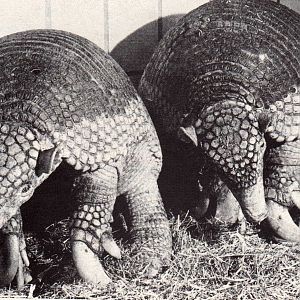
I had no idea there were ever giant armadillos outside of South America. Would love to see one of those (not as much as I would love to see a marbled cat or bay cat though ).
London Zoo received its first giant armadillo in 1959. Another specimen was received in 1976 (when the President of Brazil presented one to the Queen); this animal was kept in the Stork & Ostrich House and sent to Rotterdam Zoo in 1978 to make a pair.
Well, here's what Wikipedia says:-http://en.wikipedia.org/wiki/Giant_Armadillo
On the surface, keeping them alive in zoos should be a lot easier than giant anteaters and aardvarks, and many places manage these well enough today.
OTH, something tells me that a breeding attempt would require space for a pair of retiring animals (the one in London never showed itself in daylight) and a deep burrow. The late Frank Wheeler (London Zoo's Small Mammal House Head Keeper), who knew his stuff, reckoned that echidna reproduction needed a burrow fifteen feet deep. Echidnas are the size of porcupines. So heaven knows how deep a burrow an animal the size of a peccary would require.
Plus the giant armadillo is listed on CITES Appendix I.
So it looks as if an awful lot of bureaucracy will have to be overcome, and a lot of hard work is going to be needed, to build up a captive stock of an animal that most zoo visitors probably wouldn't see. Call me cynical, but I fear that many North American or European zoo directors will not want the bother.
Which is a pity, because as well as being very interesting, it seems to be an animal in need of help.