OTH, something tells me that a breeding attempt would require space for a pair of retiring animals (the one in London never showed itself in daylight) and a deep burrow. The late Frank Wheeler (London Zoo's Small Mammal House Head Keeper), who knew his stuff, reckoned that echidna reproduction needed a burrow fifteen feet deep. Echidnas are the size of porcupines. So heaven knows how deep a burrow an animal the size of a peccary would require.
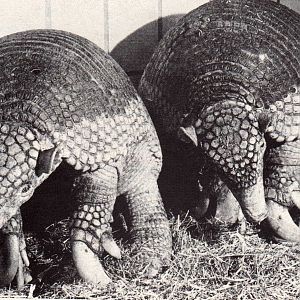
Well, I've done some calculations. A short-beaked echidna, which weighs 7kg at the most, needs a 15 foot deep burrow to breed. A Giant armadillo, the largest specimen known weighing 80kg, will need a burrow aproximately 11,5 times deeper; that is a 172.5 foot/ 52.5 m deep burrow. If they ever made it, it would be an incredible ordeal, but if it worked, it would be an incredible success.
Well, I've done some calculations. A short-beaked echidna, which weighs 7kg at the most, needs a 15 foot deep burrow to breed. A Giant armadillo, the largest specimen known weighing 80kg, will need a burrow aproximately 11,5 times deeper; that is a 172.5 foot/ 52.5 m deep burrow. If they ever made it, it would be an incredible ordeal, but if it worked, it would be an incredible success.
Well, if an African elephant ever decided to evolve toward a bizzarre subterranean lifestyle without reducing its maximum weight of 6048 kg AND had the same necessities as echidnas and giant armadillos when digging a cubbing den relative to size, an elephant burrow would be 13041 feet/ 3975m deep. Heavens knows, maybe they'll use molephants to build underground train systems...
Well, if an African elephant ever decided to evolve toward a bizzarre subterranean lifestyle without reducing its maximum weight of 6048 kg AND had the same necessities as echidnas and giant armadillos when digging a cubbing den relative to size, an elephant burrow would be 13041 feet/ 3975m deep. Heavens knows, maybe they'll use molephants to build underground train systems...
I think you missed my point. Even if echidnas needed a burrow 15ft deep for breeding (which they don't) that has no bearing at all on what sort of burrow a giant armadillo would need. All you did was upscale the imaginary burrow for an entirely unrelated species based on its body-size, and then said that is what would be "needed". Hence my quip about elephants.
Even in the above quote you say "... the same necessities as echidnas and giant armadillos when digging a cubbing den relative to size..." when that "necessity" is straight out of your own imagination.
The fact that this new research also indicates blue whales need a burrow a shade over 124km deep probably goes some way to explaining RSCC's lack of breeding success with the species.
I think you missed my point. Even if echidnas needed a burrow 15ft deep for breeding (which they don't) that has no bearing at all on what sort of burrow a giant armadillo would need. All you did was upscale the imaginary burrow for an entirely unrelated species based on its body-size, and then said that is what would be "needed". Hence my quip about elephants.
Even in the above quote you say "... the same necessities as echidnas and giant armadillos when digging a cubbing den relative to size..." when that "necessity" is straight out of your own imagination.
Well, can't we do that same type of calculation based on a smaller armadillo species? Or better yet, determine the depth of the burrow through the observation of the giant armadillo itself?
Well, can't we do that same type of calculation based on a smaller armadillo species? Or better yet, determine the depth of the burrow through the observation of the giant armadillo itself?
why should upscaling the habits of a smaller species of armadillo equal the habits of a giant armadillo? Very little is know about most armadillo species anyway, except the nine-banded armadillo.
In any case, when wild giant armadillos have been studied they were shown to dig burrows around five metres in depth (quite a lot smaller than your suggested 52 metre burrow). They seem to dig new burrows every few days and move around constantly. When giving birth a female simply stays in her most recent burrow until the baby can leave with her.
This one major animal I'd love to see and photograph. I'm thinking gee if zoo's have been successful with keeping the aardvark, then why not a giant armadillo? My quess would be their nocturnal nature, not the sexy fussy animal popular to drawing crowds. Heaven forbit actual compassion to learning about and helping save a species and actually educating public to understand animals well outside what we know and understand. Wouldn't giant armadillo be a truly wonderful nocturnal species to see in a night zoo settings.