Did myself a lot of Googling and discovered that this group of fish can be VERY difficult to ident ! Found also this article about the many different forms and morphs which alone the Amphiprion chrysopterus has ! CORAL BONUS: From One Comes Many - The Myriad Blue Stripe Clownfishes
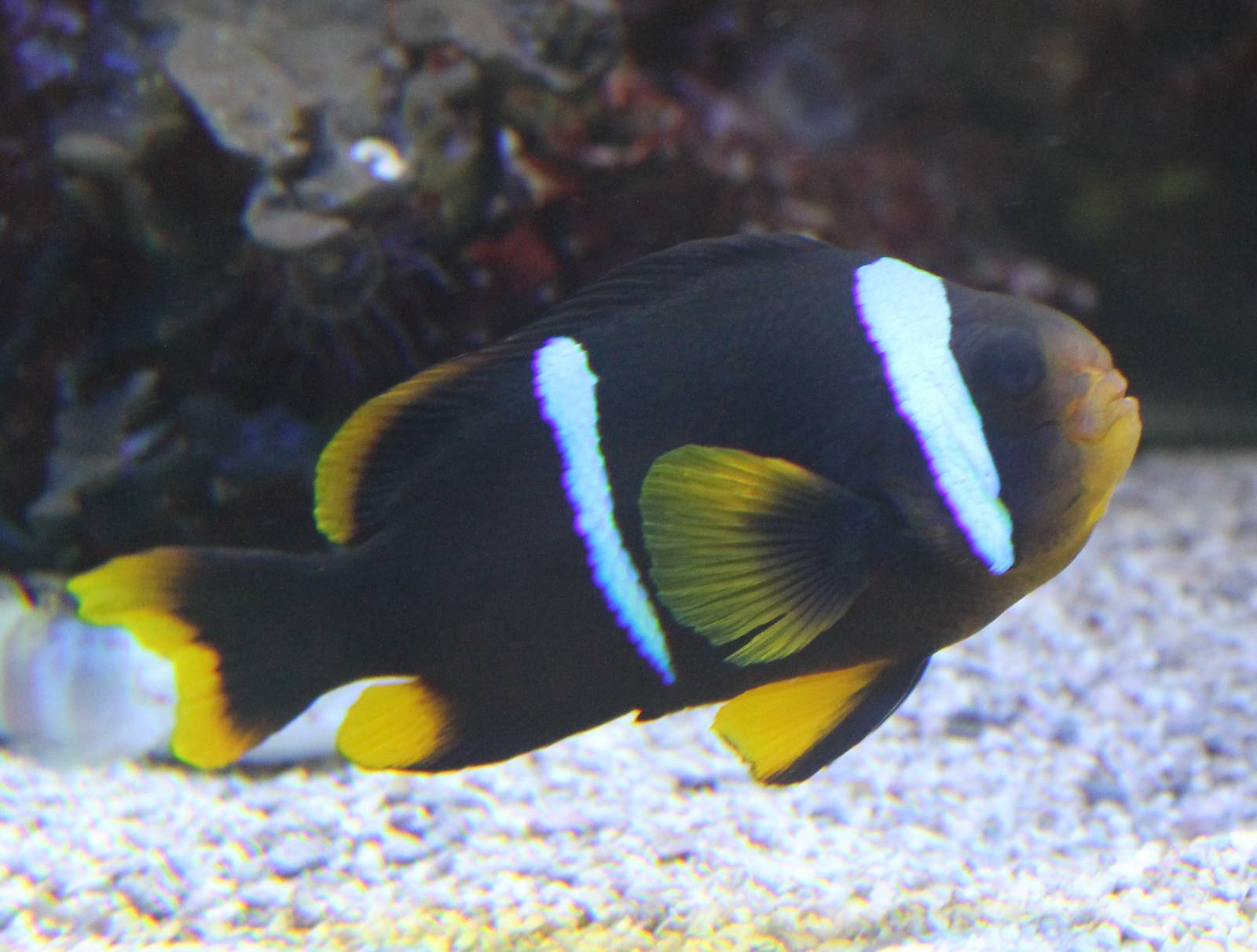
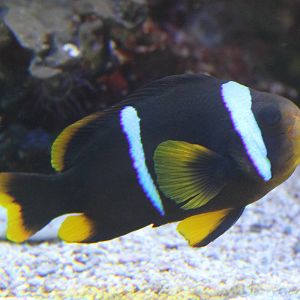
I believe that this might be an OLD captive-bred Two Stripe Clownfish, Amphiprion bicinctus. The shape of the face and head, which are slightly disfigured, are what tip me off that this might be a captive-bred fish. If it's captive bred, it narrows down the options, and A. chrysopterus has only been bred very rarely and sporadically, while A. bicinctus is a staple in the aquarium trade. It's still quite dark for a specimen of A. bicinctus, but not without precedent. This "Spotcinctus" is a genetic variant of A. bicinctus that has extra white markings on it; if you take that away you'll see the similarities - https://reefbuilders.com/2013/10/16/mature-adult-spotcinctus-knockout-clownfish/
It is also possible that this IS A. chrysopterus; I would guess the Fijian group where all the fins are yellow (don't have "white tails" as cited above). It is darker than any Fijian-type chrysopterus I've ever seen, but that doesn't eliminate it outright. I should note that it cannot be an A. akindynos variant because of the yellow tail (Akins are white). For the most part it's ruled out as any A. clarkii that I'm aware of because *most* have a caudal peduncle stripe. A. allardi is ruled out because it would have a white tail as well. A. chagosensis is another two-striped clownfish, but it's not in the trade and doesn't look like this anyway. A. omanensis would be yet another possibility, but again should have a white tail.
So it's not surprising to come back to either A. bicinctus or the eastern forms of A. chrysopterus. In fact, when I showed a bunch of A. chrysopterus to "the Internet", the most common misidentification was as A. bicinctus - Can Facebook Identify a Clownfish?
Including everything else already mentioned, the last thing that pushes me towards thinking this is a dark, old, captive-bred A. bicinctus, is the shape of the headstripe. In A. chrysopterus, its width is more or less consistent from top to bottom. In A. bicinctus, it tends to be more wedge shaped, with the thickest area being at the top of the head. This fish has a wedge shaped headstripe.
So...that's my take on it. I *believe* the most likely candidate for this atypical looking clownfish is A. bincinctus, the Red Sea Two-Banded Clownfish.