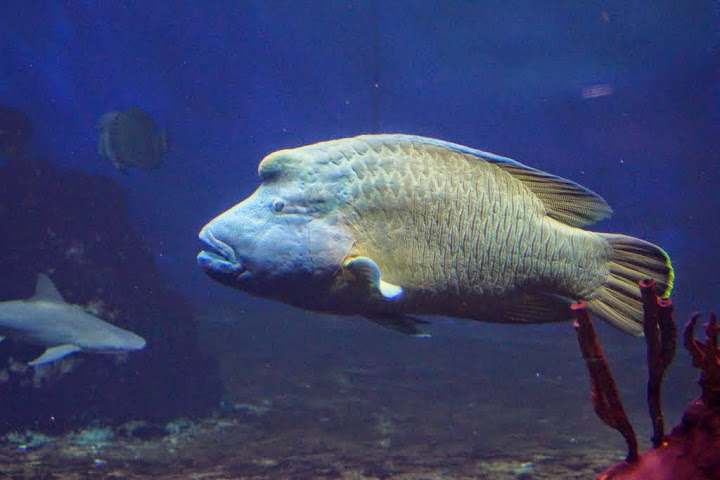
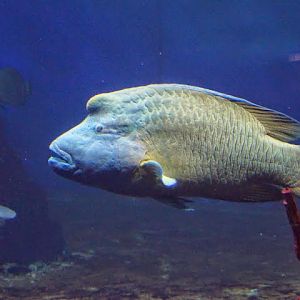
The large ones are a bit course & I always worry about ciguatera in fish over about 40 kg but the smaller fish have beautiful white flakes & are delicious. I guess its because they mainly eat the best things on the reef like crabs, crays & clams.
No. In some states in Aust they have become a "protected" species, but are still very abundant (some might argue over abundant in some areas) & they are not endangered down here. The protection here was placed on them because people thought them too photogenic to kill & the pressure on this species from destructive fishing practices in Asia (not Aust). There are still plenty of places in the Pacific where its acceptable to kill these fish, although the commercial trade is regulated. The threat to this species in Asia is from cyanide fishing for the live trade, not recreational or subsistence fishing.
So the one in this photo was captive raised, not caught in the wild using cyanide?
I am sure you are correct in saying that fishing for live specimens is a threat to some populations and of course the use of cyanide is particularly destructive. I have never seen this species in the hobby trade in the UK, but that does not prove anything. I have seen it in a public aquarium and Zootierliste names 29 collections that hold specimens in Europe and 2 in Dubai (nearer its natural range): I do not know how they were captured or at what size they were imported.
The Red List page for this species is at Cheilinus undulatus (Giant Wrasse, Humphead, Humphead Wrasse, Maori Wrasse, Napoleon Wrasse, Truck Wrasse, Undulate Wrasse). It states that the total global catch is low, but "severe declines are noted in all places for which data are available". I know that Australia has strict regulations protecting many endangered endemic species, I trust that this magnificent fish is not an exception.
From the conservation actions section of the IUCN redlist page (scroll to the very bottom of the link provided above by gentle lemur):
Australia*
Western Australia – complete protection since May 1998 because stocks determined to be insufficient and susceptible to overfishing. From December 1st, 2003, Coral Reef Fin Fish Management Plan (for Queensland waters, including the Great Barrier Reef Marine Park) prohibited all take and possession of Humphead Wrasse, other than for limited educational purposes and public display.*