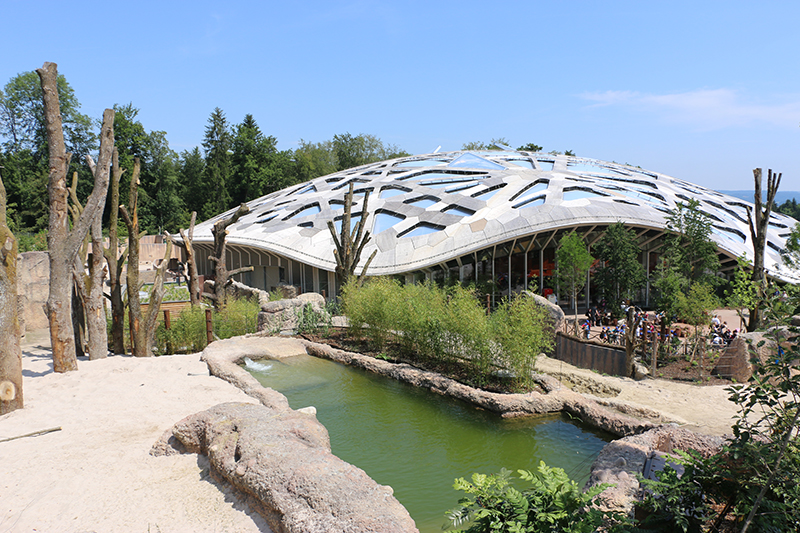
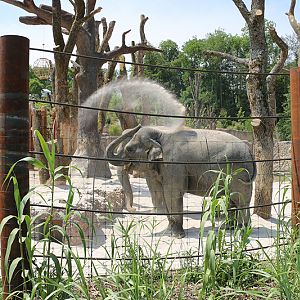
Size aside, when I visited the elephants always seemed engaged in "meaningful" activities: foraging for food, bathing, swimming, showering, drinking, taking a mud bath, dusting, scratching, exploring, playing, socializing, resting, etc. . I find the enclosure quite cleverly designed. The paddocks are structured in a way that they can never be overseen in their entirety from any single point, creating interesting "subdivisions" and lines of sight. There are three separable outdoor paddocks (2 visible, 1 off-site), and three indoor paddocks (1 visible & separable into 2, 2 off-site), plus the managament area. Every paddock (save one) has at least one pool for bathing, there are streams, a waterfall, showers, sand mounds, dirt pits, trees, countless enrichments for foraging, slopes, steps, and other small obstacles, (living) trees for shade. I would favor this exhibit over a much larger one (e.g. san diego) that offers little more than open space on any day. I am no expert on elephant husbandry, but tbh this park is the most convincing elephant enclosure I have seen so far. I would be very interested to learn of those elephant enclosures that are even better and where the major differences lie.
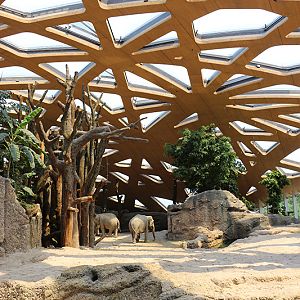
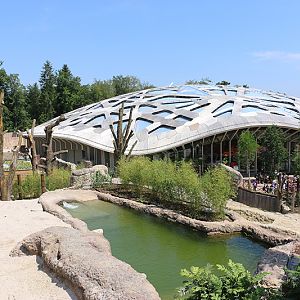
Having said that, the indoor area, to me, is a total game changer. It is the first indoor elephant exhibit I have seen (in pictures or live) that is at the same time aesthetically appealing, naturalistic and of a decent size. It is impressive architecture - but the architecture doesn't get in the way of the exhibit at all. Everything feels very natural. It evokes the feel of an ecosystem hall for elephants... though still a somewhat empty one. I really hope that with time the zoo will figure out a way to house free flying birds in the hall, hoofstock, fish in the pool(s) - perhaps even the gibbons could move here from their current housing. It is a game changer, because if an appealing naturalistic indoor exhibit can be done for the largest and most destructive animal, elephants, it can also be done for any other (land) animal.
Size aside, when I visited the elephants always seemed engaged in "meaningful" activities: foraging for food, bathing, swimming, showering, drinking, taking a mud bath, dusting, scratching, exploring, playing, socializing, resting, etc. . I find the enclosure quite cleverly designed. The paddocks are structured in a way that they can never be overseen in their entirety from any single point, creating interesting "subdivisions" and lines of sight. There are three separable outdoor paddocks (2 visible, 1 off-site), and three indoor paddocks (1 visible & separable into 2, 2 off-site), plus the managament area. Every paddock (save one) has at least one pool for bathing, there are streams, a waterfall, showers, sand mounds, dirt pits, trees, countless enrichments for foraging, slopes, steps, and other small obstacles, (living) trees for shade. I would favor this exhibit over a much larger one (e.g. san diego) that offers little more than open space on any day. I am no expert on elephant husbandry, but tbh this park is the most convincing elephant enclosure I have seen so far. I would be very interested to learn of those elephant enclosures that are even better and where the major differences lie.
Having said that, the indoor area, to me, is a total game changer. It is the first indoor elephant exhibit I have seen (in pictures or live) that is at the same time aesthetically appealing, naturalistic and of a decent size. It is impressive architecture - but the architecture doesn't get in the way of the exhibit at all. Everything feels very natural. It evokes the feel of an ecosystem hall for elephants... though still a somewhat empty one. I really hope that with time the zoo will figure out a way to house free flying birds in the hall, hoofstock, fish in the pool(s) - perhaps even the gibbons could move here from their current housing.
This is--by far--the most naturalistic and behaviorally-friendly elephant exhibit in a temperate climate that I'm aware of. Dallas' is terrific as well, but does not have to contend with extended cold winters.
The big open expanses of San Diego, SDZSP, North Carolina, Nashville and Oklahoma City exhibits are all nice (if in some cases ugly), but relatively barren of the sorts of environmental variety and enrichment opportunities that Zurich has incorporated into their design.
Finally, the point needs to be made yet again that the now gospel assertion that elephants need to have vast spaces "because in the wild they walk 30 or 40 miles a day" ignores the reality that forest-dwelling Asian and African Forest elephants generally don't travel far at all because the food and water resources they need are much more readily at hand. Nor do savanna elephants when 'the goods' are abundant.
This is--by far--the most naturalistic and behaviorally-friendly elephant exhibit in a temperate climate that I'm aware of. Dallas' is terrific as well, but does not have to contend with extended cold winters.
The big open expanses of San Diego, SDZSP, North Carolina, Nashville and Oklahoma City exhibits are all nice (if in some cases ugly), but relatively barren of the sorts of environmental variety and enrichment opportunities that Zurich has incorporated into their design.
Finally, the point needs to be made yet again that the now gospel assertion that elephants need to have vast spaces "because in the wild they walk 30 or 40 miles a day" ignores the reality that forest-dwelling Asian and African Forest elephants generally don't travel far at all because the food and water resources they need are much more readily at hand. Nor do savanna elephants when 'the goods' are abundant.
I do not doubt that the indoor house is spectacular, and I trust your view on the enrichment opportunities that abound in this new, hugely-ambitious and expensive complex. It is also true that many far-ranging species will not go much further than their constant food supply, but my only quibble would be in regards to the numerous foot ailments that elephants suffer in captivity. If the 3 outdoor paddocks at Zurich are not very large and there is food in abundance within those enclosed spaces, then could there still be a lot of foot issues with the herd in the future? What is there that would allow the elephants to avoid problems with their gigantic feet? Are there piles of sand in all directions as has been done at Cheyenne Mountain or Copenhagen?
I do not doubt that the indoor house is spectacular, and I trust your view on the enrichment opportunities that abound in this new, hugely-ambitious and expensive complex. It is also true that many far-ranging species will not go much further than their constant food supply, but my only quibble would be in regards to the numerous foot ailments that elephants suffer in captivity. If the 3 outdoor paddocks at Zurich are not very large and there is food in abundance within those enclosed spaces, then could there still be a lot of foot issues with the herd in the future? What is there that would allow the elephants to avoid problems with their gigantic feet? Are there piles of sand in all directions as has been done at Cheyenne Mountain or Copenhagen?
Yards look to be 100% sand, indoors and out. Check out the "Streetview" in previous link. The herd moved from a largely concrete/hard packed soil situation, so may already have foot issues?
This is--by far--the most naturalistic and behaviorally-friendly elephant exhibit in a temperate climate that I'm aware of. Dallas' is terrific as well, but does not have to contend with extended cold winters.
...
Finally, the point needs to be made yet again that the now gospel assertion that elephants need to have vast spaces "because in the wild they walk 30 or 40 miles a day" ignores the reality that forest-dwelling Asian and African Forest elephants generally don't travel far at all because the food and water resources they need are much more readily at hand. Nor do savanna elephants when 'the goods' are abundant.
I recommend that you check out the elephant facility in Planckendael, which is - in my opinion - way better then Zurich. They have a large barn with an indoor sand yard and a huge pool as well, and on top of that, way more outdoor space (the big herd enclosure is almost 2,5 acres or 10.000 m²). And they use tons of enrichment as well. Many of the new elephant facilities in Europe from the last few years are better or at least as good as Zurich. They may not look that nice and "designed", and most were way cheaper, but for the elephants, "looking nice" doesn`t matter!
I agree that enrichment and structure is very important, but the best is if you combine great enrichment with space. Elephants don`t need to walk 30 miles a day to stay healthy, but they do need SOME exercise. Especially the Zurich elephants, because yes, they do have lots of foot and joint problems from the old enclosure. Elephants will walk more when the enrichment features can be placed further away from eather other! The two smaller paddocks in Zurich are totally insufficent (those with less then 1/4 acres) even with the best enrichment program possible. I have not seen ANY natural behavoir from Maxi, exept for a few minutes of spraying himself with water. He spent 95% of is time during my visit swaying. It was heartbreaking to watch. The funny thing is that there is lots of free space around the new elephant facility. It would have been very easy to add more outdoor space at least to the bull paddock.
I recommend that you check out the elephant facility in Planckendael, which is - in my opinion - way better then Zurich. They have a large barn with an indoor sand yard and a huge pool as well, and on top of that, way more outdoor space (the big herd enclosure is almost 2,5 acres or 10.000 m²). [...]
I agree that enrichment and structure is very important, but the best is if you combine great enrichment with space. Elephants don`t need to walk 30 miles a day to stay healthy, but they do need SOME exercise.
Well, it certainly looks like a well done, spacious elephant enclosure. Thanks for the tip. I think your assessment raises an interesting question though: In climates where during four or more months of the year elephants will spend most part of a day indoors, how do you justify offering less than 10% of the outdoor space to elephants indoors. Can a "barn" with less than 1000 m2 for the elephants really offer adequate space for an entire herd & bulls - or should zoos in temperate climates drop the barn concept and strive for a new standard of indoor enclosures which are an order of magnitude larger such as Zurich's or Köln's? If you look at Köln, this doesn't even have to be overly expensive.
I visited Zurich yesterday and I was quite impressed by the new enclosure, it may indeed not be the largest elephant enclosure and it is in some ways a bit over the top. But it is by far the best indoor elephant enclosure I have seen (and in Swiss winters they will need that), the indoor space provided is huge and there are many different feeding stations (in total the whole complex has over 50 feeding stations for the elephants). The outdoor enclosure may not be too large, but it is designed really clever, so it still provides long stretches that the elephants have to walk to get to the different feeding stations and I have seldom seen such active elephants (apart from the bull indeed, who was waving all the time, but old habits are hard to break and his enclosure could be larger indeed, allthough it is still one of the largest bull enclosures in Europe...).
btw. could it be that the groups are mixed again, because in the afternoon I saw 5 elephants (including the calf) feeding in the same indoor enclosure.
This is mistake Zurich did before and other zoos do. Visitor areas, access roads, grass lawns etc. use too much space which is missing for animals. Still better than some exhibits where only 1/3 or 1/4 of the nominal area is actually available for animals.
Having said that, the indoor area, to me, is a total game changer. It is the first indoor elephant exhibit I have seen (in pictures or live) that is at the same time aesthetically appealing, naturalistic and of a decent size.
Very beautiful building, can you maybe compare with Rotterdam? They already 10 years ago built similar natural indoor exhibit for elephants under a simple triangular roof. Much like commercial greenhouse design, and much lower cost.
Very beautiful building, can you maybe compare with Rotterdam? They already 10 years ago built similar natural indoor exhibit for elephants under a simple triangular roof. Much like commercial greenhouse design, and much lower cost.
It is not comparable with Rotterdam (that one is 20 years old), Rotterdams enclosure is about 1/10 of the size, looking purely to the indoor enclosure and it has no natural substrate and the whole construction of the building is different, Rotterdams one is much more a greenhouse.
Yes, at my local zoo they built a new 7 acre expansion for elephants with exactly half for animals and half for visitors. IMO they could (and should) have easily taken another acre or more away from visitor area and given it to animals. About half of the visitor area is just an unusuable planted area anyway.