Why don't you post under the English names with the latin names as an add on, after all none of us speak latin (this comment applies to all your recent posts)?
Might I suggest that using the scientific name is entirely justifiable [and can avoid confusion] when English is not one's native tongue?
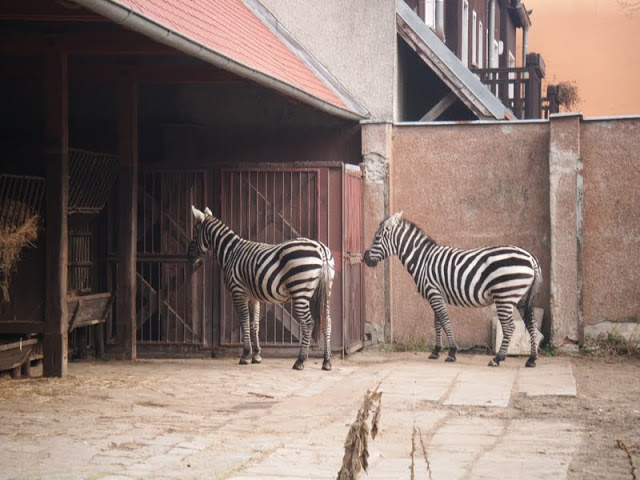
Secondly, this isn't a bad picture of two Plains Zebras.
Thirdly, Happy New Year to all Zoochatters.
Why don't you post under the English names with the latin names as an add on, after all none of us speak latin (this comment applies to all your recent posts)?
Firstly: a bit of a broad claim that no-one here speaks Latin!!
Secondly: there is nothing wrong with posting a photo under the scientific name of the animal in question. To reverse your own post, not everyone here has English as a first language or even knows the English name of any particular animal. And to add to that many animals have several English names, the use of which may be confusing if you don't know them all (!), whereas the scientific name belongs only to that one species (allowing for taxonomic changes).
Thirdly: I think this is quite a striking image and a long way from mediocre.
[EDIT: I just realised I used the same "firstly, secondly, thirdly" format of FBBird for my answer, which wasn't intentional ]
Why don't you post under the English names with the latin names as an add on, after all none of us speak latin (this comment applies to all your recent posts)?
What an incredibly rude post. I for one thank Nikola for his use of scientific names. He (or she, I'm not certain) is considered one of the best photographers on the site.
At any rate, using the scientific name is far, far better than labeling a photo "Some kinda [sic] deer."
Hmm, as the farmer of exotic animals I have a habit of applying Latin names .As for the photograph it is weak but it is only a document.He isn't starting with him to the competition.
I would have put it more tactfully, but I also appreciate common names along with latin names. No need to eliminate the latin names, of course they can be quite helpful, just put both (unless you do not speak English at all which seems to not be the case here).
What an incredibly rude post. I for one thank Nikola for his use of scientific names. He (or she, I'm not certain) is considered one of the best photographers on the site.
At any rate, using the scientific name is far, far better than labeling a photo "Some kinda [sic] deer."
Just wanted to register my agreement with jb on this one. If you're not sure what something us you can always ask - at least if it's a scientific name on its own then that can be googled for an answer - which you couldn't do with 'some kinda deer'.
Also, using a scientific name is not the same as 'speaking Latin'. Personal bugbear.
On the topic, the ssp. borensis is the rather bizarre Maneless Zebra, in which adults lose all or most of their mane. Fascinating animals, and, along with boehmi, my favourite zebras - I like a fully-black-and-white-striped Plains Zebra.
On the topic, the ssp. borensis is the rather bizarre Maneless Zebra, in which adults lose all or most of their mane. Fascinating animals, and, along with boehmi, my favourite zebras - I like a fully-black-and-white-striped Plains Zebra.
The one on the right has a mane- compare the white tail and unstriped ears of the maneless one- these seem to be connected with the gene for 'manelessness'
Certainly the taxon stands unquestioned in the never-shy-of-controversy Ungulate Taxonomy (Groves and Grubb) - one of its distinguishing features is the white ears noted above.
Groves and Grubb also suggest that another 'maneless' population currently included in E. q. boehmi might be distinct enough to be a separate subspecies, E. q. isabella.
(and yes, someone did get a nerdy Christmas present..!)