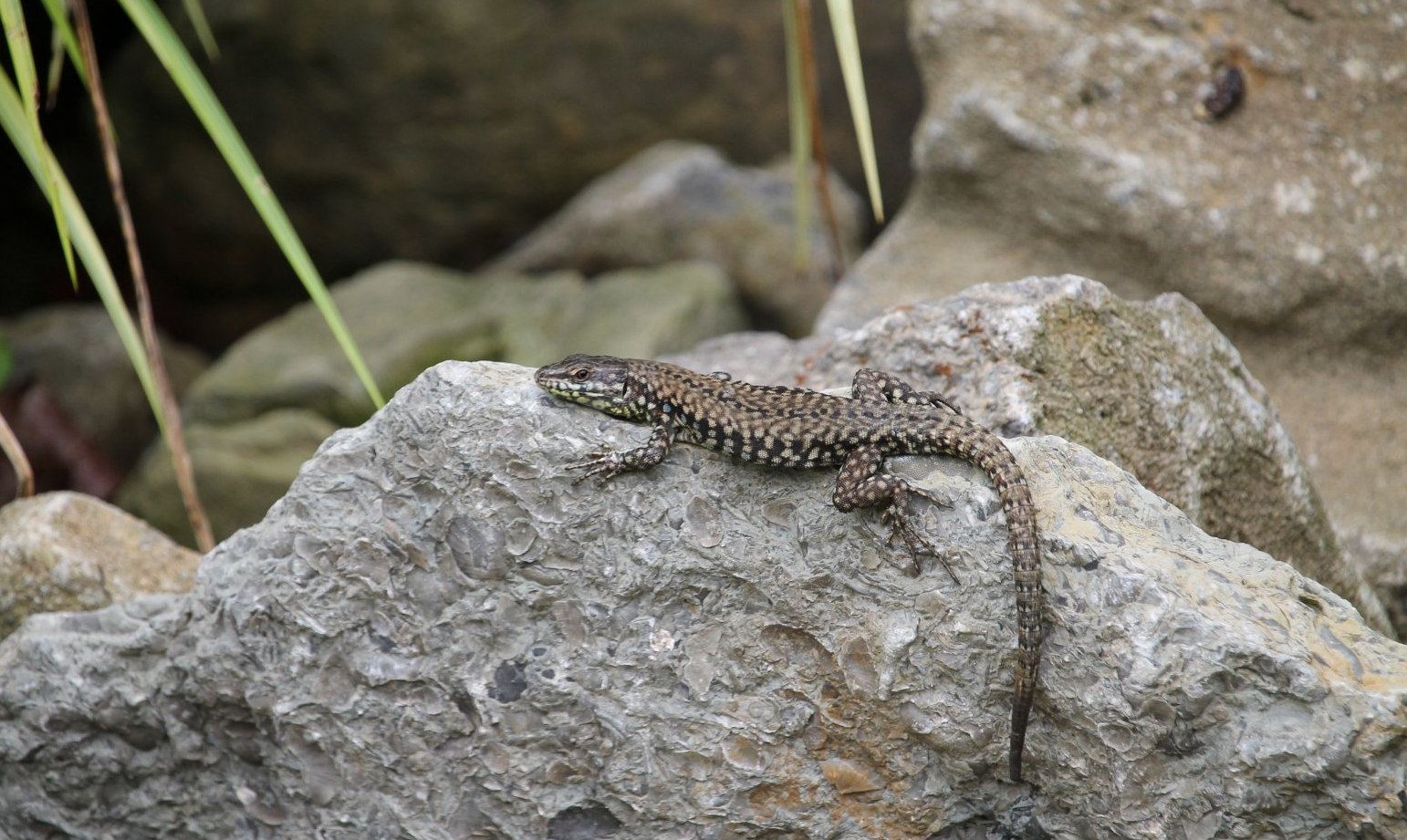
Fascinating! How long has this species been established in Cincinnati and when were they introduced to the area? This actually reminds me of when I saw a Spiderman agama (Agama mwanzae) out of the blue in a parking lot in St. Lucie County, something I certainly wasn't expecting, knowing that the species is from East Africa (specifically Tanzania, Rwanda, and Kenya).
The story is actually quite interesting and I'm very happy that there were fairly easy to see around Cincinnati, mostly around the zoo and riverfront parks.
And here is a quoted portion about the Cincinnati population.
The natural range spans much of the mainland Europe except from the north and very south and extends to Turkey.[1][4] It occurs as introduced populations in southern Britain,[1][17] where one such population in the seaside town of Ventnor on the Isle of Wight has become somewhat famous, and also in North America.[1] There has been some scientific debate as to whether the populations in Southern England represent the northern edge of their native range.[18]
North America[edit] Podarcis muralis has been introduced in the United States and is spreading throughout the Cincinnati metropolitan area. It is commonly observed living in limestone outcrops, rock walls, and rubble along the Ohio River basin.[19]
It is referred to locally in the Cincinnati/Northern Kentucky area as the "Lazarus lizard",[20] as it was introduced to the area around 1950 by George Rau, a boy who was a member of the family who owned the Lazarus department store chain (now absorbed into Macy's). After he returned from a family vacation to northern Italy, he released about 10 of the reptiles near his Cincinnati home.[21] This prolific lizard has reproduced exponentially; it continues to expand its distribution range annually, and has established itself so well in southwest Ohio, it is now considered a naturalized species by the Ohio Department of Natural Resources and is protected under state law (it is illegal to harm, capture, or possess this animal without a proper licence).[22]
Besides Ohio, P. muralis has also been introduced in other U.S. states. Populations occur in Kenton and Campbell counties in Kentucky, and in parts of Indiana.
The European wall lizard was also introduced to Vancouver Island, British Columbia, Canada in 1970, when a dozen individuals were released into the wild from a small private zoo.[23]
This lizard is also present in Los Angeles and San Diego counties in California and may exist elsewhere in California.
@ChunkyMunky pengopus oh wow! Thank you for sharing this with me. Is Cincinnati the best place to spot them in their introduced range if you will? I know that Hamilton County, Ohio where Cincinnati is is right across the state line from Kentucky, so it doesn't suprise me that they also occur in Kentucky as well.
@UngulateNerd92 I didn't really go anywhere in Kentucky where they would be, but there are definitely reports from there. It is curious to think about the lizards crossing the bridge over the Ohio to colonise new lands .
I wasn't in Cincinnati for too long, but I would say the zoo is probably one of the best spots to see them. I saw them quite a few times there along the lushly planted pathways. Observations · iNaturalist
@ChunkyMunky pengopus ah ok. Very interesting. Also, I wonder why the Ohio Department of Natural Resources made the decision to give them special protection? It is fascinating yet unexpected that they did.
Wow, so apparently Ohio State University in Columbus has information about their presence in the state on their website. Lazarus Lizards Rise in Cincinnati
Pardon my digression, but It looks as if the "Lazarus lizards" and Sumatran rhinoceros are two non-native species (though in different contexts) that made themselves a major part of Cincinnati's culture. I am pleasantly surprised by how many people from Cincinnati that aren't even zoo people, but regular residents know what a Sumatran rhinoceros is, because they grew up there and were familiar with their zoo's work with them. Similar story with "Lazarus lizards" as pointed out in the article from Ohio State University. Is that a fair comparison?