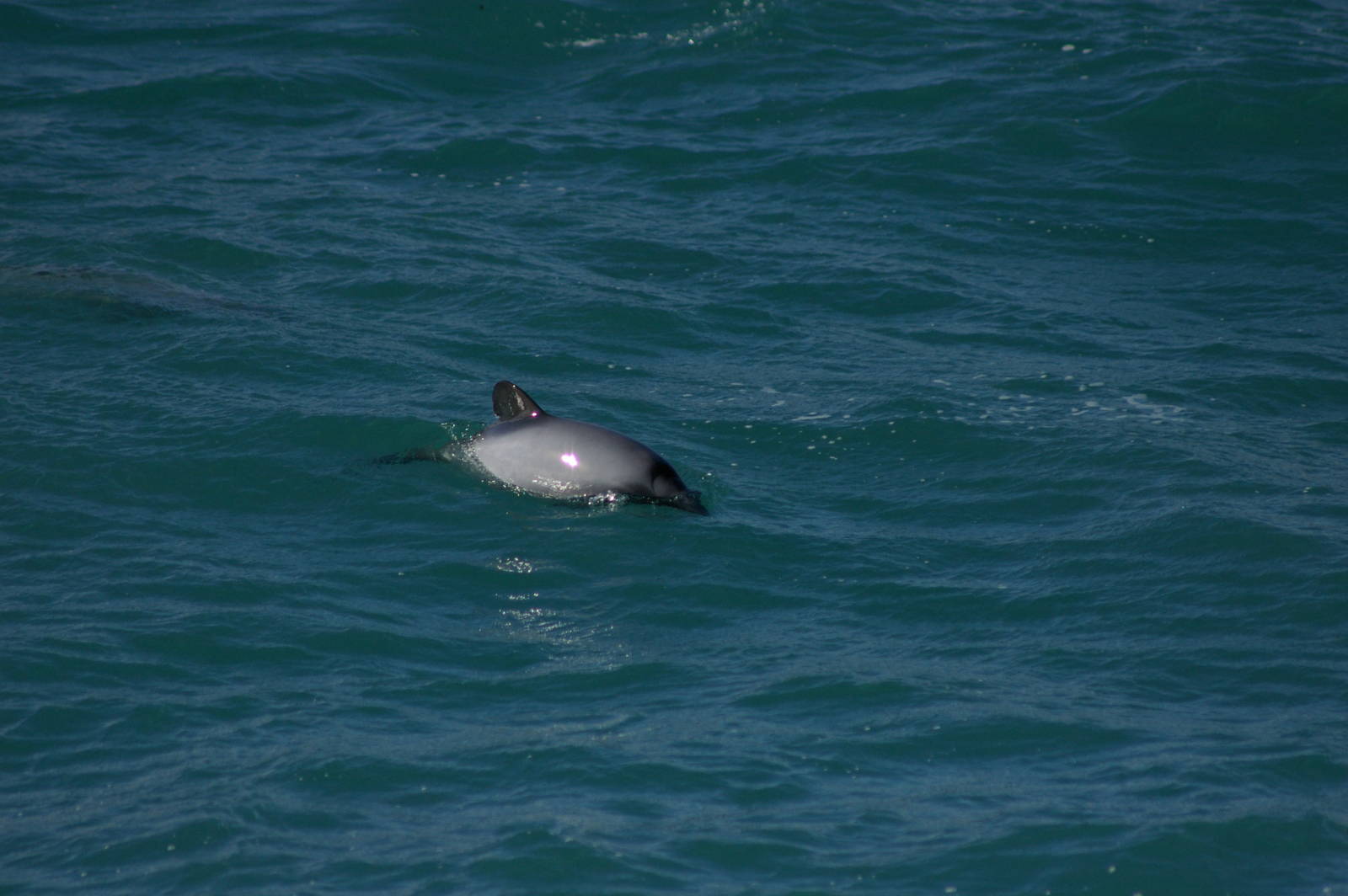
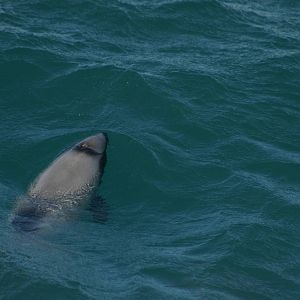
one of the smallest (1.2 to 1.4 metres long) and rarest (c.8000) dolphins in the world, endemic to New Zealand coastal waters. They are very difficult to get good photos of because they move so fast. They are oh so very cute though!
one of the smallest (1.2 to 1.4 metres long) and rarest (c.8000) dolphins in the world, endemic to New Zealand coastal waters. They are very difficult to get good photos of because they move so fast. They are oh so very cute though!
I was just reading an article in the latest NZ Geographic about Maui's dolphins (the North Island subspecies C.h. maui, the one pictured above being the South Island C.h. hectori). The most recent surveys show about 7000 Hector's dolphins (South Island) and only about 110 Maui's dolphins (North Island). The species overall decline is almost solely due to gill-nets set by recreational fishermen. Because of the Hector's dolphins' habitat requirements their distribution coincides almost exactly with the areas of set-netting. Set-netting first started in the early 1970s and the article was saying that even if set-netting could be stopped immediately it would take 200 years for the Maui's dolphin to recover to half it's 1970 population level, and 1000 years to recover fully to that level.
Further measures are being considered to protect Maui's dolphins as a new study points to a decline in the numbers of the critically endangered species.
Conservation Minister Kate Wilkinson says her department's survey shows the number of adult dolphins has declined in the last six years and there are only about 55 remaining.
She says the main areas where the dolphins live are already protected by marine mammal sanctuaries and fishing restrictions.
Ms Wilkinson is proposing extending the set net ban along the Taranaki coast and the West Coast North Island sanctuary.
She's bringing forward a review of the dolphins threat management plan from 2013 to this year.
New Zealanders are being warned the country's shrinking Maui's dolphin population is "staring down the barrel of extinction" and we could end up following in China's footsteps if more is not done to protect the rare species.
Five years ago an international group of marine scientists scoured the 1669km Yangtze River in China for the waterway's highly endangered freshwater dolphin, the Baiji.
They planned to move the last living specimens of the dolphin to a haven and rebuild the population.
But not a single Yangtze River dolphin, or Baiji, was found.
It was declared extinct, and China earned the dubious honour of the first recorded disappearance of a cetacean through human influence.
The extinction of the Baiji meant the rarest dolphin in the world was now the Maui's dolphin, found only on the west coast of New Zealand's North Island.
The dolphin's coastal habitat is a contrast to the Yangtze River, which became near-opaque with industrial waste.
But despite the Maui's cleaner waters, it contends with the gillnets and trawl nets used by commercial and recreational fishers.
A report released last week says only 55 Maui's remain.
The previous survey of the dolphin in 2004 found 111 individuals, down from 1000 in the 1970s.
University of Auckland marine biologist Rochelle Constantine said: "We are staring down the barrel of extinction of this sub-species."
Asked whether the tiny surviving population meant any protection attempts would be futile, Dr Constantine said there were still reasons for optimism.
Marine mammals had recovered from this level of depletion before.
Co-researcher Scott Baker said the population had retained an equal balance of females and males, and the individuals had reasonable genetic diversity.
The dolphins stayed mostly within a region between Kaipara and Raglan, which prevented the population from fragmenting.
But their survival will depend on how free from human interference their habitat is.
The coastline from Dargaville to Taranaki has a set net ban and sanctuary status.
Conservation Minister Kate Wilkinson responded to last week's report by proposing that the ban and the marine sanctuary be extended further south than Taranaki to Hawera. A review of the sub-species has also been brought forward.
Zoologist Liz Slooten, from the University of Otago, said the the protected area did not extend far enough south, and did not include harbours, where the Maui's dolphin were known to swim. There was also no proposed protection for an important region between the North and South Islands, and a possible corridor which could connect the population of Maui's dolphins to their South Island relatives, the Hector's dolphin.
Public and stakeholders can make submissions on the Government's proposals until April 11, and a decision is due at the end of May.
This two-month window of time has conservationists nervous.
World Wildlife Fund and Forest & Bird have called on ministers to use their emergency powers to ban gillnets and trawl nets immediately.
Dr Constantine said it would be devastating - and embarrassing - for New Zealand if a natural and cultural treasure went the way of the Baiji because of failed interventions.
"This is a big question that New Zealand needs to ask itself: do we want to have Maui's dolphins?"
There has been speculation for some time that the small population of Maui's dolphins located off the northwest coast has been in decline. But the latest numbers from the Department of Conservation are worse than expected. Scientists now estimate that there are only 55 adult dolphins remaining.
This estimate is much lower than that of 2005 which put the population at 111. It means that the dolphin is rapidly heading towards extinction. We have a short window of opportunity to save them.
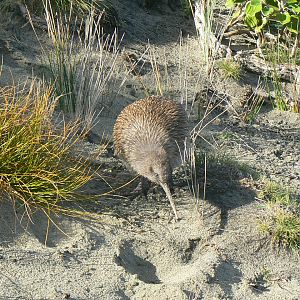
New Zealand has been here before - with the kakapo. By 1995 the kakapo population had declined to only 51 birds. This critically low number ignited concerted action. A national kakapo team was established within the Department of Conservation to focus on the recovery of the species. A comprehensive risk assessment was undertaken and this fed into a revised recovery plan. Scientific experts were mobilised. Government provided additional funding and staff. As a result, the decline of the kakapo was successfully reversed, with numbers currently well over 100 and growing.
It's time to mobilise a similar effort to save the Maui's dolphin. Being a marine species, the tools required to reverse the population decline will not be the same.
But there are a range of potentially effective tools available. Research findings indicate that if we remove the human-induced risks to the dolphins, there is a good chance that the population will gradually recover under its own steam.
With the population in such a perilous situation, the recovery effort needs to be based on a deeply precautionary approach. It is therefore heartening to see the Ministers of Conservation and Primary Industries proposing urgent interim measures. These will increase the extent of a ban on set nets further south around the Taranaki coast as well as restrictions on seismic activity in connection with oil and gas exploration. It is intended that these measures will stay in place at least until the Maui's threat management plan is reviewed later this year.
Entanglement in fishing nets is thought to be the main reason for the dolphin's decline. So this is a good start.
The proposed measures have been supported by the Auckland Council, the Environmental Defence Society and Forest and Bird.
The Seafood Industry Council has called organisations supporting the measures "extremists". The Federation of Commercial Fishermen refers to 'a knee jerk reaction'. These responses are very disappointing. It is redolent of an out-dated style of oppositional politics where the response to an issue is to directly attack the parties promoting it.
It contrasts with the much more constructive position taken by the Petroleum Exploration and Production Association. It has come out in support of the interim rules proposed to manage seismic surveying off Taranaki. The Association's CEO, David Robinson, stated that the "industry recognises that caution must be taken not to do anything that could further reduce the size of the population" and "it was important that the exploration industry played its part in ensuring the survival of the Maui's dolphin".
This is the kind of response we need on behalf of all marine resource users. If we are to succeed in saving the Maui's dolphin, all parties will need to play their part.
The Department of Conservation, as our national champion for protected species, will need to play a strong leadership role. The Maui's dolphin threat management plan needs to be speedily updated. A well-resourced team should be set up within the department without delay, tasked with preparing the new plan, and spearheading a multi-agency effort to implement it. The scientific community needs to be brought on board to work closely with the department.
As well as extending the area covered by the set-net ban, the Ministry for Primary Industries will need to ensure full observer coverage on fishing vessels operating within the west coast North Island marine mammal sanctuary area. This is to ensure that the rules are adhered to. On smaller boats, where there is little room for an additional person, video cameras can be deployed. Fishing industry bodies could provide useful assistance in liaising with their members over observer arrangements but there will need to an attitude change first to reassure the public that they will act responsibly.
The Auckland Council, Northland Regional Council and Waikato Regional Council will all need to make changes to their regional coastal plans to ensure that activities such as mining and coastal development do not adversely impact on the dolphins. Under the New Zealand Coastal Policy Statement, councils are legally required to change their plans to avoid adverse effects on threatened species. Such plan changes are urgent, because there is growing interest in mining ironsand along this coastline. This activity could impact on the dolphins and resource consent applications are expected soon.
Maui's are New Zealand's own special little dolphins. It would be a national tragedy if we lost them. Now is the time to all pull together to bring them back from the brink.
I don't normally promote online petitions, but this is of great importance. Only 55 Maui's dolphins left in existence, and we don't want it to follow in the wake of the baiji do we: Save The Maui's Dolphin
I don't normally promote online petitions, but this is of great importance. Only 55 Maui's dolphins left in existence, and we don't want it to follow in the wake of the baiji do we: Save The Maui's Dolphin