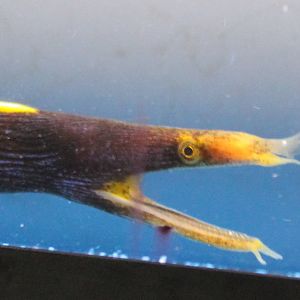
The name Ribbon eel was also known to me but in the Netherlands its commonly known as Bladneus murene = Leaf nose murey-eel. BTW how can you tell its a male ?
In the wild, all are supposed to start black, then turn to the blue adult male and finally (at around 95 cm in length) change sex to become a yellow adult female, i.e. protandrous hermaphrodism. The yellow adult females are reputed to be very short-lived, only getting a few months in this form before dying. These color differences are not reliable in captivity. It is not clear if this is a captive thing or if the commonly quoted color differences are questionable in the wild too. I've probably seen close to 50 at various aquariums and have seen many black, some blue, a few intermediate blue-yellow but no pure yellow yet.
In 2001 the Karlsruhe Vivarium in Germany managed to get fertile eggs for the first time in captivity (at least first time documented). The parents arrived at the aquarium as blue, then turned black and spawned! The later spawning at Steinhart Aquarium in USA and Schönbrunn Zoo in Austria have also involved parents that weren't the colors they were "supposed" to be: Both black in former, black male and yellow female in latter. As noted by Schönbrunn in the article related to the spawning: "body color variations of ribbon eels in captivity do not reflect its sex or sexual maturity". In many cases it appears they stay the color they arrived in, or make seemingly random changes that aren't supposed to happen: Blue ("adult male") to black ("juvenile"), black ("juvenile") directly to yellow ("adult female") without the blue ("adult male") stage!
Remarkably Schönbrunn managed to keep the larvae alive for a week and hopefully the next places to get spawning will be able to go even further, eventually completing the breeding circle. It would be the first species of moray eel where this has been achieved. At presents most keep the ribbon eel in the general moray family Muraenidae, but it has several unique features and some believe it should be moved to its own family Rhinomuraenidae.
Regardless even adult ribbon eels have an awful survival record in captivity and only belong in places with resources and experience such as public aquariums and pro aquarists.
Thanks temp. I've seen a few full yellow specimens at some SE Asian aquariums. I didn't know that changing from adult to juvenile colouration was a common occurence at all, but almost all of those I've seen in Europe have been black. http://www.zoochat.com/1993/ribbon-eels-may-2013-a-348507/