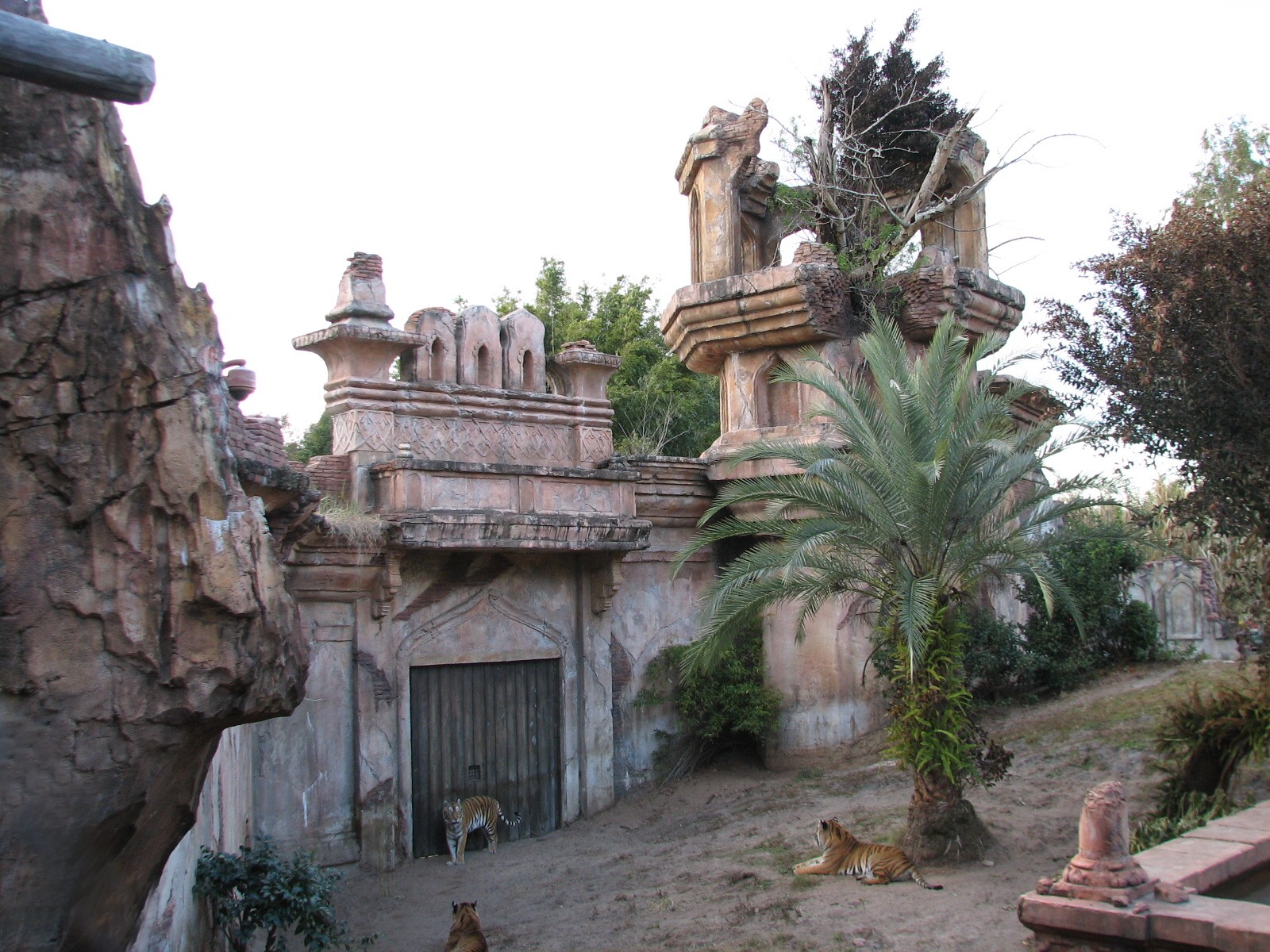
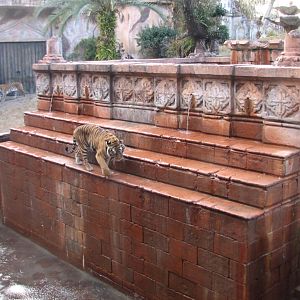
Are there still 6 generic tigers between the two exhibits? On a side note, I'm sure that far more money was spent on the surrounding ruins than the actual tiger enclosures, as those dilapidated buildings do look spectacular if one likes that sort of thing. I'd personally take the Minnesota Zoo's two giant forests for Amur tigers over Disney's ruined temples.
What's unique about the temple theming of this exhibit is it is not the temple walls that contain the animals, the temple walls are more about defining the visitor space. The tiger space goes off into the forest in the distance. It's as if you are visiting these ruins and you see tigers that have come in from the forest.
The first time that I visited Disney's Animal Kingdom, I noticed that the tigers were simply identified as "Tiger". I asked a docent what type of tigers they were and he answered, "They're Asian tigers!". I told him that I knew that they were from Asia but I wanted to know if they were Bengal, Sumatran, Indochinese, etc. He replied, "No sir. They're Asian tigers!".
Realizing that he wasn't informed, I smiled and moved on. Later in the day, I asked another docent the same question and he told me that they were all rescued tigers that had been "Pets" and they had come from less than reliable animal breeders. Thus, their lineage couldn't be accurately traced.
A few years back we had a lecture for the local zoo-association here about that park. It was said that the tigers were trained to respond to certain bird noises from speakers to get active (they were fed always to these bird noises). Of cause it were bird noises from birds who don't live there in the wild. So if the visitors don't see the tigers the bird noises were played and the tigers got active.
That is what the zoo director here told us about that method to keep the tigers active, so I have no reason not to believe that. But can someone tell me if it is still done there?
A few years back we had a lecture for the local zoo-association here about that park. It was said that the tigers were trained to respond to certain bird noises from speakers to get active (they were fed always to these bird noises). Of cause it were bird noises from birds who don't live there in the wild. So if the visitors don't see the tigers the bird noises were played and the tigers got active.
That is what the zoo director here told us about that method to keep the tigers active, so I have no reason not to believe that. But can someone tell me if it is still done there?