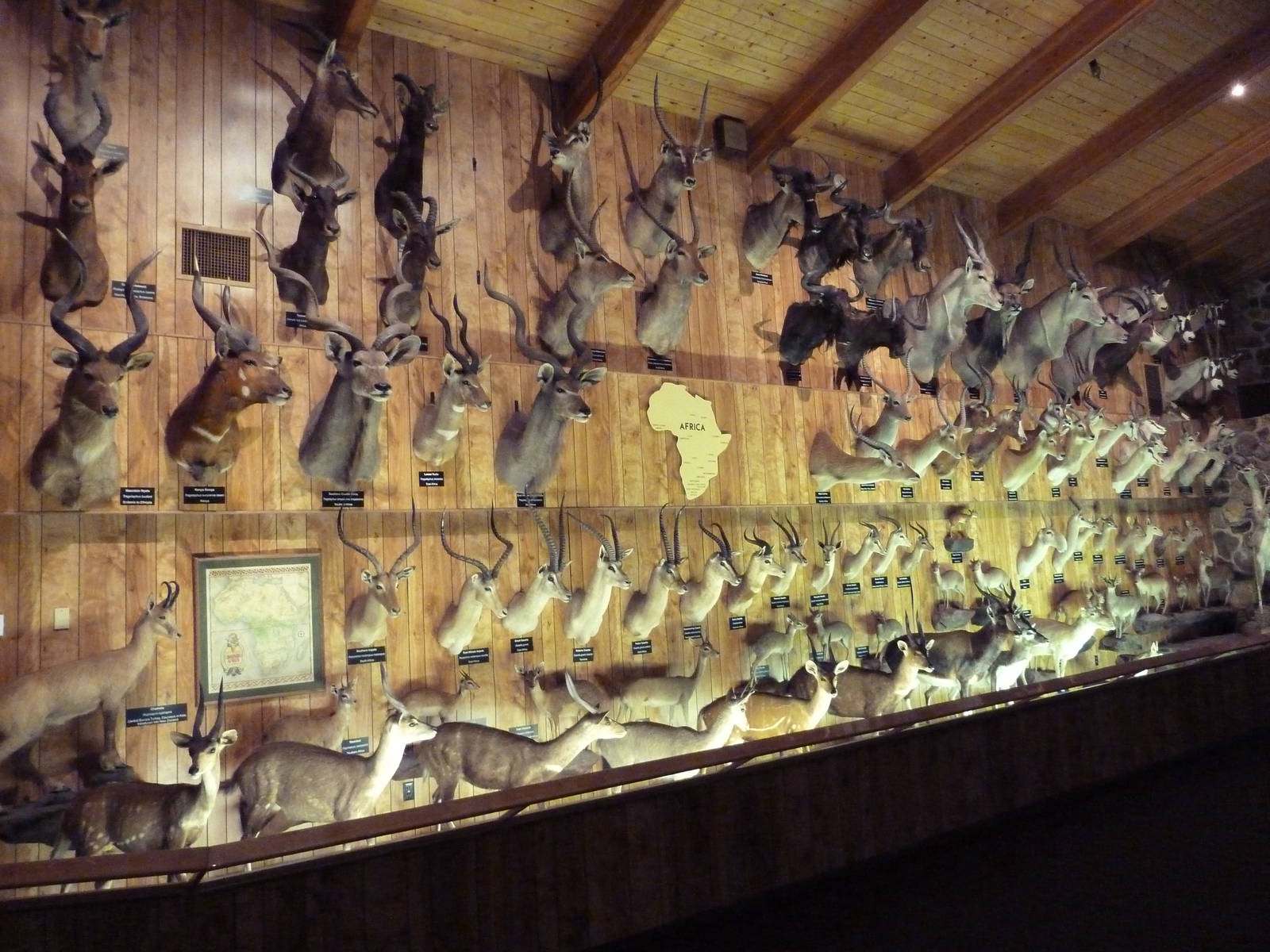
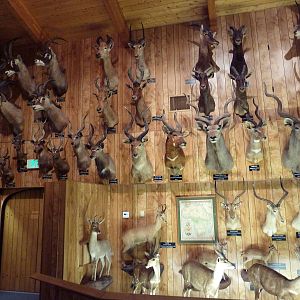
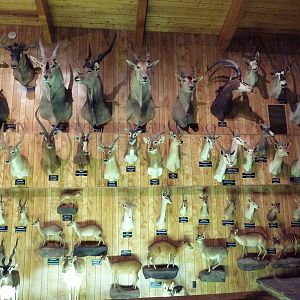
McElroy Hall – Here are the star attractions for hoofstock fans, although there are many other species on display in a massive, high-ceilinged central room. Golden takins lead the way into the main collection, and then the sight is breathtaking. It is also quite sad to realize that hundreds of mammals had to die to fill the collection, but it is amazing to see what is on display. In the center are the cats, and there is a tiger, lion, two jaguars, leopard, puma, snow leopard, cheetah and lynx. There is also a Nile crocodile here as well.
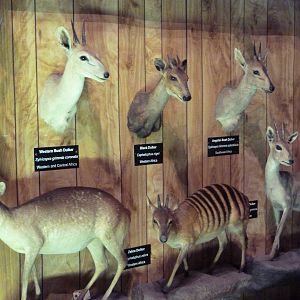
On a single huge wall I counted over 110 different species of African hoofstock, and I wonder if some of the taxonomic names are still the same as names have probably changed since the mounted heads were erected. There are at least 7 species of bushbuck, 7-8 duikers, 5 wildebeest, innumerable gazelles, and the museum must have over 90% of all of the African antelopes in existence, as well as a few other treasures on that side of the room such as a black-backed jackal and a saiga antelope.
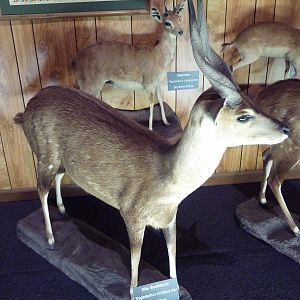
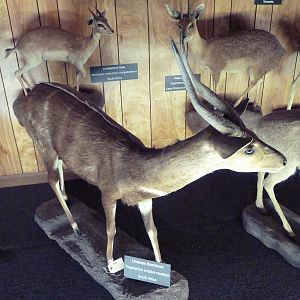
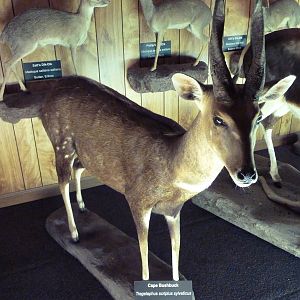
Some hoofstock include: zebra duiker, Angolan bush duiker, black duiker, Weyn’s duiker, red duiker, East African bush duiker, western bush duiker and at least a couple of other duikers. There must be 5 different species of springboks, harnessed bushbuck, cape bushbuck, Limpopo bushbuck, Masai bushbuck, Nile bushbuck and maybe a couple more bushbucks. There must be at least 20 species of various goats and sheep, a few different lechwe and everything else that you could imagine.
There are dioramas all around the big cats in the center of the room, and species either on the wall as mounted heads or as full specimens in side dioramas include: two polar bears, grizzly bear, Eurasian brown bear, Kodiak bear, American black bear, American black bear with glacial color form and sloth bear. There are probably at least 120 antelope species in total, several rhinos, at least 5 species of buffalo, muskox, wolves, all sorts of deer (an entire long wall), a giraffe, zebras, and both species of hippo, elephants and at least 5-6 moose heads.
I really would be intrigued as to how many taxonomic name changes there have been with ungulates over the years, as some ZooChatters (although I am not one of them) keep lifetime species lists and many of those can be tossed out of the window with all of the numerous alterations. When I was younger I saw 5 species of zebra at Edmonton's Polar Park Zoo (I also saw 90 species of hoofstock at ONE TIME, along with baikal seals, saiga, etc) but now many of those ungulates have had name changes.
Am l alone in thinking this photo does not belong on zooochat?
All these animals were shot in the prime of their life by individuals who call this sport!
I believe the intent behind the International Wildlife Museum is ego and nothing to do with conservation or education, however l can see how en education message can come from this display.
I guess l see it as disrespectful to look at an Animal that has been killed for sport and stuffed and mounted for ego.
Am l alone in thinking this photo does not belong on zooochat?
All these animals were shot in the prime of their life by individuals who call this sport!
I believe the intent behind the International Wildlife Museum is ego and nothing to do with conservation or education, however l can see how en education message can come from this display.
I guess l see it as disrespectful to look at an Animal that has been killed for sport and stuffed and mounted for ego.
That may not be true. In reality as long as the skin is good enough you can mount it. I have a friend who is a taxidermist and he once saw a road kill bobcat and was able to salvage the skin and mount it.