Snakes of the same species can vary quite differently in their markings, from one individual to another. Relying on illustrations to identify a species is not always an accurate way to do things (as you recently discovered). In many cases the best way to identify a snake with certainty is to count the scales.
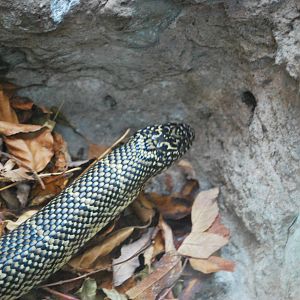
I have no idea what species is in the picture above, but I'm reasonable certain the snake is a species of culubrid. I would say your guess of kingsnake is pretty close, but I don't know which species. A profile shot of the head would help.
Kingsnakes (and milksnakes) are of the genus "Lampropeltis", meaning literally "shiny shield". These snakes are named because of their exceptionally smooth and shiny, delicate scales.
All Lampropeltis are snub nosed, with a very rounded snout.
Here is a typical Californian Kingsnake, Lampropeltis getula californiae;
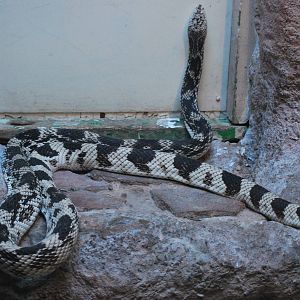
The Northern Pine in the picture is a Pituophis (meaning literally Hissing - Snake). This genus is comprised of large heavy bodied (for colubrids) snakes with an adapted rostral scale, this is visible even in the pic above, the snake has a very pointed elongated snout, the head is a teardrop shape from above.
This genus also have large, strongly keeled, matt, rough scales.
Like I keep saying, identification is a skill, the average British person probably knows the difference between a fox and a badger but the birds in their garden are just "birds". It is an ability to remember and identify key characteristics and differences in morphology.