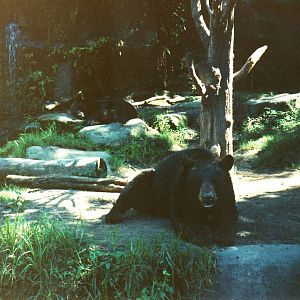
Yes, this exhibit is currently used for sun bears. It is a decent sized exhibit (especially for the bears, who, before coming to Taronga, were in the restaurant trade in Cambodia) with a thick planting of bamboo at the front, a few dead log 'huts' (shelters), and a few parallel logs for the bears to climb on, which the male paces on quite a bit (another result from their horrific previous life). Visitors actually stare down at the bears, and as geographically mistaking as possible, this exhibit is at the start to the African section of the zoo, even if not technically part of the 'African Waterhole' set of exhibits.
Yes, this exhibit is currently used for sun bears. It is a decent sized exhibit (especially for the bears, who, before coming to Taronga, were in the restaurant trade in Cambodia)
Not sure that there is any proof that past experience in running a restaurant necessarrily leads to pacing, but other sun bears born in captivity also pace ....
Not sure that there is any proof that past experience in running a restaurant necessarrily leads to pacing, but other sun bears born in captivity also pace ....
These animals (as with most animals in the restaurant trade) are kept in very small cages with only food and water, and limited or no enrichment, which leads to pacing and is very hard to break (as is with the case with the male Mr. Hobbs, who paces quite a lot). If they have the right enrichment, then they mostly will not pace, but sometimes the habit does still happen even with alot of enrichment.
Agreed. I think most people are familiar with the barbaric practice of bear farming/bile extraction in Asia.
I for one love seeing bears in zoos and certainly the life of Mr Hobbs etc. are better from having been rescued, but it remains a challenge to keep bears in captivity, even in relatively large and enriched zoo environments....because of obvious reasons like most bears in the wild have very large ranges, adult males are mostly solitary etc., so it's important to keep learning more and taking specific actions, particularly during breeding season.