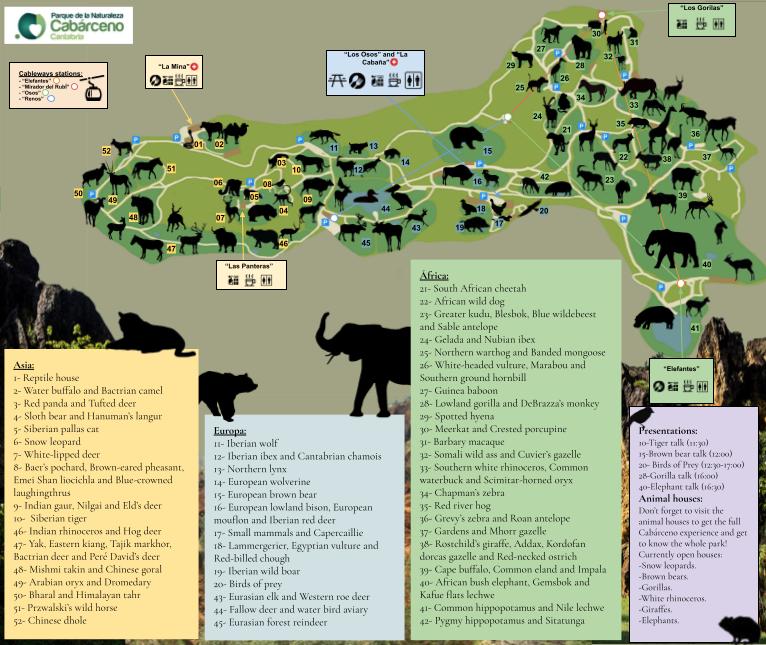
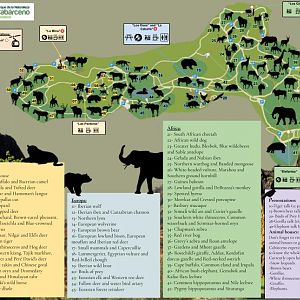
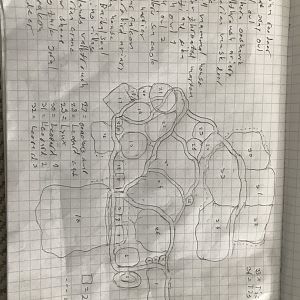
Welcome to a new master plan for the Cabárceno park! As per my Barcelona master plan, I tried to be as realistic as possible when it comes to species and geographic arrangement of buildings and exhibits, but the difference is that I based the Barcelona plans on current ideas the zoo has for its future. I basically picked what I’d do at the park and went with it! I wanted to give it a geographical arrangement, but sadly this has limited the capacity of adding some species I wanted to add (Black rhinos, mountain zebras, and forest buffaloes, mostly), but I really like this result.
I also did this one because I REALLY hate the first Cabárceno map “edit” I posted over here ahahaha. We can for now on pretend it doesn’t exist.
If you want to see the map in better quality this is a link directing you to a Google Drive folder where you can get a PDF of the map in its full glory, click here and enjoy yourself!
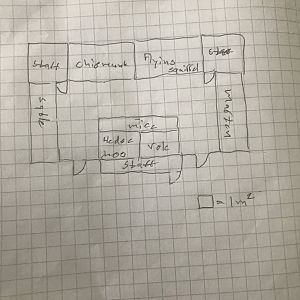
Rio Fuerte beaded lizard (Heloderma horridum exasperatum)
West Indian iguana (Iguana delicatissima)
Right oustide the Reptile house you will be able to locate a small aviary (Current tortoise exhibit). This exhibit houses the following species:
Himalayan monal (Lophophorus impejanus) and Green imperial pigeon (Ducula aenea)
2- South European water buffalo (Bubalus bubalis) and Bactrian camel (Camelus bactrianus)
3- Himalayan red panda (Ailurus fulgens) and Michie’s tufted deer (Elaphodus cephalophus michianus)
4- Indian sloth bear (Melursus ursinus ursinus) and Hanuman langur (Semnopithecus entellus)
5- Siberian pallas cat (Otocolobus manul manul)
6- Snow leopard (Panthera uncia)
Snow leopard house. Indoors housing for both the leopards and pallas cats. Full of educative displays for guests. It will feature a small indoors exhibit for:
15- European brown bear (Ursus arctos arctos)
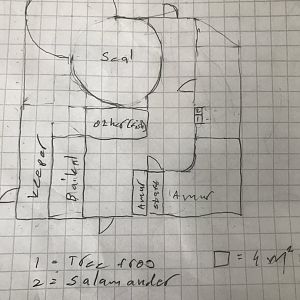
Brown bear house. Large indoor space gives housing to the brown bears. Loads of educative displays for guests on the topic of the history of the brown bear in the Iberian peninsula. This is the place where the bear speech will take place at, where vets and educators will give information on the brown bear while performing vet training behaviours on one of the bears in the enclosure. The house will have some small ponds outdoors giving housing to a bunch of European herptiles as well as a small exhibit:
European pond turtle (Emys orbicularis), European tree frog (Hyla arborea), Alpine newt (Ichthyosaura alpestris) and Marbled newt (Triturus marmoratus)
Eurasian harvest mouse (Micromys minutus)
16- European lowland bison (Bison bonasus bonasus), European mouflon (Ovis orientalis musimon) and Iberian red deer (Cervus elaphus hispanicus)
17- Small mammals and Capercaillie. This row of exhibits is set on the current farm area, with several educative displays throughout the trail. These species inhabit said exhibits:
European mink (Mustela lutreola biedermani)
Western capercaillie (Tetrao urogallus) adn Bohemian waxwing (Bombycilla garrulus)
Eurasian otter (Lutra lutra lutra)
Eurasian beaver (Castor fiber)
European wildcat (Felis silvestris silvestris)
18- Lammergeier (Gypaetus barbatus barbatus), Western Egyptian vulture (Neophron percnopterus percnopterus) and Red-billed chough (Pyrrhocorax pyrrhocorax)
19- Iberian wild boar (Sus scrofa castillianus)
20- Birds of Prey. The birds of prey area will consist of a row of aviaries displaying the animals that would take part in the presentation. Daily a big presentation will take place at the park, but you might be able to catch a training session throughout the day if you are passing by the amphitheater. The species you will be able to spot are the following:
Western European barn owl (Tyto alba alba)
Iberian golden eagle (Aquila chrysaetos homeyeri)
White-tailed sea eagle (Haliaeetus albicilla)
Booted eagle (Hieraaetus pennatus)
Western Eurasian griffon vulture (Gyps fulvus fulvus)
Western Egyptian vulture (Neophron percnopterus percnopterus)
Iberian eagle-owl (Bubo bubo hispanus)
Snowy owl (Bubo scandiacus)
Eurasian great grey owl (Strix nebulosa lapponica)
European white stork (Ciconia ciconia ciconia) and Demoiselle crane (Grus virgo)
Off-show:
Red kite (Milvus milvus milvus)
South European peregrine falcon (Falco peregrinus brookei)
European kestrel (Falco tinnunculus tinnunculus)
Western cattle egret (Bubulcus ibis ibis)
Little egret (Egretta garzetta garzetta)
Iberian raven (Corvus corax hispanus)
43- Eurasian elk (Alces alces alces) and Western roe deer (Capreolus capreolus)
28- Western lowland gorilla (Gorilla gorilla gorilla) and DeBrazza’s monkey (Cercopithecus neglectus)
Gorilla house: Indoor housing for the gorillas and monkeys, with various educative displays for guests. One of these educative displays will consist of “Diane Fossey’s hut” (This display exists in the real park’s gorilla house). This area will have nocturnal lighting and two exhibits:
Gambian giant pouched rat (Cricetomys gambianus)
Garnett's greater galago (Otolemur garnettii)
29- Spotted hyena (Crocuta crocuta)
30- Meerkat (Suricata suricatta) and Crested porcupine (Hystrix cristata)
31- Barbary macaque (Macaca sylvanus)
32- Somali wild ass (Equus africanus somaliensis) and Cuvier’s gazelle (Gazella cuvieri)
33- Southern white rhinoceros (Ceratotherium simum simum), Ellipsen waterbuck (Kobus ellipsiprymnus ellipsiprymnus) and Scimitar-horned oryx (Oryx dammah)
Rhino house. Indoors housing for rhinoceroses and the antelope sharing the paddock. The house will feature diverse displays as well as some terrariums housing the following species:
African rock python (Python sebae)
South African pygmy mouse (Mus minutoides)
Acacia rat (Thallomys paedulcus)
Savanna monitor (Varanus exanthematicus)
34- Chapman’s zebra (Equus quagga chapmani)
35- Red river hog (Potamochoerus porcus)
36- Grevy’s zebra (Equus grevyi) and Roan antelope (Hippotragus equinus)
37- Mhorr gazelle (Nanger dama mhorr)
38- Rothschild’s giraffe (Giraffa camelopardalis rothschildi), Addax (Addax nasomaculatus), Kordofan dorcas gazelle (Gazella dorcas osiris) and Red-necked ostrich (Struthio camelus camelus)
Giraffe house. Indoors housing for all the animals in the paddock as well as the neighboring red river hogs. The house will be visitable by guests and will feature several educative displays. It will feature a medium-sized outdoors aviary featuring the following species:
39- Cape buffalo (Syncerus caffer caffer), Common eland (Tragelaphus oryx) and Common impala (Aepyceros melampus melampus)
40- African bush elephant (Loxodonta africana), Kafue flats lechwe (Kobus leche kafuensis) and Gemsbok (Oryx gazella)
Elephant house. Indoors housing for the park’s elephant herd as well as the antelope sharing the paddock. Guests will be able to visit the house which will feature several educative displays. This is the area where the elephant speech will take place, showcasing some of the vet training behaviors and a speech about captive elephant management that our educators and vets will give. Two small exhibits can be found in the exhibit:
Cape hyrax (Procavia capensis capensis) and Von der Decken’s hornbill (Tockus deckeni)
@JigerofLemuria Hehehe I really wish that was the case too. They should make me the curator of species at the park, I'm sure I would make excellent decisions based upon no personal biases whatsoever.