It is unfortuate that there has been so much confusion over names (both English and scientific) in this group of monkeys, as it causes considerable confusion over what species are in zoos.
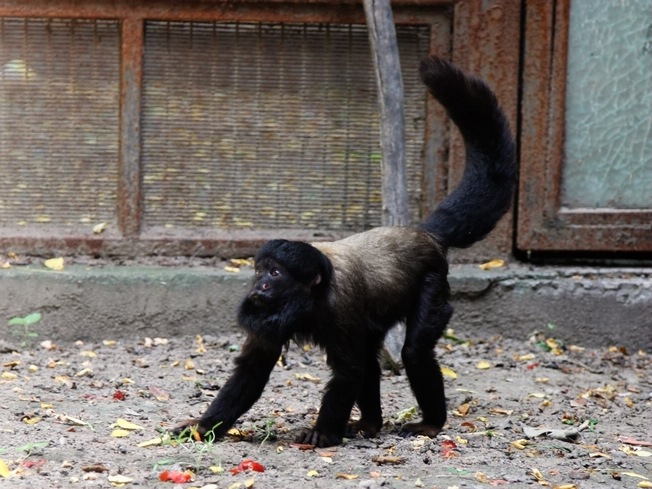
As already pointed out in my comment below the other photo, it is difficult to separate the pale-backed species of bearded sakis from photos. However, it is not a black bearded saki, which has a blackish or dark brown back, as can be seen on the photos in my other post (here and here). So, it is one of the pale-backed species and they are very similar:
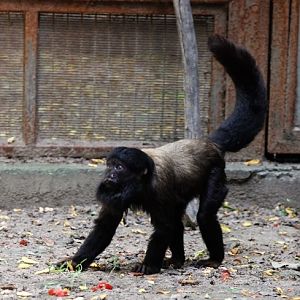
Brown-backed Bearded Saki (aka Rio Negro Bearded Saki): In wild specimens, the back is tawny-olive to buffy-brown. There is a photo of a juvenile here. I am not aware of any photos of adults on the net, so I have attached one. I realize that it isn't the best, but it is better than nothing. This is probably the species least likely to show up in zoos due to its distribution being restricted to very remote regions. It is the only species of bearded saki where I am not aware of *any* in zoos.
Red-backed Bearded Saki (aka Guianan Bearded Saki): In wild specimens, the back is almost orange, ochraceous or pale rufescent. However, as I also mentioned in the other post, I've seen captive specimens that were unusually pale-backed, possibly due to differences in diet or exposure to more light than usual for wild specimens. This include the European and North American specimens that definitely are red-backed bearded sakis because they are from Guianas. Here is a video of a captive in Suriname with a more normal color. Since the Guianan countries are the only in the bearded saki range that regularly allow export of animals and the red-backed bearded saki remains fairly common in the wild, it is the species most likely to be seen outside South America.
Uta Hick's Bearded Saki: In wild specimens, the back is mainly brownish to buff. There are photos here, here, here and here. Just like the black bearded saki and the white-nosed saki, this is an endangered Brazilian endemic and the Brazilian authorities are extremely hesitant when it comes to exporting their wildlife. While all these Brazilian endemics are (or at least were until very recently) kept in Brazilian facilities, the chance of exports are small. 25+ years ago, exports were easier and a small number did leave the country.
In summary, the Beijing animals are unlikely to be black bearded saki, but are one of the species with pale backs. Unfortunately, these pale-backed species are very hard to separate from photos and your best chance is to find out where the zoo got their animals. If they're a relatively recent export, they're probably from the Guianas and red-backed bearded sakis. If they're an earlier export, they could be from Brazil in which case they are most likely Uta Hick's bearded saki. Regardless, they are rather unlikely to be brown-backed bearded sakis (attached photo is that species).
In summary, the Beijing animals are unlikely to be black bearded saki, but are one of the species with pale backs. Unfortunately, these pale-backed species are very hard to separate from photos and your best chance is to find out where the zoo got their animals. If they're a relatively recent export, they're probably from the Guianas and red-backed bearded sakis. If they're an earlier export, they could be from Brazil in which case they are most likely Uta Hick's bearded saki. Regardless, they are rather unlikely to be brown-backed bearded sakis (attached photo is that species).