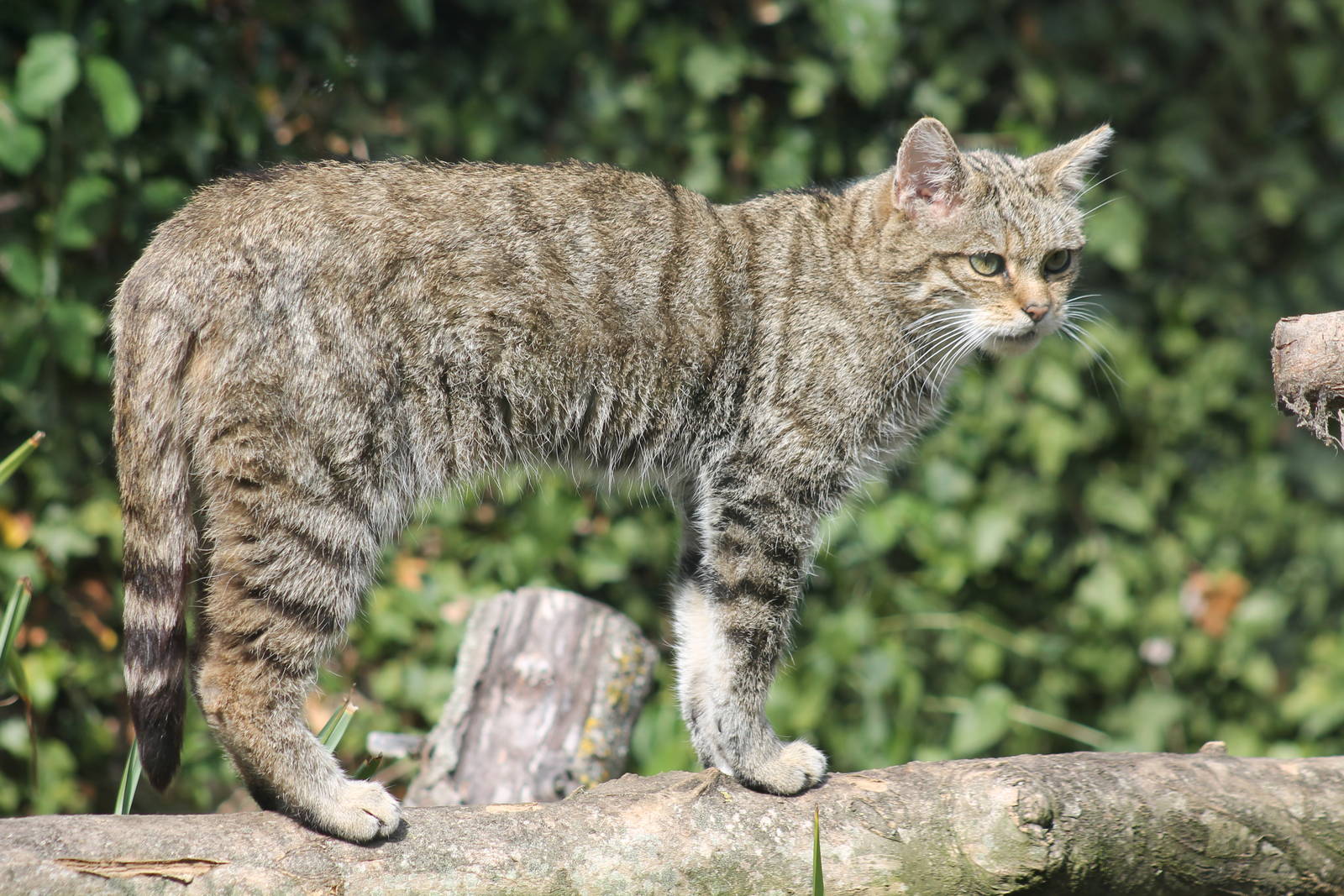
The diagnostic criteria for judging purity in captive populations keep changing, but there are a handful believed to be pure up at HWP and one or two other Scottish collections.
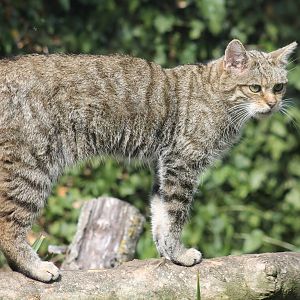
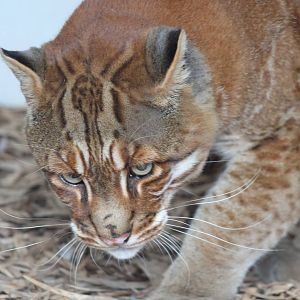
In any case, this individual looks to be a lot more hybridised than most in the UK, which often do look wildcat-like to some extent in the build and tail - the closer an animal is to the domestic strain, the more slender and pointed the tail, so a cat such as the one in the photograph is probably more domestic than wild.
I'm a novice to all this hybrid and pure bred stuff. I've always enjoyed going to zoos and been interested in the cats, but until I found this site and took part in last years challenge I hadn't realised just how many species, sub species, hybrids etc there were. I've now started to take a bit more interest and find it all quiet fascinating.
The species as a whole - Felis silvestris - is found all over Europe, Africa and much of Asia. There is a lot of disagreement as to whether the Scottish Wildcat (F.s.grampia) is a valid subspecies or whether it belongs within the European Wildcat (F.s.silvestris).
If the former, it is endemic to the Scottish Highlands only, having formerly been found throughout Great Britain until the early 20th century - if the latter, it is found throughout Europe, with some populations suffering the same interbreeding problems found in Scotland and some populations remaining largely pure.
Has anybody done any work that validates F.s.grampia? This is something that UK zoos and conservationists really should treat as a priority. If it is valid, then it's likely to merit being dubbed Critically Endangered . If it isn't, then the Scottish animals need to be treated as part of a European programme for the nominate subspecies.
Oh - and I take no pleasure in saying this, but all suspect animals caught in the Highlands need culling. And owners of domestic cats in the area should be given incentives to have their animals neutered.
Has anybody done any work that validates F.s.grampia? This is something that UK zoos and conservationists really should treat as a priority. If it is valid, then it's likely to merit being dubbed Critically Endangered . If it isn't, then the Scottish animals need to be treated as part of a European programme for the nominate subspecies.
Oh - and I take no pleasure in saying this, but all suspect animals caught in the Highlands need culling. And owners of domestic cats in the area should be given incentives to have their animals neutered.
Another is … trap all remaining pure-bred Scottish wild cat and step up the conservation breeding effort in captivity (prior to release in cleared areas .. that is of hybrids and domestics) with these plus the handful purebreds already in captivity.
The latter point is starting to be(come) addressed thanks to John Aspinall Foundation on a small Scottish island off the coast. They have a project to that effect right now.
The species as a whole - Felis silvestris - is found all over Europe, Africa and much of Asia. There is a lot of disagreement as to whether the Scottish Wildcat (F.s.grampia) is a valid subspecies or whether it belongs within the European Wildcat (F.s.silvestris).
If the former, it is endemic to the Scottish Highlands only, having formerly been found throughout Great Britain until the early 20th century - if the latter, it is found throughout Europe, with some populations suffering the same interbreeding problems found in Scotland and some populations remaining largely pure.
I scanned walker's mammals of the world last night and saw the distribution which pretty much follows your info, but it didn't make any real sense of the Scottish wild cat being a sub species.
I would think it very unlikely that, with the small size of our island and the wanderings of the domestic cat, that there can be many pure breads left.
may be they should bring them in from Europe as they did red kites or fish eagles. Of course cats are very difficult to catch and you couldn't be sure of getting each hybrid/ domestic one so the of shore island may be the best option. They could be used as a natural rabbit or rat control too, except they may eat sea birds as well, but so I, have read do fish eagles. "Terns"