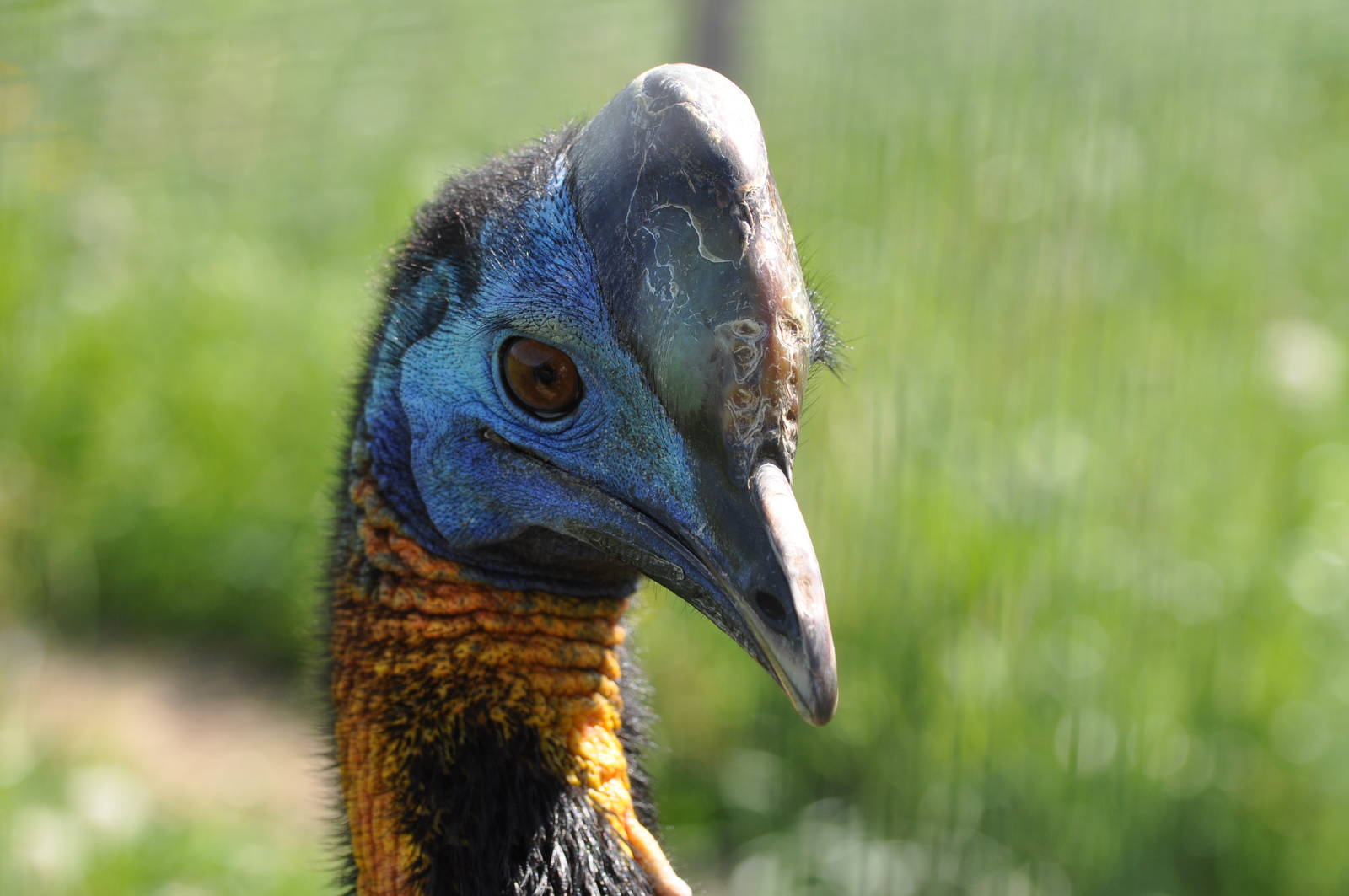
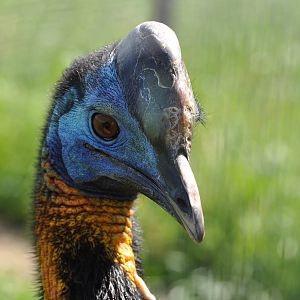
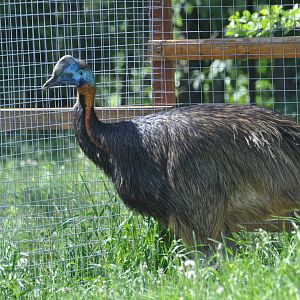
Rather, it is certainly a bird coming from imports from Papua New Guinea or Indonesia. With an area of Europe I know of only one case of breeding this species - in Vogelpark (now Weltvogelpark) Walsrode, in 1980.
Does anyone know a good publication on the identification of cassowary subspecies? I have HBW Vol I. from 1992, "Rarities and Tinamous" by Davies in 2000 (but there are actually only listed subspecies) and reprint "A Monograph of the Genus Casuarius" by Walter Rothschild of 1899.
Congratuations Alexkant on a nice picture, almost a portrait study.
The list of all cassowary subspecies is on my web site Taxonomy of the Genus Casuarius
There are twelve listed subspecies of Casuarius unappendiculatus, but there are a number of problems with accepting these as valid.
The cassowary, of all birds, tends to be very individualistic in the adult form and many of the listed subspecies are probably invalidated because of this. Taxonomy, in the 19th and most of the 20th Centuries, was only based on morphological considerations and the classification often rested on differences in wattle length, helmet size or shape and colour. Anyone who has had cassowaries over several years will testify that even siblings can develop quite individual features.
A second problem in confirming subspecie status is the question of origin. Even today the origin is often given as 'New Guinea' and few birds can be safely traced back to a specific geographical location.
A serious problem with C. unapendiculatus is the fact that it hybridises with C. casuarius in captivity and almost certainly in the wild. It may also hybridise with C. bennetti.
For many years I have been studying the mDNA of cassowaries but the number of samples I have, although illustrating clear differences, is not yet adequate for any definitive statement and samples of nDNA are going to be necessary before anyone can be even reasonably certain. Although technology is developing fast and the price of sequencing is coming down, it will be about another ten years before serious work can be undertaken.
There is a degree of reluctance within the zoo community to sharing information and samples. Since there are less than a dozen C. unappendiculatus in captivity world wide this is very regrettable. The specimen photographed in Israel might be the nominate form C.u. unappendiculatus or C.u. aurantiacus but we will have to wait and see as it grows. Even then, any choice of a subspecies will be very arbitrary.