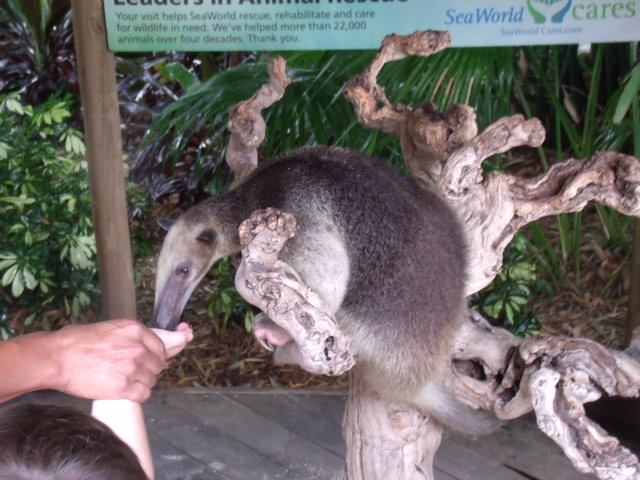
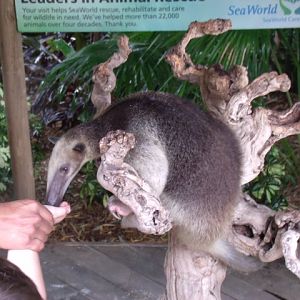
They announced the debut of the female tamandua who is from the Denver Zoo. They mentioned in a few weeks she would be joined by a nine year old male tamandua from Discovery Cove. I also heard that the male has darker coloration than her and is a bit smaller as well. I am not sure how many tamandua Discovery Cove has right now, but if this is a male, I bet it is the 8 year old or maybe his 5 year old son.
They announced the debut of the female tamandua who is from the Denver Zoo. They mentioned in a few weeks she would be joined by a nine year old male tamandua from Discovery Cove. I also heard that the male has darker coloration than her and is a bit smaller as well. I am not sure how many tamandua Discovery Cove has right now, but if this is a male, I bet it is the 8 year old or maybe his 5 year old son.
In that case we have an interesting situation on our hands. This animal is a Tamandua tetradactyla nigra and, officially speaking, the female at Smithsonian is also a T. t. nigra. However, T. t. nigra is likely due for a split with the new ssp being T. t. longicaudata and the female looks to be that. So officially, Smithsonian has two T. t. nigra which they plan to breed but technically they have 1.0 nigra and 0.1 longicaudata which they plan to cross breed.
In that case we have an interesting situation on our hands. This animal is a Tamandua tetradactyla nigra and, officially speaking, the female at Smithsonian is also a T. t. nigra. However, T. t. nigra is likely due for a split with the new ssp being T. t. longicaudata and the female looks to be that. So officially, Smithsonian has two T. t. nigra which they plan to breed but technically they have 1.0 nigra and 0.1 longicaudata which they plan to cross breed.
He's slightly misinterpreted a conversation he had with myself, in which I told him that although both tamandua in question are alleged to be nigra, the female strongly resembles the phenotype of longicaudata, the latter being a long-debated subspecies which is often lumped into the former taxon as a result of their ranges being partially sympatric, although no detailed genetic or morphological research has taken place.
As I have observed individuals belonging to both debated taxa, I said to Thylo that in my opinion further research would quite possibly demonstrate they *do* merit separation from one another, in which case the above problem would arise at the Smithsonian; I suspect Thylo interpreted this as an indication that further research was already underway, which to my knowledge it is not.