DavidBrown

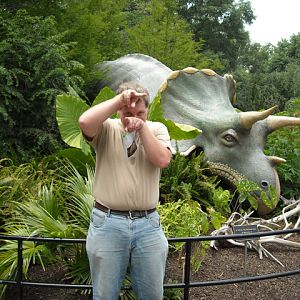
Triceratops and Triceratops impersonator

This life-sized model of a Triceratops was originally in front of the Smithsonian Natural History Museum on the National Mall and now resides at the zoo. It apparently was used in a television adaptation of the book "The Enormous Egg". I'm not sure why it is at the zoo, but it is cool.
 
his name is Uncle Beazley, and this article explains why he is at the zoo: Zoo Art: Uncle Beazley - National Zoo| FONZ
"Uncle Beazley," a fiberglass triceratops, can now be seen near Lemur Island. The life-size statue is named after a dinosaur in the children's book The Enormous Egg, by Oliver Butterworth, and the movie adaptation, in which the statue appeared.

The book, published in 1956, and the 1968 film tell the story of a boy who finds an enormous egg laid by a hen that hatches a baby triceratops. The triceratops, named Uncle Beazley, gets too big, so the boy brings him to the “National Museum” in Washington, D.C. He remains there until he is eventually transferred to the National Zoo’s Elephant House because there is a law against stabling large animals in District.

Louis Paul Jonas created the Zoo's Uncle Beazley statue in 1967 for The Enormous Egg TV special that aired the next year. It was subsequently donated to the Smithsonian by the Sinclair Company.

The Smithsonian's “Uncle Beazley” was initially displayed at the Zoo, then at the Anacostia Neighborhood Museum, and later at the Museum of Natural History. In 1994, it was returned to the Zoo and was displayed in the former rhinoceros yard until 2003, when the yard was renovated for the Zoo’s expanding Asian elephant family.

In 2007, the Zoo and Smithsonian exhibits staff began work to restore the dinosaur. Zoo staff also created a garden exhibit thanks to a gift from a Director’s Circle donor in memory of her parents.

The “dinosaur garden” features plants such as ferns, papyrus, and giant taro whose ancestors existed during the age of the dinosaurs.
 

Media information

Category
ZooChat Members
Added by
DavidBrown
Date added
View count
769
Comment count
2
Rating
0.00 star(s) 0 ratings

Share this media

Back
Top