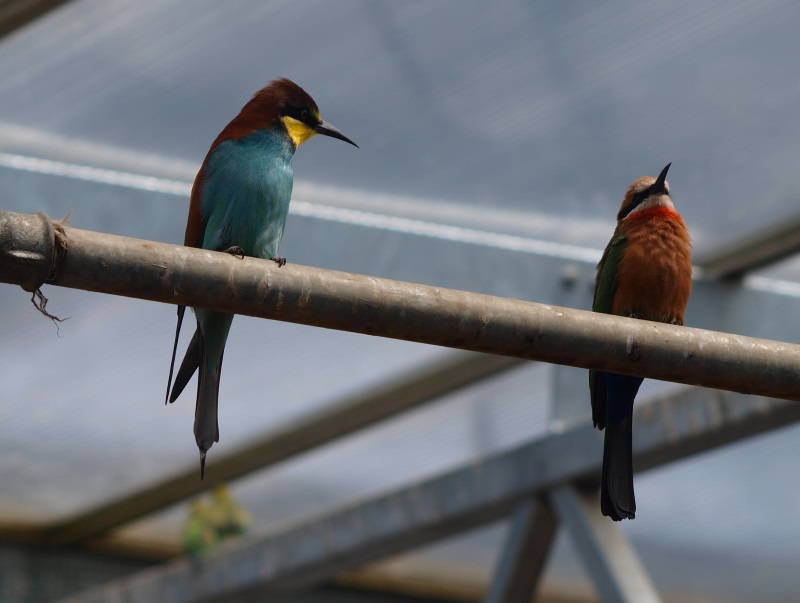
Interesting, I don't think I've seen (or noticed) multiple bee-eater species mixed before. How closely related are the species? Is there a danger of inbreeding?
@Laughing dove, in Africa it is common to see several bee-eater species next to each other in the wild, so I would guess that hybridisation would not be a large problem. Although it would work very well against inbreeding . Diergaarde Blijdorp had a mix of carmine bee-eaters with European bee-eaters for a while, but that did not seem to give any problems in terms of hybridisation.
I've seen multiple species of bee-eaters housed together before, i.e. at the Rotterdam Zoo aviary which is now no longer there. I've never noticed it being any kind of problem, not in terms of competition and not in terms of hybridisation. The bee-eaters at the Olmense Zoo seemed to get along just fine, they stayed in the same area and have nests in the same location. Perhaps bee-eaters are one of those species for which different coloration works to prevent mating (and thus hybridisation).
Also at Wisbroek Breeding Center - the Netherlands several bee-eaters are kept together without problems.
At Walsrode we kept the different species seperated - at least at the end of the 1980-ties.