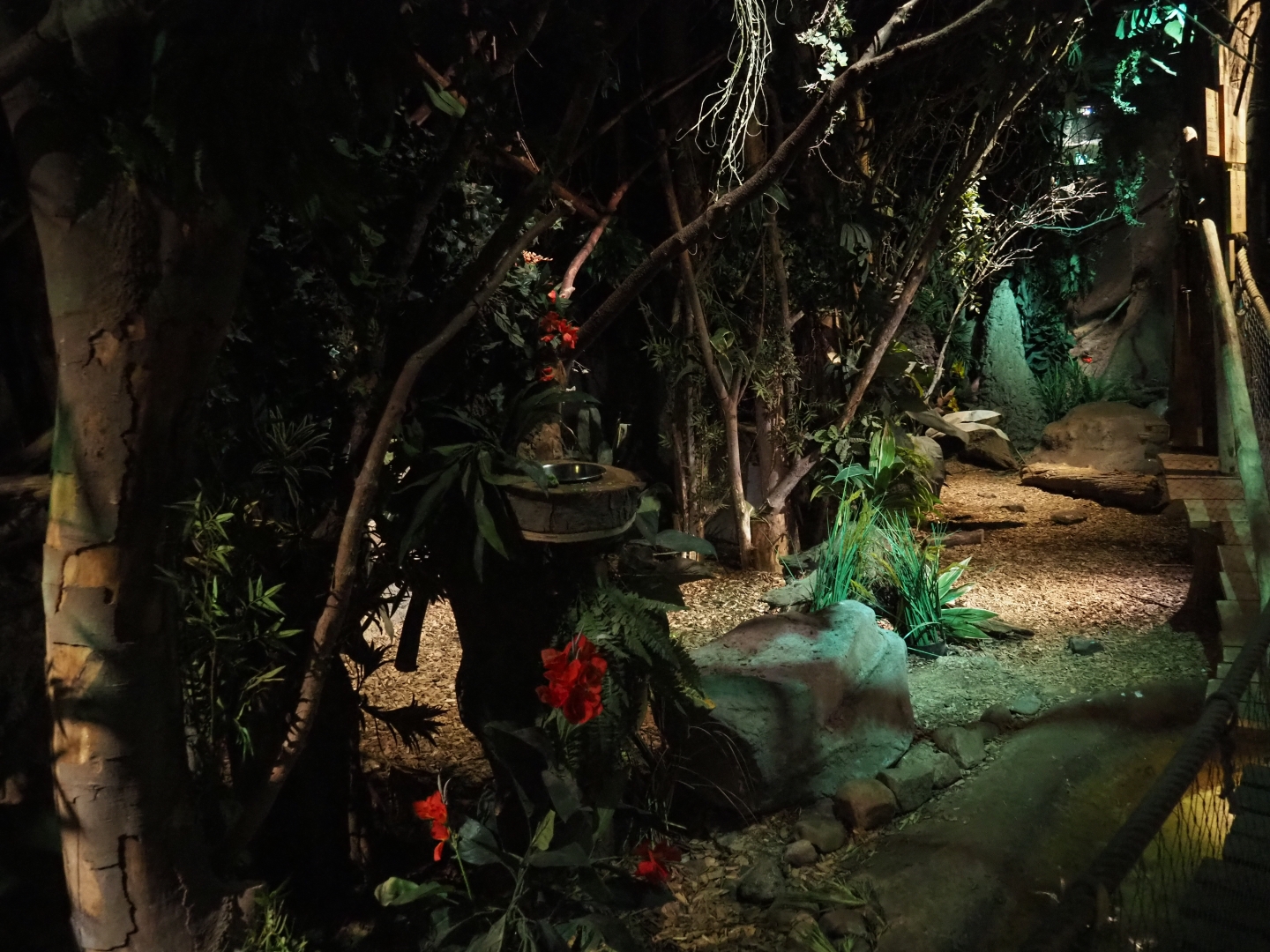
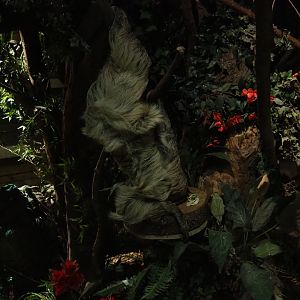
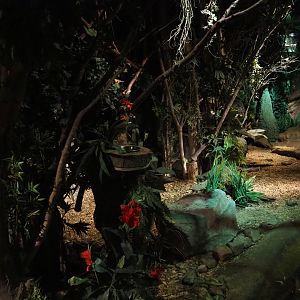
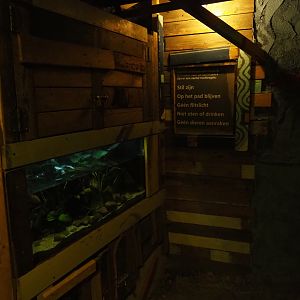
According to information I found on a Facebook page for Dutch zoo enthusiasts, originally "De Nacht" or "The Night" was originally divided into continental sections (Africa and Madagascar, Australia and South America), but because the animals eventually managed to move between the section (which are divided by automatic sliding doors) and intermingle, that idea was abandoned and "De Nacht" now consists of three connection sections of walk-through exhibit with various species as well as a few separate exhibits.
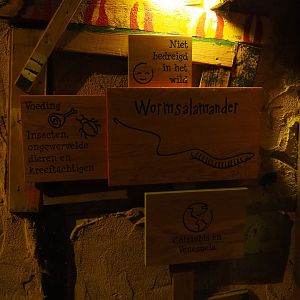
According to the Dutch Facebook page, the signs in the exhibit, my observations during my visit and some earlier research on Zootierliste, the following species are kept free-ranging in "De Nacht" or "The Night":
- Western Woylie or Western brush-tailed bettong (Bettongia penicillata ogilbyi)
- Grey-handed night monkey or Grey-handed douroucouli (Aotus lemurinus griseimembra)
- Linnaeus's two-toed sloth (Choloepus didactylus)
- Long-nosed potoroo (Potorous tridactylus)
- African brush-tailed porcupine (Atherurus africanus)
- Azara's agouti (Dasyprocta azarae)
I also spotted (and will show elsewhere in this gallery) at least one votsotsa or Malagasy giant jumping rat (Hypogeomys antimena) roaming free. The votsotsas were however supposed to be in a separate exhibit with bushbabies (which I will also show elsewhere in this gallery - and I did see at least one more in there) so not such what's going on there.
During my visit I did not see the African brush-tailed porcupines, the woylies or the douroucoulis, the other species I did spot at least briefly.
My new camera, which I bought in June to replace my previous one which broke down in May, is why I was able to make any pictures in "De Nacht" at all - with my old camera I had no chance of getting anything useful in nocturnal houses, but with my current camera it is doable - even if it is still a challenge to get decent, non-blurry shots of animals. But at least I can give it a go now, with a chance of getting some semi-decent results.
At my first visit to "De Nacht" in 2004 it was still divided in continental sections. I will search on my computer if I still have a overview of the setup of that time.
- First hall: "Africa" with greater galago and African brush-tailed porcupine
- Second hall (free ranging): "Australia" with common brushtail possum, sugar glider and brush-tailed bettong
- Second hall (small enclosure): "Madagascar" with grey mouse lemur and lesser hedgehog tenrec
- Second hall (large enclosure): plains viscacha
- Third hall: "South America" with two-toed sloth, big hairy armadillo, red-rumped agouti and night monkey