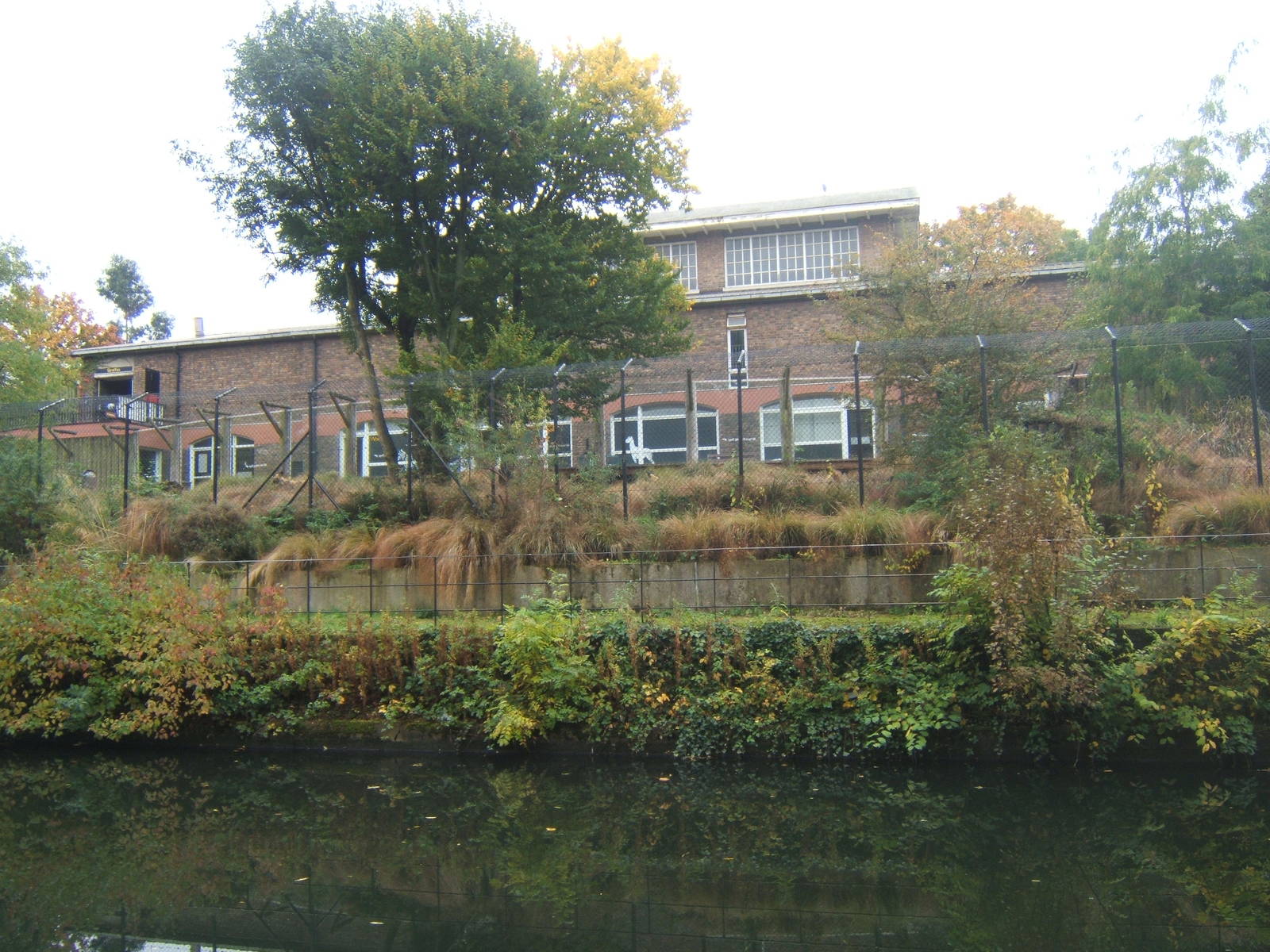
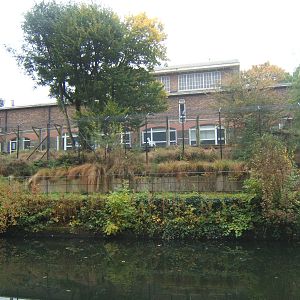
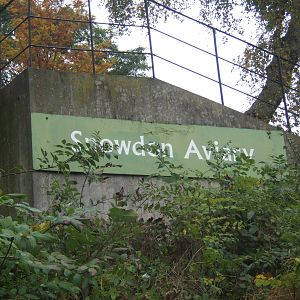
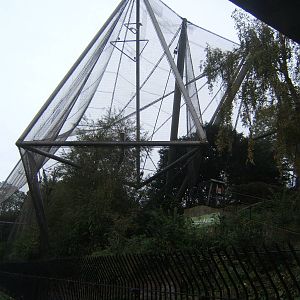
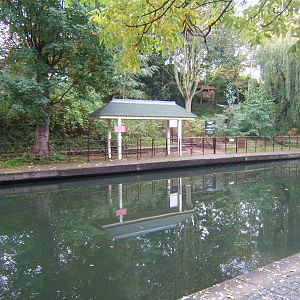
The Cotton Terraces (so called because the capital required was given by a London property tycoon, Jack Cotton) resulted from the re-development of the area surrounding Decimus Burton's 1830s Giraffe House (which was renovated internally), and the terracing of the canal banks below.
The area was in urgent need of attention, since the equid accommodation to the west of the Giraffe House had been destroyed by a bomb in World War II. (Miraculously, no animals were killed, although a Grevy's Zebra stallion escaped, and had to be pursued into Camden Town by a keeper and the then Secretary, Julian Huxley, the latter in his pyjamas. A series of paintings of that escapade exists somewhere (is it at the Tate Gallery?)).
Housing was created for camels and llamas to the East of the Giraffe House, and for wild cattle and equids to the West. The canal bank paddocks were allocated to various deer and antelope.
The Giraffe House itself had two wings added, which it was hoped would in due course hold Okapi and Bongo, both very rare animals in zoos in the early 1960s. Neither were actually obtained until the late 1970s/early 1980s.
This entailed the loss of Hippopotami, which as someone born in 1963 I can never remember at London. The venerable London Lion House came down with the aim of providing a suitable space for their return in 1976, which has not materialised.
The area was in urgent need of attention, since the equid accommodation to the west of the Giraffe House had been destroyed by a bomb in World War II. (Miraculously, no animals were killed, although a Grevy's Zebra stallion escaped, and had to be pursued into Camden Town by a keeper and the then Secretary, Julian Huxley, the latter in his pyjamas. A series of paintings of that escapade exists somewhere (is it at the Tate Gallery?)).
The paintings of the escaped Grevy's zebra - by Carel Weight - are (or at least were) in the Manchester Art Gallery; they have also been displayed at the Imperial War Museum.
This entailed the loss of Hippopotami, which as someone born in 1963 I can never remember at London. The venerable London Lion House came down with the aim of providing a suitable space for their return in 1976, which has not materialised.
At the risk of turning a discussion about historical fact into one about contemporary opinions on London Zoo, it is a fact that at no time in the Zoo's history until 1976 did that large central area sit there with no exhibits in place.
For many years after 1976 - when the money simply wasn't there - it was used as a track for Llama amd pony traps. Even in the aborted 1993 masterplan it was envisaged that the area would be used as an extension to the Elephant paddock, a plan made impossible by the pony and donkey paddock when the Ambika Paul Children's Zoo was opened.
Miraculously, no animals were killed, although a Grevy's Zebra stallion escaped, and had to be pursued into Camden Town by a keeper and the then Secretary, Julian Huxley, the latter in his pyjamas.