JigerofLemuria

Zoo City 1: GC Natural History Museum

Welcome to Zoo City, a city with five distinct zoological collections! In this first entry, we have a place with no living animals, but instead countless priceless biological specimens and a whole lot more; the Grand Conservatory Natural History Museum.
Next up: Grand Conservatory Aquarium.
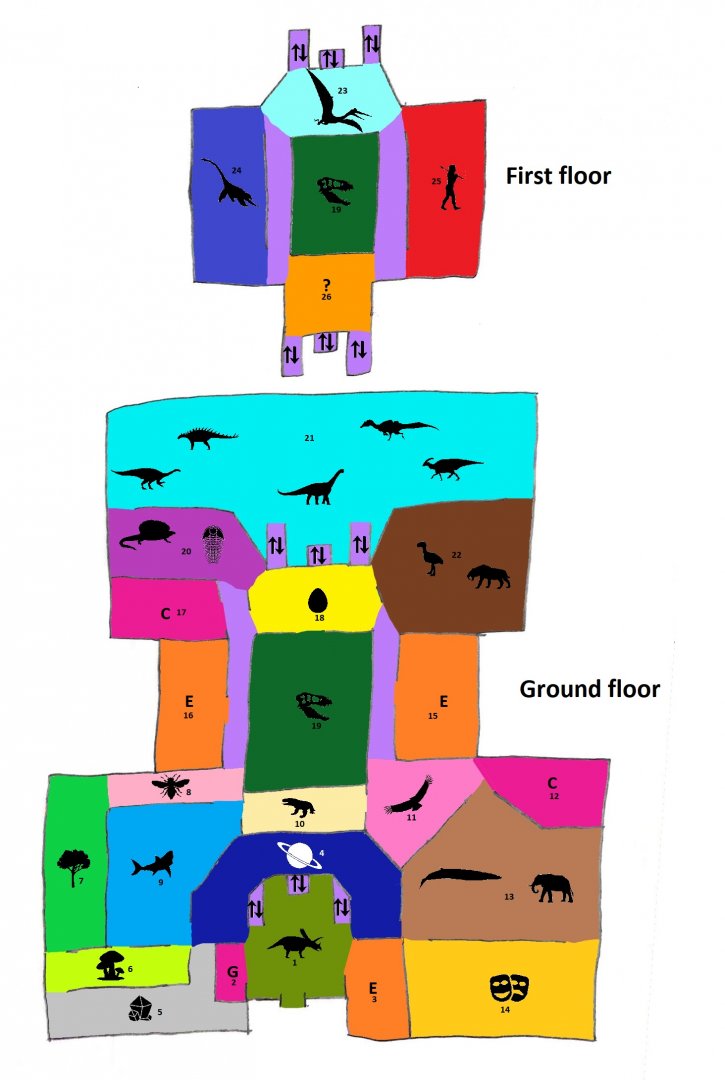
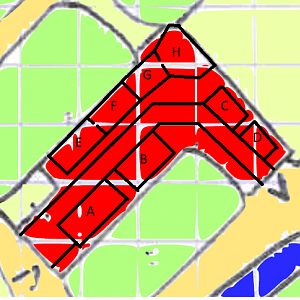
Grand Conservatory Natural History Museum: part of the Grand Conservatory Complex.

First floor:

1- Entrance Hall: the entrance to the free-of-charge museum, with a single mounted skeleton welcoming the guests inside; a Pentaceratops sternbergii
2- Gift store
3- Temporary exhibition space 1
4- Space gallery:
complete with many informative panels and murals, interactive screens, video monitors, planet models and science experiments to educate visitors about outer space.
5- Mineral gallery: many different crystals, metallic ores and rare stones are featured in this gallery.
6- Fungi and bacteria gallery: mostly consists of informative panels and illustrations, but also includes larger models, interactive microscopes and taxidermied mushrooms.
7- Vegetal gallery: many preserved seeds, leaves and other vegetal parts are kept, along with all sorts of informative panels.
8- Invertebrate gallery: Mostly consists of specimens in formaldehyde and taxidermied arthropods, especially butterflies.
9- Fish gallery: Apart from preserved specimens, whether taxidermied or in formaldehyde (including formaldehyde), the centrepiece is a glass pyramid on the ceiling, formed by screens showing a school of anchovies, and around it there are fibreglass models of large bony fish, such as tuna, ocean sunfish and swordfish, and cartilaginous fish, such as requiem sharks and manta rays.
10- Reptiles and amphibians: mostly stuffed and formaldehyde specimens, along with skeletons of large reptiles, and the centrepiece is a fibreglass model of a leatherback sea turtle.
11- Birds: Many stuffed birds and skeletons are featured in this colourful gallery. Many exact fibreglass models of birds will be hanging from the ceiling.
12- Safari Cafeteria
13- Mammal gallery:
inmense gallery with tons of stuffed mammals, along with skeletons. The centrepiece are a stuffed African bush elephant almost touching a suspended fin whale skeleton with its raised trunk.
14- Grand Nature Auditorium: an auditorium with a large screen that can both display documentaries and host talks.
15- Temporary exhibition space 2
16- Temporary exhibition space 3
17- Fossil Fuel cafeteria
18- Palaeo-fun:
a highly interactive zone mostly consisting of science experiments for kids, and some models of dinosaurs, either the whole animal or part of it. The centrepiece would be a Utahraptor ostrommaysi skeleton posed next to a model of the animal in the flesh (and feathers)
19- Paleo Park: a garden with primordial plants from the temperate rainforests of New Zealand surrounding a pebble-filled “digging pit” with two grounded skeletal reconstructions of Camarasaurus lentus and Ceratosaurus nasicornis buried beneath the substrate.
20- Palaeozoic hall: a selection of mounted skeletons and fossils behind glass windows split up into various thematic sub-sections;
Early Palaeozoic:
Models:
Aegirocassis benmoulai
Jaekelopterus rhenaniae
Titanichthys termieri

Fossils:
Burgess shale (stone slab with various fossils)
Orthoceras regulare (full)
Kainops invius (full)
Pteraspis rostrata (body armour)
Nerepisacanthus denisoni (full)
Cooksonia (full)
Acanthostega gunnari (full)
Late Palaeozoic:
Mounts:
Edaphosaurus pogonias
Eryops megacephalus
Lystrosaurus hedini
Anteosaurus magnificus

Fossils:
Arthropleura armata (partial body armour)
Meganeuropsis gigas (full)
Seymouria baylorensis (full)
Procolophon trigoniceps (full)
Estemmenosuchus mirabilis (cranium and horns)
Helicoprion davisii (tooth whorl)
Shuichengoxylon tianii (leaves)
Walchia
(petrified log)

21- Mesozoic hall: a selection of mounted skeletons and fossils behind glass windows split up into various thematic sub-sections;
Triassic Germany:
Mounts:
Plateosaurus engelhardti
Lilliensternus liliensterni
Mastodonsaurus giganteus

Fossils:
Cycad (petrified log)
Mussaurus patagonicus (egg and partial foetal skeleton)
Hyperodapedon gordoni (skull)
Typothorax coccinarum (partial skeleton, body armour)
Teratosaurus suevicus (partial jaws)
Bienotherium yunnanense (partial skull)
Tanystropheus conspicuus (neck vertebrae)
Early Jurassic Arizona and Middle Jurassic Sichuan:
Mounts:
Dilophosaurus wetherilli
Scutellosaurus lawleri
Huayangosaurus taibaii
Xiaosaurus dashanpensis

Fossils:
Barapasaurus tagorei (femur)
Kulindadromeus zabaikalicus (full skeleton)
Fabrosaurus australis (partial lower jaw with teeth)
Magnosaurus nethercombensis (partial tibia)
Omeisaurus junghsiensis (hip bone)
Equisetum (leaves)
Schmeissneria (leaves)
Late Jurassic Tanzania:
Mounts:
Dicraeosaurus hansemanni
Elaphrosaurus bambergi

Fossils:
Hesperosaurus mjosi (back plates, tail spike)
Metriacanthosaurus parkeri (vertebrae, partial jawbone with teeth)
Camarasaurus supremus (skull)
Uteodon aphanoecetes (ribs)
Compsognathus longipes (full skeleton)
Yimaia recurva (leaves)
Juramaia sinensis (partial skeleton)
Giants of the Mesozoic:
Mounts:
Sauroposeidon proteles
Acrocanthosaurus atokensis

Early Cretaceous Laos and Middle Cretaceous Queensland:
Mounts:
Ichthyovenator laosensis
Muttaburrasaurus langdoni
Kunbarrasaurus ieversi

Fossils:
Confuciusornis sanctus (full)
Paralititan stromeri (humerus)
Graciliceratops mongoliensis (partial skeleton)
Morelladon beltrani (vertebrae)
Equijubus normani (teeth)
Therangospodus (single footprint)
Archaefructus (leaves)
Late Cretaceous Alberta:
Mounts:
Parasaurolophus walkeri
Gorgosaurus libratus
Centrosaurus apertus
Euoplocephalus tutus
Stegoceras validum
Chirostenotes pergracilis
Saurornitholestes langstoni

Fossils:
Microraptor zhaoianus (full skeleton)
Titanoceratops ouranos (partial frill)
Hungarosaurus tormai (partial lower jaw with teeth)
Beipiaosaurus inexpectus (arm)
Struthiomimus altus (ribs and hip)
Citipati osmolskae (egg with foetal skeleton)
Brachychampsa montana (body armour)

22- Cenozoic Hall: a selection of mounted skeletons and fossils behind glass windows split up into various thematic sub-sections;
Palaeogene:
Mounts:
Coryphodon eocaenus
Boverisuchus magnifrons
Arsinoitherium zitteli
Dorudon atrox
Moropus elatus
Daeodon shoshonensis

Fossils:
Titanoboa cerrejonensis (vertebrae)
Godinotia neglecta (full)
Eurotamandua joresi (full)
Eohippus angustidens (scrambled full)
Sarkastodon mongoliensis (skull)
Hyracodon medius (ribcage, front legs, vertebrae)
Glyptostrobus europaeus (leaves)
Neogene
Mounts:
Brontornis burmeisteri
Lestodon armatus
Stegodon zdansky
Megantereon vakshensis
Diprotodon optatum
Procoptodon goliah

Fossils:
Teratornis merriami (ribcage, keel)
Aepycamelus alexandrae (vertebrae)
Glyptodon clavipes (body armour)
Proconsul africanus (full)
Aepyornis maximus (egg)
Pachycrocuta brevirostris (skull)
Hippidion principale (foot)
C-4 grass (leaves)

Second floor:
23- Pterosaurs: most of the mounted skeletons fly over both the balcony and the twin escalators, but a couple are grounded.
Mounts:
Hatzegopterx thambena
Dsungaripterus weii
Nyctosaurus gracilis
Anhanguera blittersdorffi
Rhamphorhynchus longicaudus

Fossils:
Eudimorphodon ranzii (head, torso, wings)
Sordes pilosus (full)
Scaphognathus crassirostris (head, torso, wings)
Ctenochasma roemeri (full)
Nemicolopterus crypticus (full)
Iberomesornis romerali (full)
Avisaurus archibaldi (full, scrambled)

24- Marine reptiles: the mounted specimens represent the changing seascape in the Western Interior Seaway, 90 million years ago. Around them there are fossils giving a more general perspective on the Mesozoic's oceans.
Mounts:
Platypterygius americanus
Thalassomedon haningtoni
Brachauchenius lucasi
Xiphactinus audax
Enaliornis barretti

Fossils:
Saurichthys apicalis (Full)
Besanosaurus leptorhynchus (partial; head and upper torso)
Placochelys placodonta (body armour)
Ichthyosaurus communis (full)
Asteroceras stellare (full)
Cryptoclidus eurymerus (flippers, ribs)
Dakosaurus andiniensis (paddle, lower jaw)
Parapuzosia seppenradensis (partial shell)
Cladocyclus gardneri (full)
Platecarpus tympaniticus (Skull)
Cretoxyrhina mantelli (teeth)
Enchodus petrosus (full)
Bonnerichthys gladius (partial body)

25- Human evolution: various displays, including bones, stone and ivory tools, and fibreglass models representing the different evolutionary stages of humanity.
26- The Future: A gallery with informative panels concerning how the Earth may change, due to human intervention or otherwise. The centrepiece is a circular glass screen showing a changing earth, into the past and into the future. Also of note, a section of the gallery dedicated to future animals would include a fuzzy life-sized model of a Night Stalker from Dougal Dixon’s After Man.
 

Media information

Category
Fantasy Zoos
Added by
JigerofLemuria
Date added
View count
1,833
Comment count
3
Rating
0.00 star(s) 0 ratings

Image metadata

Filename
Grand Conservatory Natural History Museum.jpg
File size
305.7 KB
Dimensions
1464px x 2180px

Share this media

Back
Top