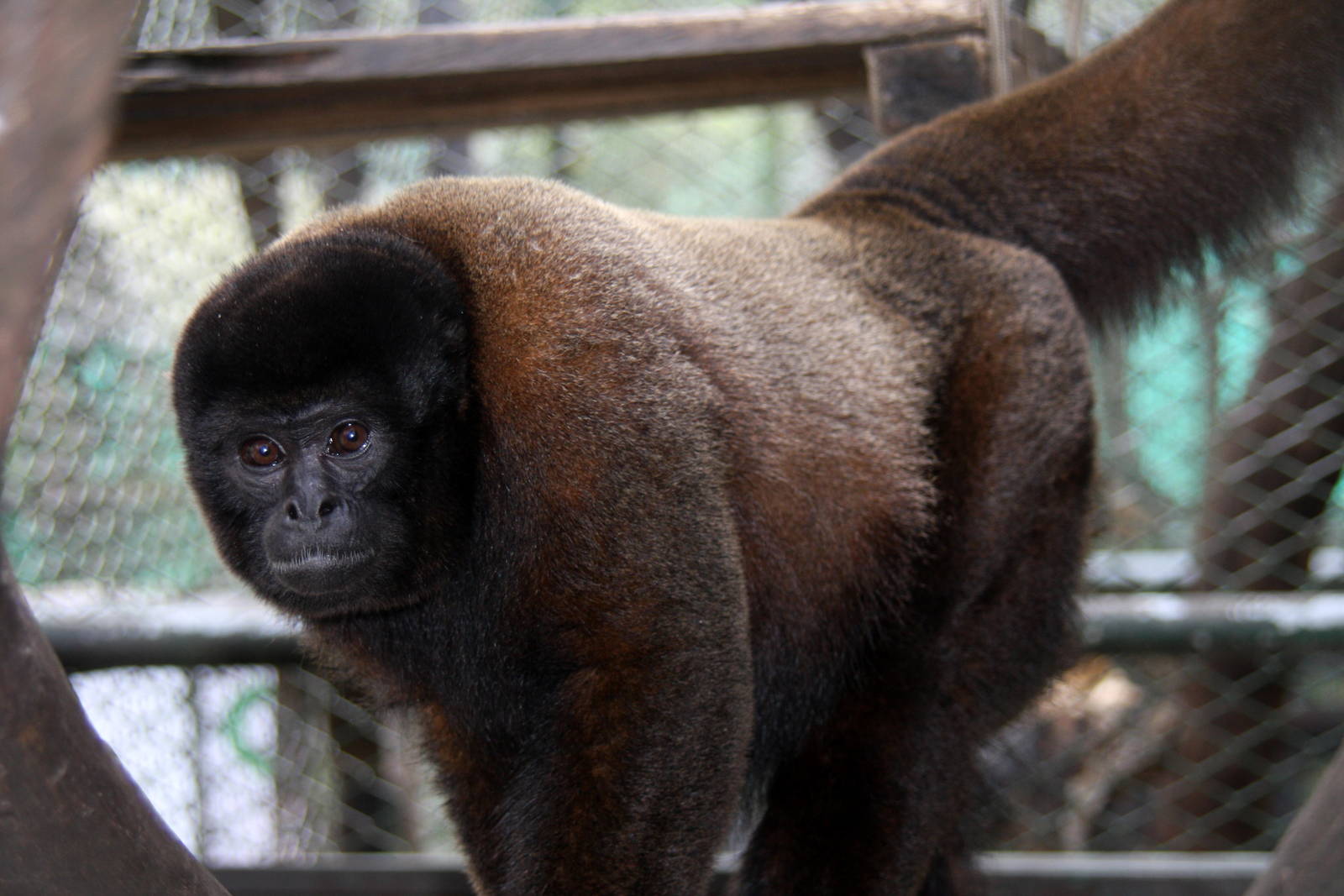
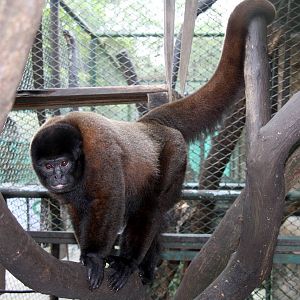
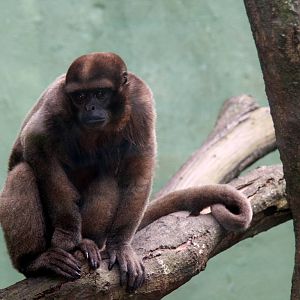
Yes this was the only one they had. I was told it was found in a hotel room. Not sure if there are any others in smaller zoos in South America, but I doubt it. I know I never saw the species listed on ISIS anywhere.
not something you'd normally expect to find in a hotel room.
"Excuse me concierge, there appears to be a monkey in my room."
"I see. What sort of monkey is it sir?"
"Well, it's a yellow-tailed woolly monkey."
"Very good, I'll have the boy see to that immediately sir"
Thanks for posting GE. Why are they called yellow-tailed? I've looked at google images and the tails always seem to be the same brown colour as the rest of the animal?
It seems like there's a slight bit of a yellowish color on the inner part of the final foot or so of the tail. Unfortunately I double checked and none of my photographs show that part of the tail. It was hard to photograph since it was behind wire.
not something you'd normally expect to find in a hotel room.
"Excuse me concierge, there appears to be a monkey in my room."
"I see. What sort of monkey is it sir?"
"Well, it's a yellow-tailed woolly monkey."
"Very good, I'll have the boy see to that immediately sir"
We summarize our re-examination and extension of the Groves (2001) parsimony analysis of Woolly monkeys, genus Lagothrix, which led him to conclude that the species flavicauda is not most closely related to lagotricha but to Ateles, the Spider monkeys. As a consequence, Groves further proposed that the Yellow-tailed woolly monkey should be assigned to a separate genus, Oreonax, previously erected by Oldfield Thomas (1927). Our analysis, while closely following his methods, samples a greater diversity of species and sub-species representing all the living ateline genera and makes minor revisions in Groves’ data matrix of craniodental characteristics. With this broader analysis we show that Groves’ cladistic results cannot be replicated except by duplicating his study using only a restricted range of taxa. A more wide ranging taxonomic sampling fails to link consistently flavicauda and other ateline species, in any particular cladogram topology, while the overall craniodental morphology of flavicauda does not separate it from lagotricha. Groves’ cladistic conclusion is likely to be an artifact stemming from a chance combination of the particular taxa used as a study group and selection of characters that may not be appropriate in intergeneric comparison. There is thus no justification for recognizing Oreonax as a distinct genus, and its usage should be rejected.
It seems like there's a slight bit of a yellowish color on the inner part of the final foot or so of the tail. Unfortunately I double checked and none of my photographs show that part of the tail. It was hard to photograph since it was behind wire.
When I saw your picture I also thought it to be a "normal" Woolly monkey and when I compared it with the photo in your second link I was almost sure these where 2 different species so I guess devilfish could be right. Never the less, a nice picture !