
Review of the GarLyn Zoo Wildlife Park
https://www.garlynzoo.com
This is a privately-owned family zoo situated in Michigan’s Upper Peninsula, specifically a short drive away from Naubinway. It was established in 1994 by a couple who desired to live and start a business in the area. They started out displaying pets such as goats, exotic birds, deer, and more, before acquiring and rescuing larger and more exotic creatures as time went on. The first few years were difficult, practically living paycheck to paycheck to afford to keep the place going, all while battling the frigid Michigan winters. By the third season, things began to look up as the Zoo became more well-known, and the facility hasn’t looked back since, thriving mainly on entrance and gift sales.
GarLyn reminded me in many ways of the DeYoung Family Zoo, which I toured almost a decade ago. Both are in the same geographical location, are family-owned, have similar animal collections, and even some of the same habitat designs. Between the two, I’d pick GarLyn as the more successful facility, for there is a higher level of professionalism and presentation in comparison. To be honest, when looking at it amongst several other zoos I’ve visited, this isn’t saying a whole lot, but with that said, there were some features that still made for an overall charming visit.
Large Mammal Habitats – Of the Zoo’s inhabitants, I’d say the largest ones have the most successful habitats. For the most part, they are a good size and/or take advantage of the surrounding woodlands rather well, giving ample opportunities to display natural behaviors, whether that is clambering over fallen logs or slinking along the dense undergrowth. At the same time, the animals can still get away from the crowds if need be, which shows some good thought went into the design and layout. Sometimes there are visible manmade objects such as enrichment items, feeding stations, or metal troughs for a pool, but overall, these are effective displays that show off the animals in a natural way. The exceptions to these would have to be the camel and warthog pens, which are attached to the “Main Barn” near the front of the Zoo. These dusty enclosures are on the small side for their occupants, along with being minimally detailed. Viewing is a hit-or-miss case, for some habitats are easily seen over railings such as most of the carnivores, or through tall wire fencing for those with up-close encounters like the deer species. There are even a few newly erected windows that look into the tiger and wolf habitats, and there’s apparently more planned down the line. On the other hand, there are some that have tall, thick fencing not just for animal containment, but also on the guest side, making for challenging viewing and photography. Species include African lion, Amur tiger, snow leopard, cougar, gray wolf, coyote, New Guinea singing dog, Syrian brown bear and American black bear mixed together(!), spotted hyena, Sika deer, white-tailed deer, reindeer, Bactrian camel, warthog, and red kangaroo.
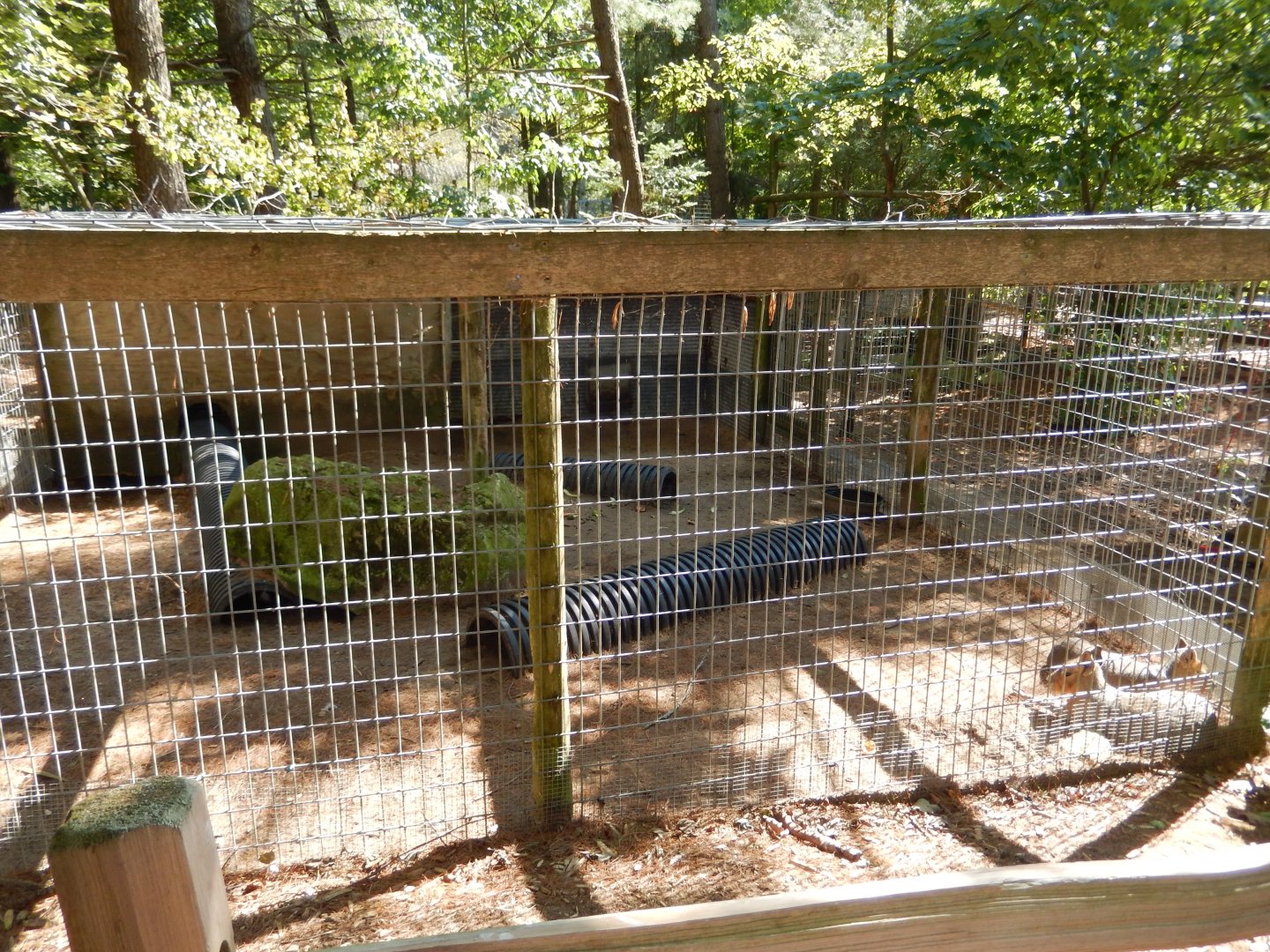
Small Mammal Habitats – On the opposite end of the spectrum, these creatures (which are mainly in the center of the property) have among the least impressive exhibitry found here. There are a couple that stand-out for one reason or another, like the striped skunk habitat (didn’t see) is perhaps the largest and most naturalistic of them all, and a pair of fennec foxes resides in a mid-sized habitat furnished with rocks. Beyond that, the rest of these are not quite as successful. Wood-and-wire cages for American badger (didn’t see), Patagonian mara, and red fox range from being small for the occupants, to having minimal natural elements, to sometimes having awkward viewing. Regarding the last aspect, the fennec fox and mara cages have wiring that drape over the top, and is somewhat low to the ground. Not only does it sometimes limited viewing, but it makes these spaces feel smaller than they really are. And then there’s the two least impressive of the bunch; one is a corn crib cage for coati, which is a tiny environment with very little in the way of furnishings and space. The other is the North American river otter pool, which surprisingly doesn’t take advantage of the surrounding forest or nearby creek. Instead, the four mustelids share a cramped area that is purely cement and stone. Half of the land area is raised, while the lower half contains a shallow pool that is fed via what resembles a stream. Other than some up-close viewing windows being provided, this habitat would benefit from a major expansion and dose of naturalism.
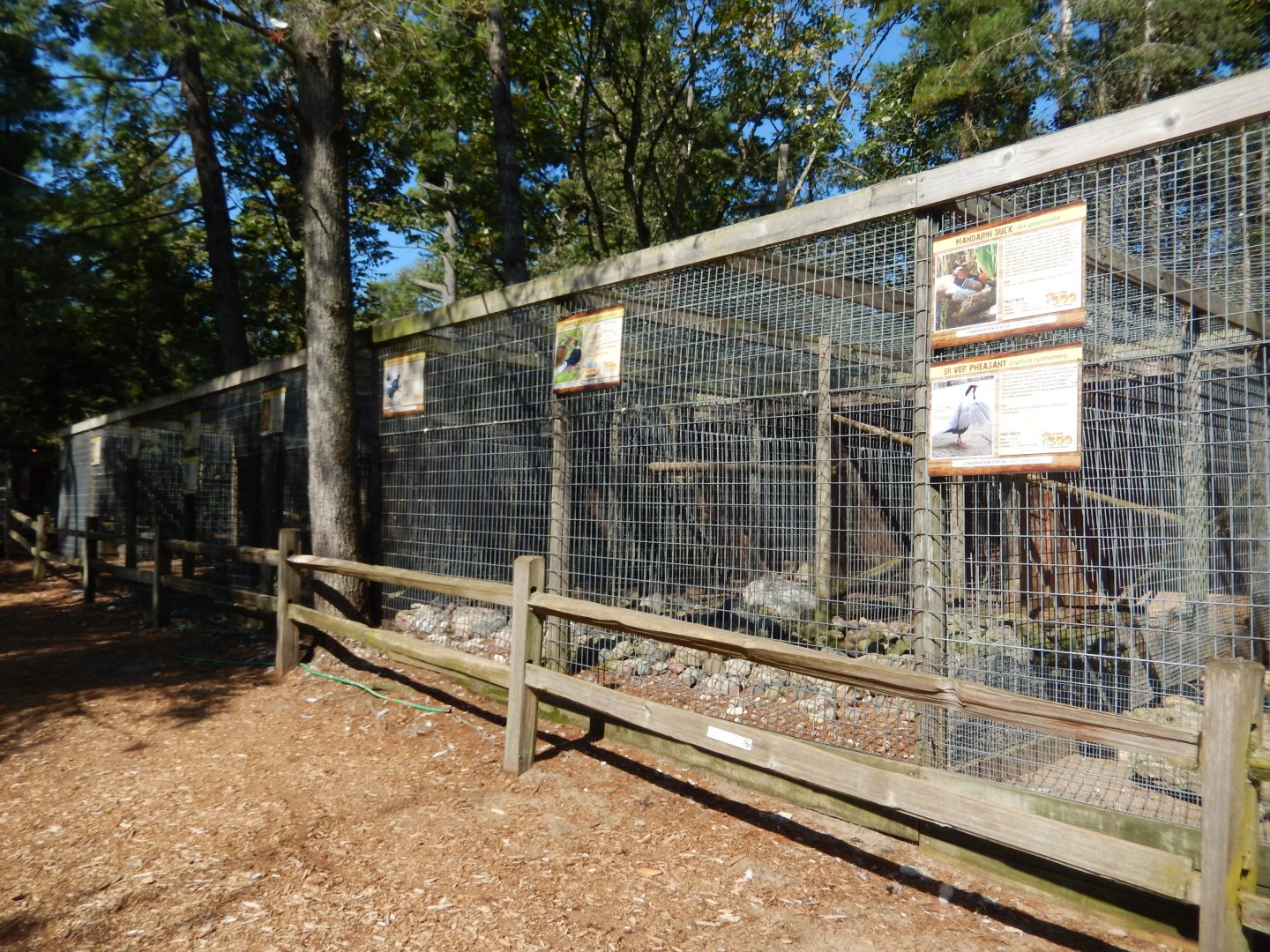
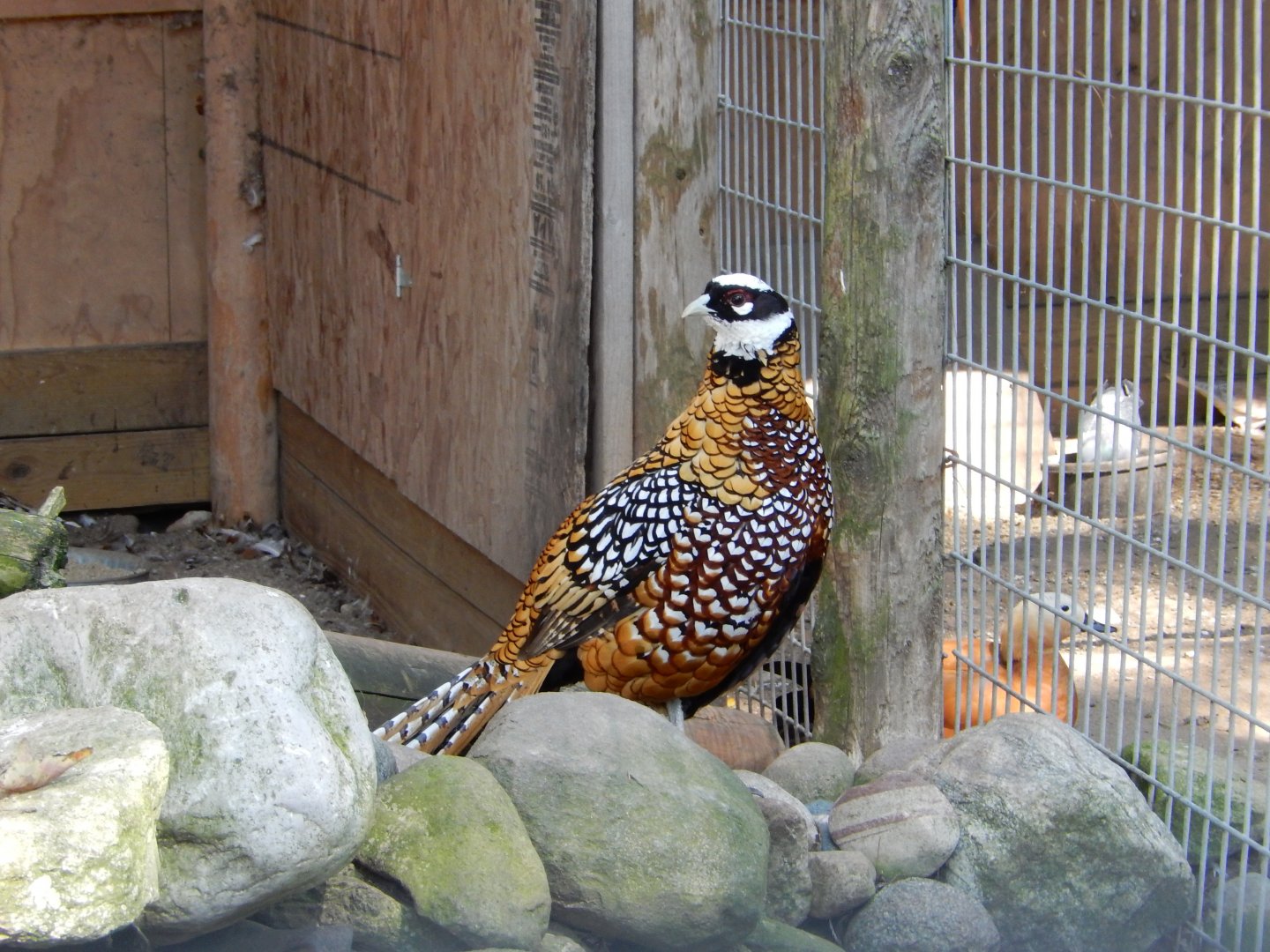
Bird Habitats – GarLyn’s feathered denizens can be found all around the establishment. In fact, before paying my admission ticket, I was greeted by the squawking, cawing, and cackling of colorful birds (both physically and personality wise)! Not only are there tons of peafowl and chickens roaming the Zoo grounds, but simple cages for cockatoo, Amazon parrot, and macaw are present on the porch as guests arrive. Moving beyond that, there are more generic metal cages scattered throughout the Zoo for species like laughing kookaburra, white-cheeked turaco, keel-billed toucan, blue-and-gold macaw, and a wide variety of finches, doves, and pigeons. Next to the sika deer, guests can enter a walkthrough aviary, dodging multi-colored budgies as they divebomb all over the place. The aviary was closed during my visit, but I could also see a pool while peering through the mesh. Next to the camels, there was a pair of ostriches hanging out next to the wire fencing that surrounds their sandy pen, while up the hill is a spacious emu paddock situated between the cattle and reindeer. The two most notable bird displays are on the north side of the property. First, there is a pheasantry nestled between the otters and coati; these aviaries all look very similar with a narrow amount of space, dusty substrate, some perching, and a rock stream that flows from one end of the structure to the other. What makes this area stand out is the array of birds on display – several pheasant species (including Reeve’s, golden, impeyan, Lady Amherst’s, silver, Swinhoe’s, and blue-eared) and a couple types of duck (mandarin and ruddy shelduck) all make their home here - I don’t remember for sure, but I wouldn’t be surprised if at least one of these pheasant species was a life tick for me. The second is across from the white-tailed deer, and is essentially a fenced-in slice of woodland pond containing several waterfowl from black swan and ducks, to an assortment of geese (like barnacle and Magellan). Like most of the large mammal habitats, this display is quite effective just for utilizing the surrounding environment.
Domestics – Most of these animals are in a central location of the facility. Attached to the “Main Barn” are dusty pens for goats and pot-bellied pigs; the former has a feeding area and a couple of structures to leap and bound around on, but other than that these are rather run-of-the-mill. Across the path, Scottish highland cattle and yak (including a calf) share an average-sized paddock that slopes to one side. Lastly, there is dirt-filled pit home to a few rabbits that provides some up-close viewing and a few shelters dedicated to each individual lagomorph.
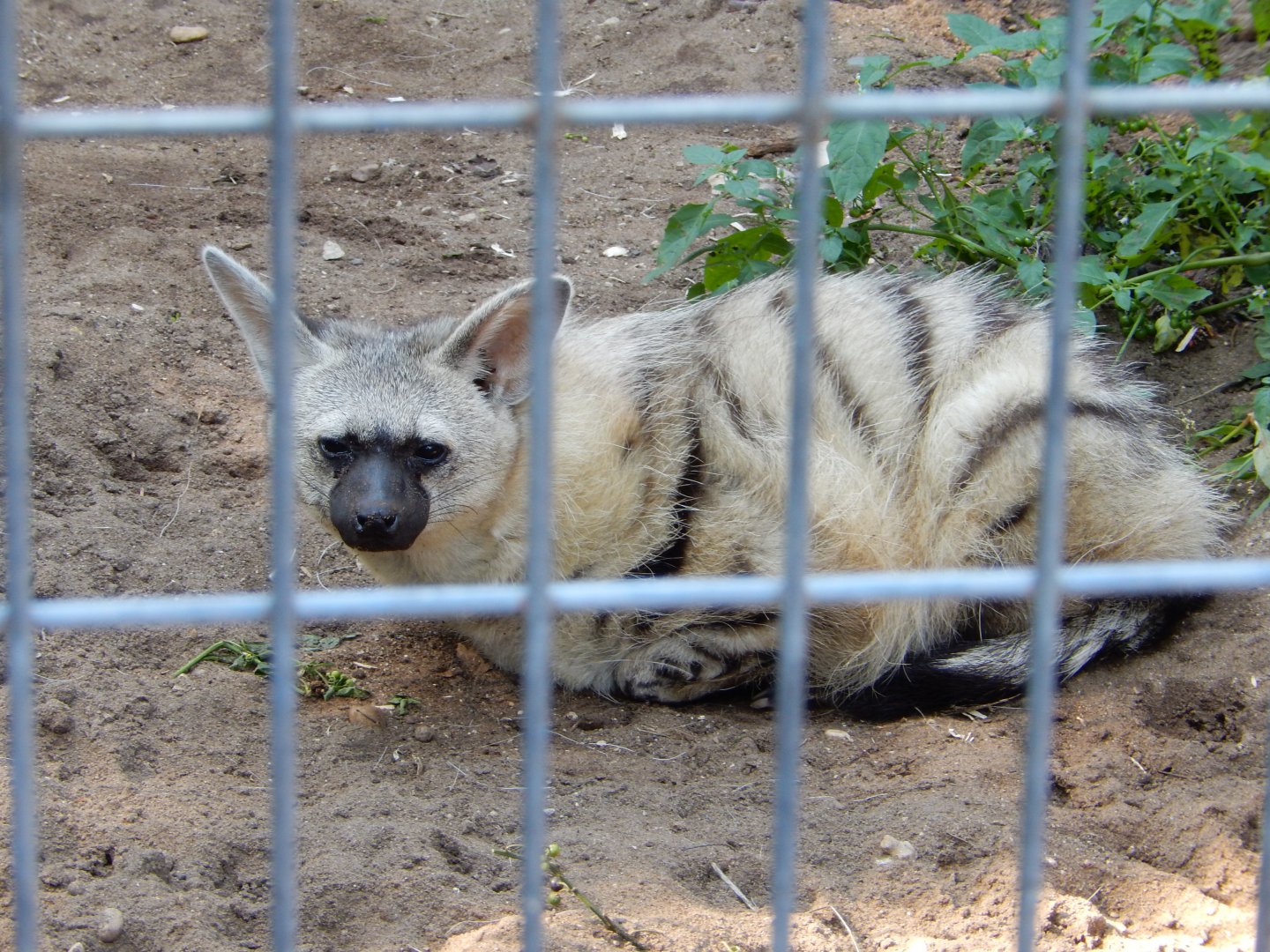
Tropical Building – This is not just the sole dedicated complex at GarLyn, but also a treasure trove of rarities for guests! While there is close to nothing to reflect on the “tropical” name of this structure, there were a couple notable surprises within. To start off is a row of wood-and-wire cages attached to the building; these are mostly the same design with a few ropes or other forms of climbing apparatus, a grassy or dirt substrate, and rather tiny size. The exception to this is the American alligator habitat, which has a small grassy space with a shallow pond to cool off in. The other residents are ring-tailed lemur, squirrel monkey, black-and-white ruffed lemur, binturong, and aardwolf (what a treat! ). Heading indoors, one will come across the holding rooms for these species, along with the surprise addition of a few African spurred tortoises roaming the dividing area between the habitats and guest barriers. Also on this side of the structure is a spacious all-indoor room that six-banded armadillo and two-toed sloth share. All of these displays are pretty basic with little more than shaving substrate, shelters, heaters, and bonus features to cater to specific animals, like branches for the climbers, and another shallow gator pool. Other than the sloth/armadillo combo, they are all small for their occupants. Things pick up a little on the other side of the building, with a number of terrariums that had more naturalistic details, some being decently-sized for their occupants, and even a few species mixes. While not comparable to most major zoos, there is a bit of effort to make these more presentable in comparison to other private/family-owned zoos. Here’s a sampling of what’s on offer: Indian mudskipper (a first for me)/fiddler crab (didn’t see), Gila monster, bearded dragon, blue-tongued skink, ball python, Argentine black-and-white tegu, common marmoset, green iguana, and poison dart frogs. Most unexpected, and possibly the highlight of the building for me, was a pair of nocturnal habitats on each side of the room. A colony of Egyptian fruit bats was fluttering around in one darkened room, while a spotted genet briefly made an appearance before retreating into a shelter in its own habitat. Again, tough to compete with some others of their kind, but kudos to going the extra mile. Lastly, while not part of the complex, there is a nearby turtle pond that was quite large and pretty to look at for species like common snapping, red-eared slider, and painted.
Being adjacent to the shores of Lake Michigan certainly has its benefits, especially for this establishment. The Zoo is set in a very pretty coniferous forest, where guests are engulfed in shade for the entire tour. The pathways consist of wide woodchip trails that add to the scenic walks, with few elevation changes to deal with. Likely due to how the forest is laid out (there is a creek that runs through part of it for instance), the Zoo is laid out in two dead-end trails, each jutting out from the “Main Barn,” the Zoo’s largest and primary animal containment, in the property’s center. While this would normally be seen as excessive backtracking, GarLyn is able to get away with it a bit thanks to its smaller size. One final aspect that shouldn’t go unmentioned is the homemade feel of the Zoo, and it’s a mixed affair. Sometimes it works to its advantage, such as the wooden guest barriers that blend in nicely with the woods. However, there are as many times where it can look more amateur such as the minimal details in the Tropical Building. Moving onto guest amenities, there isn’t a whole lot due to the Zoo’s small size, which isn’t exactly a bad thing. Before parking in the gravel lot, visitors are greeted by a large bear statue accompanied by the Zoo’s logo and a scenic waterfall setting – it’s actually pretty impressive for a homemade facility such as this! Guests enter and exit via the gift shop, which is a standard wooden structure fronted by an African style totem pole. The Zoo’s only set of restrooms are adjacent, along with a picnic area. Beyond the bare necessities, the only additional attractions are a gem mining station next to the rabbits, and the ability to purchase food to feed the two deer species or the bears. I purchased apples for the bears, and it was neat to see them get in a dispute between the fruit!
HIGHLIGHT OF THE DAY: My visit was “gone to the dogs!” It was a joy to watch the fennec foxes as they bounded throughout their habitat the whole time I was present. There was an instance where one fox stopped in front of the fencing, making for a neat close encounter. Nearby, the New Guinea singing dogs were also drawing some attention. It’s cool enough to see this rarely displayed canine species, but to see them active and howling up close was a sweet bonus. They did this for the first half of my visit, with one dog mainly hanging out on the rock formation towards the back, and the other patrolling up front.
OVERALL: The GarLyn Zoo Wildlife Park is in my eyes the epitome of a homemade family-owned zoo. There is a mostly simplistic approach to its habitat design, the animal collection has mainly familiar faces, the visitor amenities range from non-existent to basic…and yet, in a bizarre way, there was something about that I couldn’t help but find a little charming. Maybe it’s because I’ve seen very few facilities of this type, but I’ll give it credit that there was a little more effort put into making the Zoo a bit more presentable amongst its kin. The exhibitry, while hit-or-miss overall, has a couple surprises up its sleeve whether it’s those that utilize the landscape or the Tropical Building’s nocturnal spaces; there are a few rarities within its group of wildlife (aardwolf, spotted genet, New Guinea singing dog, some pheasants), and the property is gorgeous. My recommendation would be for those that wish to stretch their legs for a couple hours as they’re driving to/from the UP; other than that, I wouldn’t quite say it’s worth going out of the way for - unless you want to see the rarities of course. I won’t deny it has its elements that hold it back compared to the majority of the zoos I’ve visited, but I was pleasantly surprised to find it a bit better than I anticipated – likely in the middle of the pack of family-owned zoos I’ve come across.
According to the donation box in the gift shop, there’s a long line of future projects for GarLyn. These include windows into some of the habitats (much needed!) and bringing in new species like tamandua and clouded leopard.
https://www.garlynzoo.com
This is a privately-owned family zoo situated in Michigan’s Upper Peninsula, specifically a short drive away from Naubinway. It was established in 1994 by a couple who desired to live and start a business in the area. They started out displaying pets such as goats, exotic birds, deer, and more, before acquiring and rescuing larger and more exotic creatures as time went on. The first few years were difficult, practically living paycheck to paycheck to afford to keep the place going, all while battling the frigid Michigan winters. By the third season, things began to look up as the Zoo became more well-known, and the facility hasn’t looked back since, thriving mainly on entrance and gift sales.
GarLyn reminded me in many ways of the DeYoung Family Zoo, which I toured almost a decade ago. Both are in the same geographical location, are family-owned, have similar animal collections, and even some of the same habitat designs. Between the two, I’d pick GarLyn as the more successful facility, for there is a higher level of professionalism and presentation in comparison. To be honest, when looking at it amongst several other zoos I’ve visited, this isn’t saying a whole lot, but with that said, there were some features that still made for an overall charming visit.
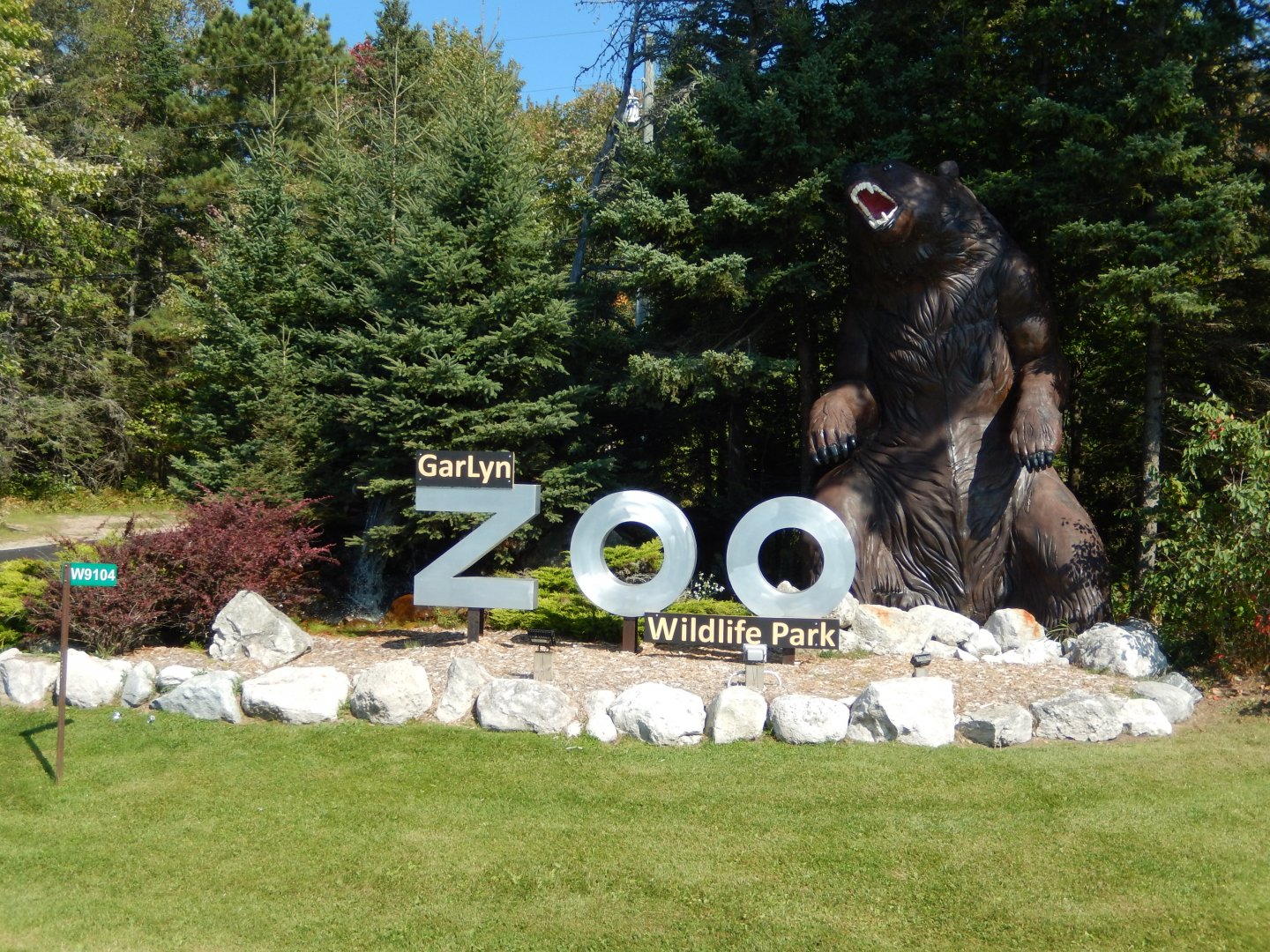
9/15/2025 - Zoo Entrance - Impressive!
This welcome wagon was a rather pleasant surprise, for I didn't expect such a grand first...
Animal Habitat Complexes
Large Mammal Habitats – Of the Zoo’s inhabitants, I’d say the largest ones have the most successful habitats.
For the most part, they are a good size and/or take advantage of the surrounding woodlands rather well, giving ample opportunities to display natural behaviors, whether that is clambering over fallen logs or slinking along the dense undergrowth. At the same time, the animals can still get away from the crowds if need be, which shows some good thought went into the design and layout. Sometimes there are visible manmade objects such as enrichment items, feeding stations, or metal troughs for a pool, but overall, these are effective displays that show off the animals in a natural way. The exceptions to these would have to be the camel and warthog pens, which are attached to the “Main Barn” near the front of the Zoo. These dusty enclosures are on the small side for their occupants, along with being minimally detailed. Viewing is a hit-or-miss case, for some habitats are easily seen over railings such as most of the carnivores, or through tall wire fencing for those with up-close encounters like the deer species. There are even a few newly erected windows that look into the tiger and wolf habitats, and there’s apparently more planned down the line. On the other hand, there are some that have tall, thick fencing not just for animal containment, but also on the guest side, making for challenging viewing and photography. Species include African lion, Amur tiger, snow leopard, cougar, gray wolf, coyote, New Guinea singing dog, Syrian brown bear and American black bear mixed together(!), spotted hyena, Sika deer, white-tailed deer, reindeer, Bactrian camel, warthog, and red kangaroo.
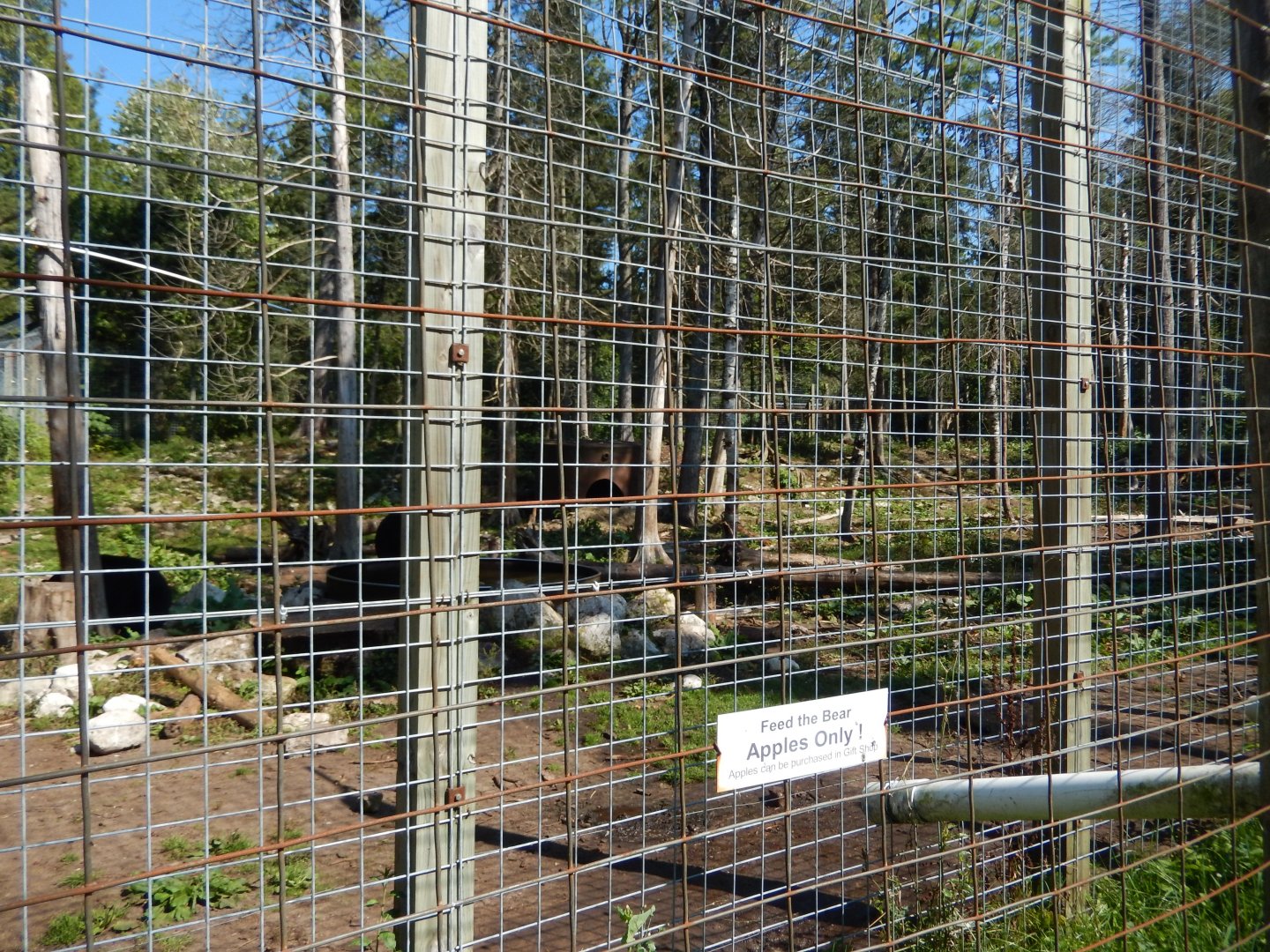
9/15/2025 - American Black & Syrian Brown Bear Habitat
Notice the tube for feeding apples to the bears.
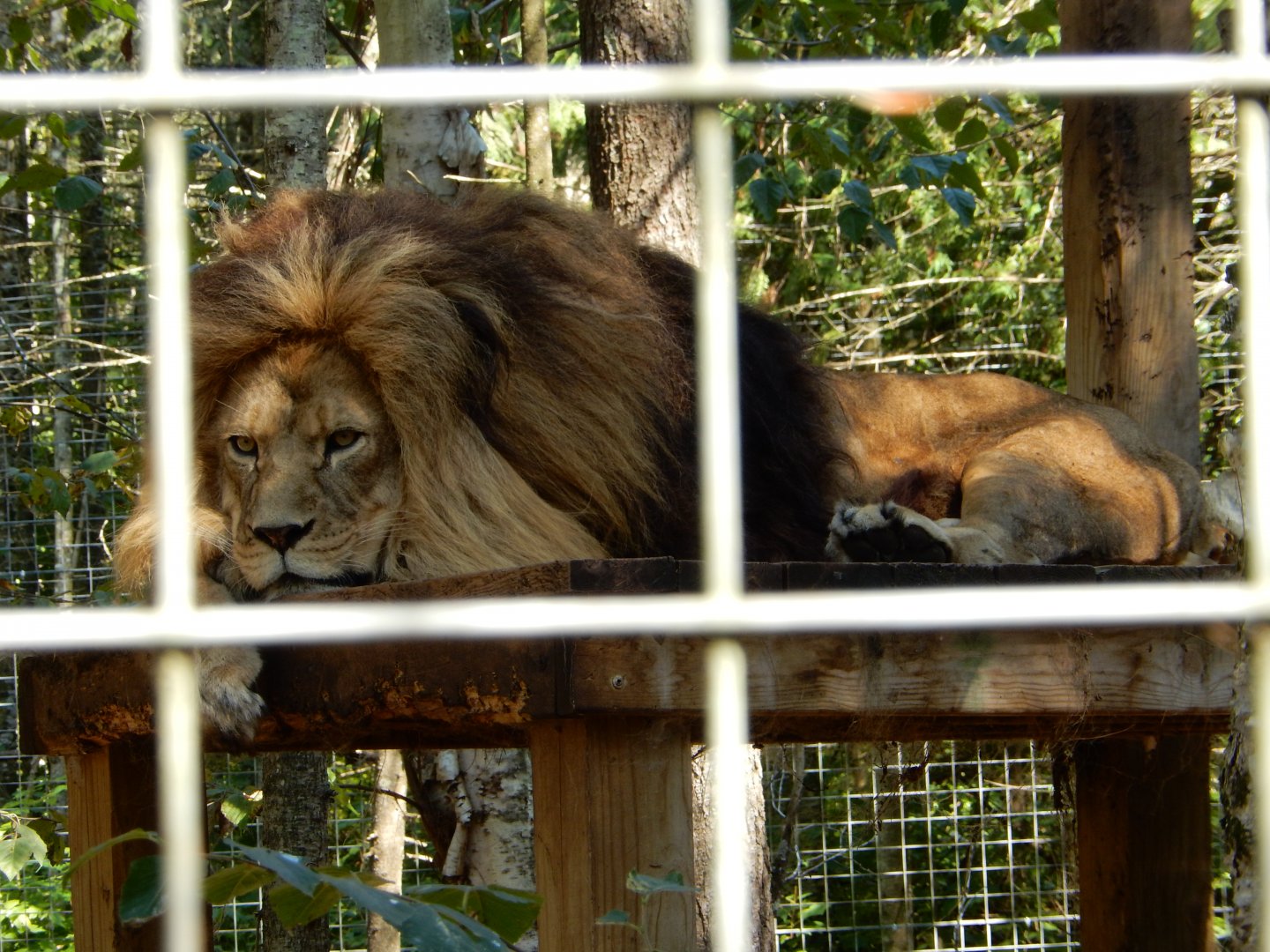
9/15/2025 - The King of GarLyn Zoo Wildlife Park
Vern is the name of this majestic lion.
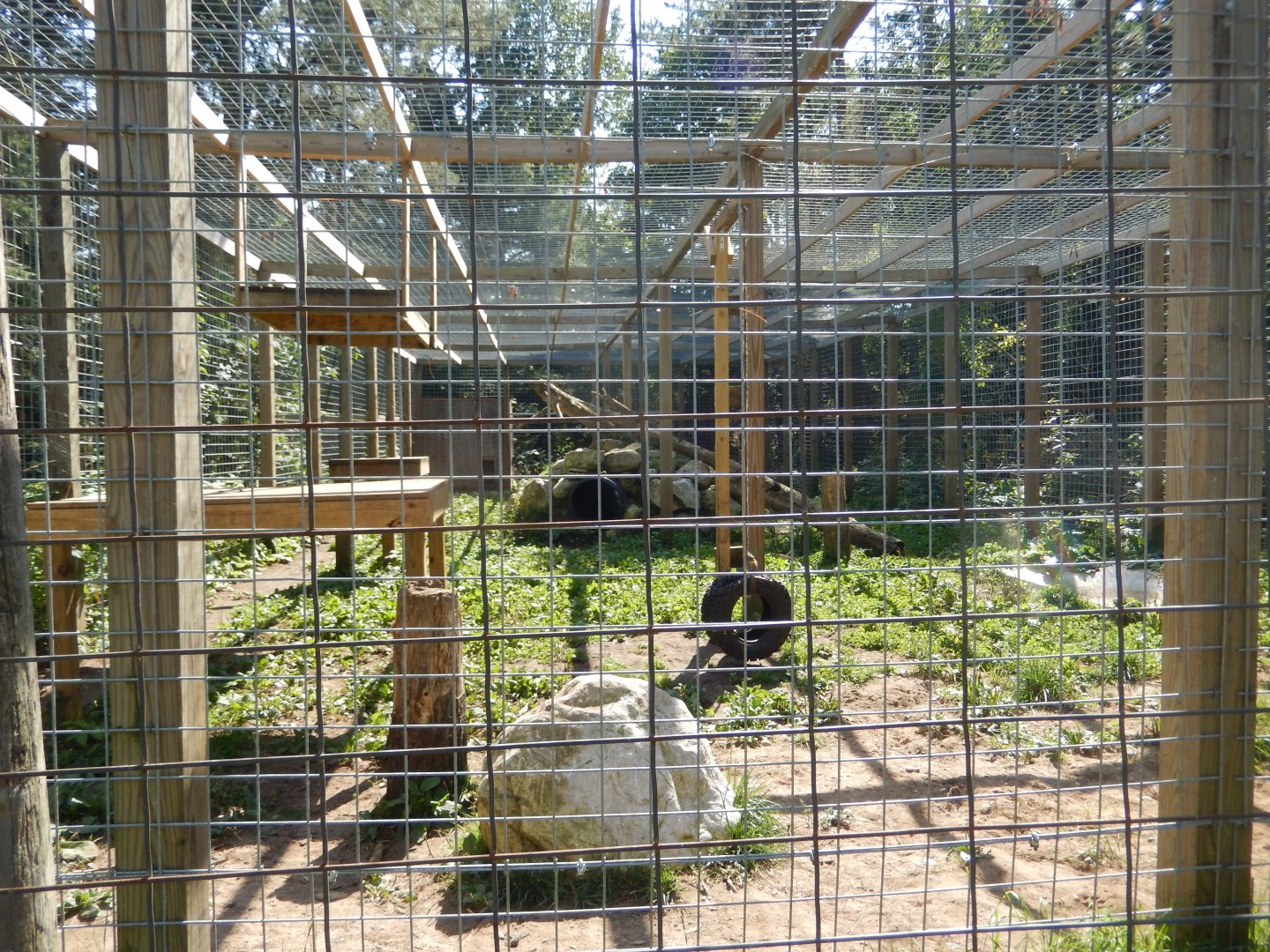
9/15/2025 - Snow Leopard Cage
One of the newer habitats to open at the Zoo; it debuted in the early 2020's.
Small Mammal Habitats – On the opposite end of the spectrum, these creatures (which are mainly in the center of the property) have among the least impressive exhibitry found here. There are a couple that stand-out for one reason or another, like the striped skunk habitat (didn’t see) is perhaps the largest and most naturalistic of them all, and a pair of fennec foxes resides in a mid-sized habitat furnished with rocks. Beyond that, the rest of these are not quite as successful. Wood-and-wire cages for American badger (didn’t see), Patagonian mara, and red fox range from being small for the occupants, to having minimal natural elements, to sometimes having awkward viewing. Regarding the last aspect, the fennec fox and mara cages have wiring that drape over the top, and is somewhat low to the ground. Not only does it sometimes limited viewing, but it makes these spaces feel smaller than they really are. And then there’s the two least impressive of the bunch; one is a corn crib cage for coati, which is a tiny environment with very little in the way of furnishings and space. The other is the North American river otter pool, which surprisingly doesn’t take advantage of the surrounding forest or nearby creek. Instead, the four mustelids share a cramped area that is purely cement and stone. Half of the land area is raised, while the lower half contains a shallow pool that is fed via what resembles a stream. Other than some up-close viewing windows being provided, this habitat would benefit from a major expansion and dose of naturalism.
Bird Habitats – GarLyn’s feathered denizens can be found all around the establishment. In fact, before paying my admission ticket, I was greeted by the squawking, cawing, and cackling of colorful birds (both physically and personality wise)! Not only are there tons of peafowl and chickens roaming the Zoo grounds, but simple cages for cockatoo, Amazon parrot, and macaw are present on the porch as guests arrive. Moving beyond that, there are more generic metal cages scattered throughout the Zoo for species like laughing kookaburra, white-cheeked turaco, keel-billed toucan, blue-and-gold macaw, and a wide variety of finches, doves, and pigeons. Next to the sika deer, guests can enter a walkthrough aviary, dodging multi-colored budgies as they divebomb all over the place. The aviary was closed during my visit, but I could also see a pool while peering through the mesh. Next to the camels, there was a pair of ostriches hanging out next to the wire fencing that surrounds their sandy pen, while up the hill is a spacious emu paddock situated between the cattle and reindeer. The two most notable bird displays are on the north side of the property. First, there is a pheasantry nestled between the otters and coati; these aviaries all look very similar with a narrow amount of space, dusty substrate, some perching, and a rock stream that flows from one end of the structure to the other. What makes this area stand out is the array of birds on display – several pheasant species (including Reeve’s, golden, impeyan, Lady Amherst’s, silver, Swinhoe’s, and blue-eared) and a couple types of duck (mandarin and ruddy shelduck) all make their home here - I don’t remember for sure, but I wouldn’t be surprised if at least one of these pheasant species was a life tick for me. The second is across from the white-tailed deer, and is essentially a fenced-in slice of woodland pond containing several waterfowl from black swan and ducks, to an assortment of geese (like barnacle and Magellan). Like most of the large mammal habitats, this display is quite effective just for utilizing the surrounding environment.
9/15/2025 - Pheasantry
One of the standout bird displays at the Zoo - more so for the species collection.
Domestics – Most of these animals are in a central location of the facility. Attached to the “Main Barn” are dusty pens for goats and pot-bellied pigs; the former has a feeding area and a couple of structures to leap and bound around on, but other than that these are rather run-of-the-mill. Across the path, Scottish highland cattle and yak (including a calf) share an average-sized paddock that slopes to one side. Lastly, there is dirt-filled pit home to a few rabbits that provides some up-close viewing and a few shelters dedicated to each individual lagomorph.
Tropical Building – This is not just the sole dedicated complex at GarLyn, but also a treasure trove of rarities for guests! While there is close to nothing to reflect on the “tropical” name of this structure, there were a couple notable surprises within. To start off is a row of wood-and-wire cages attached to the building; these are mostly the same design with a few ropes or other forms of climbing apparatus, a grassy or dirt substrate, and rather tiny size. The exception to this is the American alligator habitat, which has a small grassy space with a shallow pond to cool off in. The other residents are ring-tailed lemur, squirrel monkey, black-and-white ruffed lemur, binturong, and aardwolf (what a treat!
). Heading indoors, one will come across the holding rooms for these species, along with the surprise addition of a few African spurred tortoises roaming the dividing area between the habitats and guest barriers. Also on this side of the structure is a spacious all-indoor room that six-banded armadillo and two-toed sloth share. All of these displays are pretty basic with little more than shaving substrate, shelters, heaters, and bonus features to cater to specific animals, like branches for the climbers, and another shallow gator pool. Other than the sloth/armadillo combo, they are all small for their occupants. Things pick up a little on the other side of the building, with a number of terrariums that had more naturalistic details, some being decently-sized for their occupants, and even a few species mixes. While not comparable to most major zoos, there is a bit of effort to make these more presentable in comparison to other private/family-owned zoos. Here’s a sampling of what’s on offer: Indian mudskipper (a first for me)/fiddler crab (didn’t see), Gila monster, bearded dragon, blue-tongued skink, ball python, Argentine black-and-white tegu, common marmoset, green iguana, and poison dart frogs. Most unexpected, and possibly the highlight of the building for me, was a pair of nocturnal habitats on each side of the room. A colony of Egyptian fruit bats was fluttering around in one darkened room, while a spotted genet briefly made an appearance before retreating into a shelter in its own habitat. Again, tough to compete with some others of their kind, but kudos to going the extra mile. Lastly, while not part of the complex, there is a nearby turtle pond that was quite large and pretty to look at for species like common snapping, red-eared slider, and painted.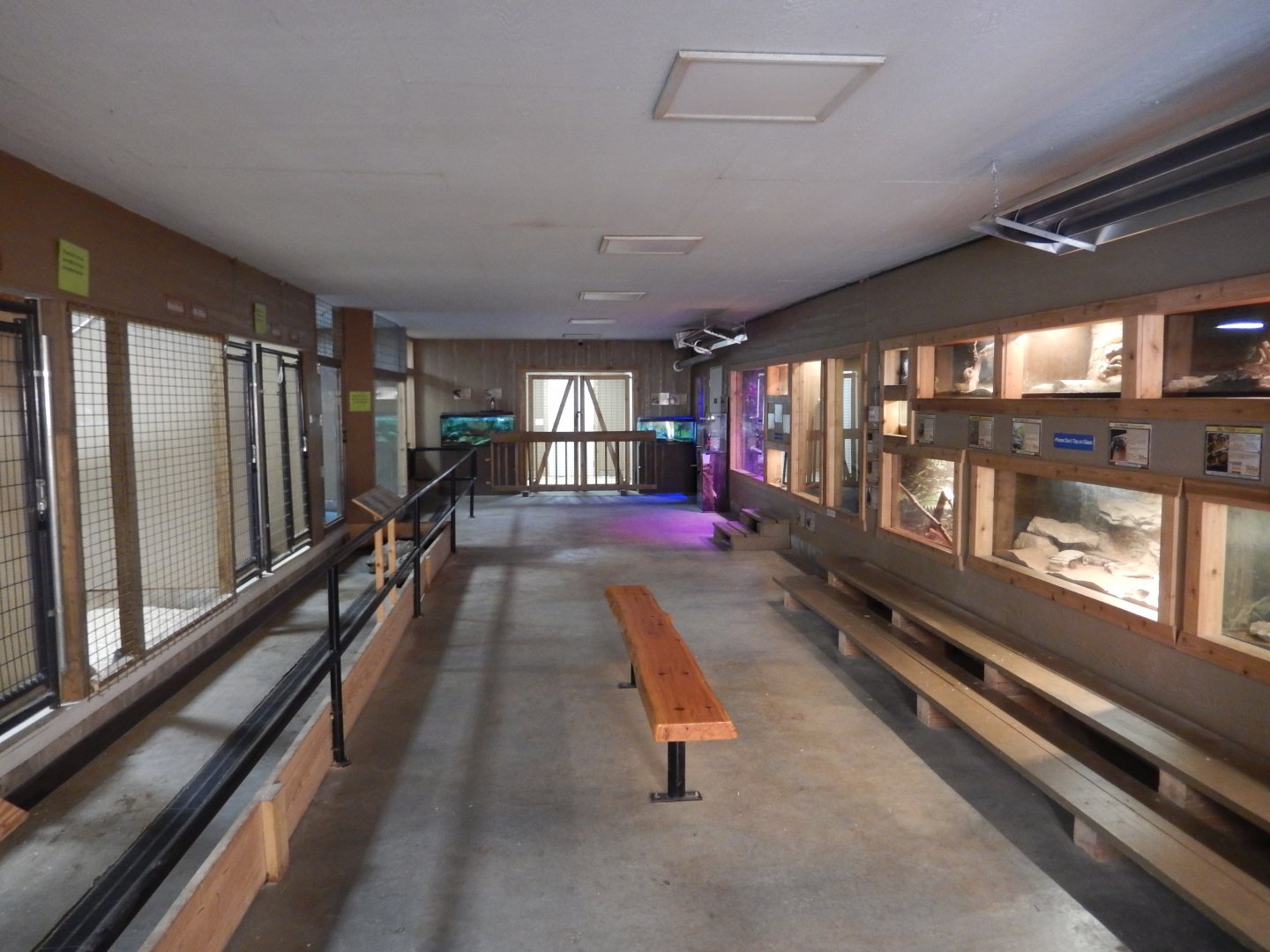

Visitor Experiences
Being adjacent to the shores of Lake Michigan certainly has its benefits, especially for this establishment. The Zoo is set in a very pretty coniferous forest, where guests are engulfed in shade for the entire tour. The pathways consist of wide woodchip trails that add to the scenic walks, with few elevation changes to deal with. Likely due to how the forest is laid out (there is a creek that runs through part of it for instance), the Zoo is laid out in two dead-end trails, each jutting out from the “Main Barn,” the Zoo’s largest and primary animal containment, in the property’s center. While this would normally be seen as excessive backtracking, GarLyn is able to get away with it a bit thanks to its smaller size. One final aspect that shouldn’t go unmentioned is the homemade feel of the Zoo, and it’s a mixed affair. Sometimes it works to its advantage, such as the wooden guest barriers that blend in nicely with the woods. However, there are as many times where it can look more amateur such as the minimal details in the Tropical Building. Moving onto guest amenities, there isn’t a whole lot due to the Zoo’s small size, which isn’t exactly a bad thing. Before parking in the gravel lot, visitors are greeted by a large bear statue accompanied by the Zoo’s logo and a scenic waterfall setting – it’s actually pretty impressive for a homemade facility such as this! Guests enter and exit via the gift shop, which is a standard wooden structure fronted by an African style totem pole. The Zoo’s only set of restrooms are adjacent, along with a picnic area. Beyond the bare necessities, the only additional attractions are a gem mining station next to the rabbits, and the ability to purchase food to feed the two deer species or the bears. I purchased apples for the bears, and it was neat to see them get in a dispute between the fruit!
HIGHLIGHT OF THE DAY: My visit was “gone to the dogs!” It was a joy to watch the fennec foxes as they bounded throughout their habitat the whole time I was present. There was an instance where one fox stopped in front of the fencing, making for a neat close encounter. Nearby, the New Guinea singing dogs were also drawing some attention. It’s cool enough to see this rarely displayed canine species, but to see them active and howling up close was a sweet bonus. They did this for the first half of my visit, with one dog mainly hanging out on the rock formation towards the back, and the other patrolling up front.
OVERALL: The GarLyn Zoo Wildlife Park is in my eyes the epitome of a homemade family-owned zoo. There is a mostly simplistic approach to its habitat design, the animal collection has mainly familiar faces, the visitor amenities range from non-existent to basic…and yet, in a bizarre way, there was something about that I couldn’t help but find a little charming. Maybe it’s because I’ve seen very few facilities of this type, but I’ll give it credit that there was a little more effort put into making the Zoo a bit more presentable amongst its kin. The exhibitry, while hit-or-miss overall, has a couple surprises up its sleeve whether it’s those that utilize the landscape or the Tropical Building’s nocturnal spaces; there are a few rarities within its group of wildlife (aardwolf, spotted genet, New Guinea singing dog, some pheasants), and the property is gorgeous. My recommendation would be for those that wish to stretch their legs for a couple hours as they’re driving to/from the UP; other than that, I wouldn’t quite say it’s worth going out of the way for - unless you want to see the rarities of course.
I won’t deny it has its elements that hold it back compared to the majority of the zoos I’ve visited, but I was pleasantly surprised to find it a bit better than I anticipated – likely in the middle of the pack of family-owned zoos I’ve come across.According to the donation box in the gift shop, there’s a long line of future projects for GarLyn. These include windows into some of the habitats (much needed!) and bringing in new species like tamandua and clouded leopard.