I visited the Volta Redonda zoo today. As expected, it took me around an hour and a half to get there from my house.
There is no entrance fee; you simply walk through the gate and you're in. Parking is also free, which explains why we (my dad and I) had to leave our car outside the zoo's limits.
The zoo is located inside an Atlantic Forest fragment, being rather small. You can see everything in under an hour, as we did today, because dad was in a hurry.
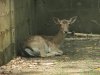
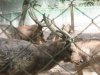
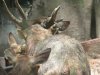
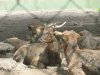
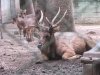
The first exhibit on the visitor path is home to the zoo's broad-snouted caiman, sliders (both red and yellow-eared and, perhaps, hybrids), tortoises (both red and yellow-footed and, perhaps, a few hybrids) and turtles (Geoffroy's side-necked). Next to it is the zoo's largest enclosure, where you can see a big herd of Asian deer (most likely a few of both Rusa timorensis and Rusa unicolor) and two Brazilian tapirs.


Can anyone help me identify these deer?
You'll have to walk for a bit until you reach another exhibit. If you follow the path, like we do, you'll find a small pen that houses baby sliders. A few meters ahead and you will find yourself in a square of four exhibits. One is home to a horned screamer, two toco toucans and a yellow-footed tortoise; the next one houses two Ariel toucans, a Cape barren goose and a Chaco chachalaca; the third one is now a common snapping turtle exhibit and the last one holds a few conures (golden and maroon-fronted).

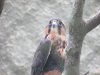
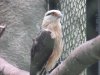
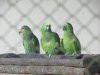
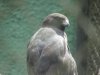
Then, a few mixed exhibits for injured birds of prey (clockwise: striped owl, yellow-eyed caracara and zone-tailed hawk; Southern caracara and white-tailed hawk; aplomado falcon, roadside hawk and yellow-eyed caracara; king vulture. On the right, four exhibits for parrots (clockwise: blue-and-gold macaws; blue-and-gold, hyacinth and scarlet macaws; blue and scaly-headed parrots and white-eyed parakeets; orange-winged, turquoise-fronted and yellow-crowned amazons plus what seemed to be a chopi blackbird).


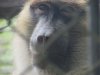
Straight ahead, the next two groups of exhibits are home to the zoo's mammals, most of which are primates and small carnivores. The ones on the left are home to crab-eating foxes (which I did not see this time), a pair of vervets, at least one brown howler and a ring-tailed coati, while the ones on the right are home to an elderly Japanese macaque, more parrots (blue-winged macaw, another turquoise-fronted amazon and more yellow-eyed parakeets) and a white-whiskered spider monkey. A few of the enclosures (one belonged to a crab-eating raccoon, another used to house an iguana and porcupines) looked empty.
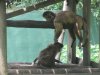
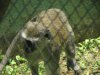
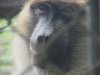
On the left, another row of three cages: one was empty (it should be home to a Peruvian spider monkey, though it might have passed away), the other housed a woolly monkey (unkown species) and the biggest one had two female olive baboons as residents. Opposite to the baboon enclosure is a small island for tufted capuchins.

The next place I usually go to is the big cat corridor, home to four enclosures. Their residents are, from left to right: two cougars, a jaguar and a "Siberian" tiger (yes, the fourth one is also empty).
On the other side of the capuchin island, there are two paddocks, both housing emus. However, the one on the right is also home to a female fallow deer, which was apprehended in the city of Maricá a year ago.
Once again, following the path, the next exhibit is a walkthrough aviary, home to an assortment of both native and exotic species. The very last enclosure is fairly isolated and, since their rhea passed away, it is now home to more red-footed tortoises.
The walkthrough aviary is home the following species:
- Blue-winged macaw;
- Chestnut-napped imperial pigeon;
- Cockatiel;
- Collared dove;
- Curl-crested jay;
- Domestic mallard;
- Hybrid slider (maybe?);
- Nile goose;
- Red-eared slider;
- Red-throated piping guan;
- Ruddy ground dove;
- Yellow-eared slider.

A picture of the zoo's map I've found online.
Overview: Volta Redonda has been in a state of decay since CSN, the company the city's revenue heavily relied on, began being neglected by the Brazilian government. The effects have also been felt by the zoo, which used to house way more species in the past.
However, Zoo VR is still very popular among the locals, who have given many different uses to the park. I have seen people riding bikes, having picnics and even praying the rosary there.
There is no entrance fee; you simply walk through the gate and you're in. Parking is also free, which explains why we (my dad and I) had to leave our car outside the zoo's limits.
The zoo is located inside an Atlantic Forest fragment, being rather small. You can see everything in under an hour, as we did today, because dad was in a hurry.
The first exhibit on the visitor path is home to the zoo's broad-snouted caiman, sliders (both red and yellow-eared and, perhaps, hybrids), tortoises (both red and yellow-footed and, perhaps, a few hybrids) and turtles (Geoffroy's side-necked). Next to it is the zoo's largest enclosure, where you can see a big herd of Asian deer (most likely a few of both Rusa timorensis and Rusa unicolor) and two Brazilian tapirs.
Can anyone help me identify these deer?
You'll have to walk for a bit until you reach another exhibit. If you follow the path, like we do, you'll find a small pen that houses baby sliders. A few meters ahead and you will find yourself in a square of four exhibits. One is home to a horned screamer, two toco toucans and a yellow-footed tortoise; the next one houses two Ariel toucans, a Cape barren goose and a Chaco chachalaca; the third one is now a common snapping turtle exhibit and the last one holds a few conures (golden and maroon-fronted).
Then, a few mixed exhibits for injured birds of prey (clockwise: striped owl, yellow-eyed caracara and zone-tailed hawk; Southern caracara and white-tailed hawk; aplomado falcon, roadside hawk and yellow-eyed caracara; king vulture. On the right, four exhibits for parrots (clockwise: blue-and-gold macaws; blue-and-gold, hyacinth and scarlet macaws; blue and scaly-headed parrots and white-eyed parakeets; orange-winged, turquoise-fronted and yellow-crowned amazons plus what seemed to be a chopi blackbird).
Straight ahead, the next two groups of exhibits are home to the zoo's mammals, most of which are primates and small carnivores. The ones on the left are home to crab-eating foxes (which I did not see this time), a pair of vervets, at least one brown howler and a ring-tailed coati, while the ones on the right are home to an elderly Japanese macaque, more parrots (blue-winged macaw, another turquoise-fronted amazon and more yellow-eyed parakeets) and a white-whiskered spider monkey. A few of the enclosures (one belonged to a crab-eating raccoon, another used to house an iguana and porcupines) looked empty.
On the left, another row of three cages: one was empty (it should be home to a Peruvian spider monkey, though it might have passed away), the other housed a woolly monkey (unkown species) and the biggest one had two female olive baboons as residents. Opposite to the baboon enclosure is a small island for tufted capuchins.
The next place I usually go to is the big cat corridor, home to four enclosures. Their residents are, from left to right: two cougars, a jaguar and a "Siberian" tiger (yes, the fourth one is also empty).
On the other side of the capuchin island, there are two paddocks, both housing emus. However, the one on the right is also home to a female fallow deer, which was apprehended in the city of Maricá a year ago.
Once again, following the path, the next exhibit is a walkthrough aviary, home to an assortment of both native and exotic species. The very last enclosure is fairly isolated and, since their rhea passed away, it is now home to more red-footed tortoises.
The walkthrough aviary is home the following species:
- Blue-winged macaw;
- Chestnut-napped imperial pigeon;
- Cockatiel;
- Collared dove;
- Curl-crested jay;
- Domestic mallard;
- Hybrid slider (maybe?);
- Nile goose;
- Red-eared slider;
- Red-throated piping guan;
- Ruddy ground dove;
- Yellow-eared slider.
A picture of the zoo's map I've found online.
Overview: Volta Redonda has been in a state of decay since CSN, the company the city's revenue heavily relied on, began being neglected by the Brazilian government. The effects have also been felt by the zoo, which used to house way more species in the past.
However, Zoo VR is still very popular among the locals, who have given many different uses to the park. I have seen people riding bikes, having picnics and even praying the rosary there.
Attachments
-
 upload_2024-12-8_23-48-1.jpeg160.1 KB · Views: 29
 -
 upload_2024-12-8_23-48-26.jpeg171.6 KB · Views: 28
 -
 upload_2024-12-8_23-48-36.jpeg141.1 KB · Views: 28
 -
 upload_2024-12-8_23-49-2.jpeg155.8 KB · Views: 28
 -
 upload_2024-12-8_23-49-13.jpeg102.4 KB · Views: 28
 -
 upload_2024-12-8_23-49-35.jpeg118.7 KB · Views: 27
 -
 upload_2024-12-8_23-50-2.jpeg80.7 KB · Views: 4
 -
 upload_2024-12-8_23-50-19.jpeg118.9 KB · Views: 27
 -
 upload_2024-12-8_23-50-52.jpeg172.5 KB · Views: 28
 -
 upload_2024-12-8_23-51-50.jpeg103.5 KB · Views: 27
Last edited: