Wingham Wildlife Park Atypical Reindeer

dillotest0

Well-Known Member
5+ year member
14798459000_efed866d09_h.jpg
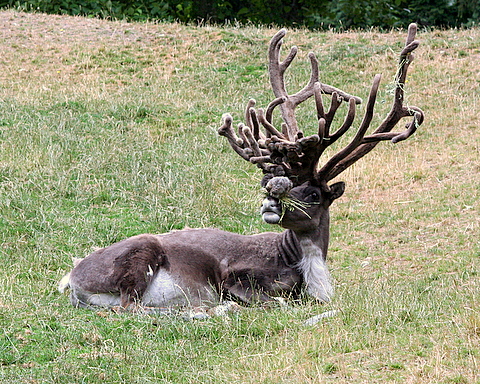
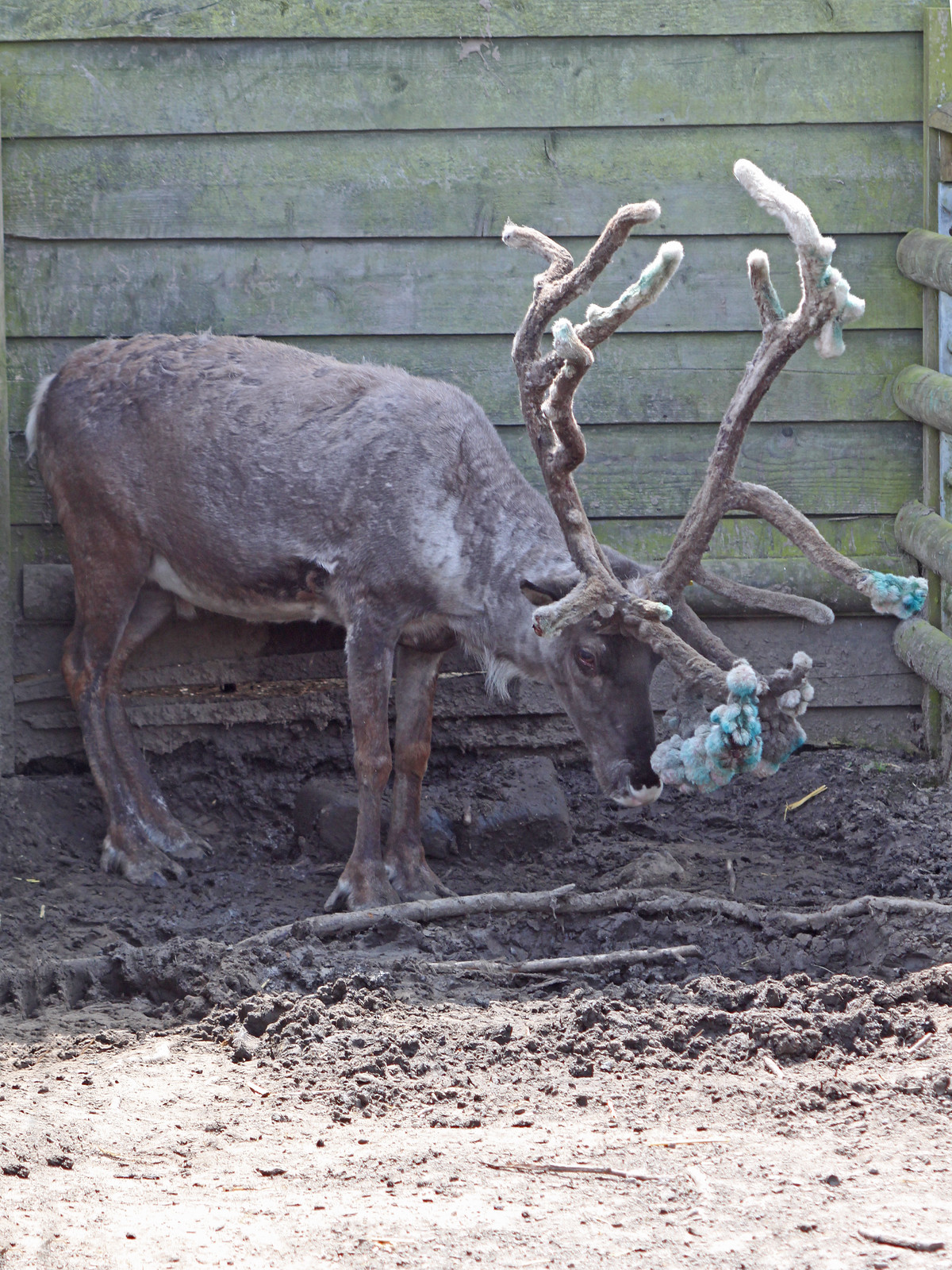
I recall recently on flickr I found this picture of a reindeer at Wingham Wildlife Park. I have put the picture in a spoiler as I felt it may be distressing to some people... as I was taken aback by the abnormal bluish development on the animal's antlers.
I recall sometimes with reindeer in captivity velvet can be abnormal - some animals retain a significant amount of velvet after September. But I hadn't seen quite a condition this severe.
36489726545_7d7267fa31_b.jpg
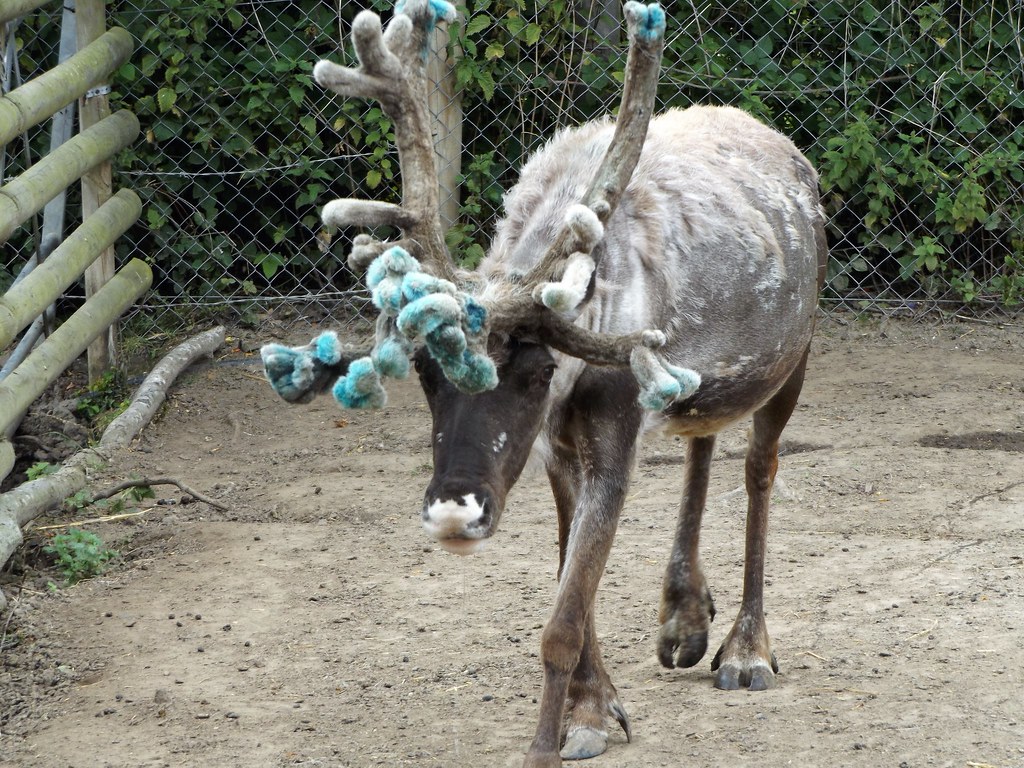
Looking into it a bit more I then found this other picture which I figured was of the same reindeer - not only because of the similar antler abnormality, but also the colouring; particularly the white nose.
The first picture was taken in 2014; and the second was in 2017 - so I figured then that the condition was not fatally severe to the animal. And given that it would've dropped the antlers, I figured that this was not necessarily a permanent event but one that was recurring every year.
But I couldn't get round to figuring out why... was this a disease? Was this caused by an environmental condition? I would be interested in more insight regarding this animal and what may have caused this.
 
I'm not a vet so don't take this as a definite answer, but they look like perukes.

Basically a lack of testosterone (eg if a deer is castrated) means that the antlers don't harden as they should and the velvet is retained instead of drying and falling off. The antlers are then not shed, and the next year's growth tries to continue on the same antlers resulting in deformities as can be seen in this deer (especially in the first photo you can see the tines are twisted at strange angles).

I'd imagine the blue colour is some sort of antibiotic medication rather than natural.
 
I'm not a vet so don't take this as a definite answer, but they look like perukes.

Basically a lack of testosterone (eg if a deer is castrated) means that the antlers don't harden as they should and the velvet is retained instead of drying and falling off. The antlers are then not shed, and the next year's growth tries to continue on the same antlers resulting in deformities as can be seen in this deer (especially in the first photo you can see the tines are twisted at strange angles).

I'd imagine the blue colour is some sort of antibiotic medication rather than natural.

Absolutely right...happens a lot in castrated reindeer, but have also seen one case with an entire one. In fact our castrate has developed a small one the past 2 years. We give him a big dose of steroids and it begins the moulting process and if we time it right, they'll drop off at the correct time in late November. Might be a little later this year as we initially had difficulty sourcing the steroids.

And yep, the blue is Alamycin spray.;)
 
Absolutely right...happens a lot in castrated reindeer, but have also seen one case with an entire one. In fact our castrate has developed a small one the past 2 years. We give him a big dose of steroids and it begins the moulting process and if we time it right, they'll drop off at the correct time in late November. Might be a little later this year as we initially had difficulty sourcing the steroids.

And yep, the blue is Alamycin spray.;)
I will say about 'your' reindeer - I found the female to have more impressive antlers than her male counterpart - and also it was funny in regards to velvet; of course the gelded male hadn't shaken all of his off [but still quite more than other castrates I've seen]; but neither had her!
 
2705498565_a42e75b070_o.jpg

I found some pictures on flickr of reindeer with even weirder [though more regularly-coloured] antlers. I'm guessing this is another neutered male. Port Defiance Zoo.
6961544720_51ee7af74e_b.jpg

This picture is also from Defiance. Not sure if the same reindeer or different. But what stands out to me aside from growth on the old antler is how clean and regular old antler looks.
Most of the pictures I see from this zoo are taken from far distance ... but somehow part of me wants a closer look at these weird things.
 
I'm not a vet so don't take this as a definite answer, but they look like perukes.

Basically a lack of testosterone (eg if a deer is castrated) means that the antlers don't harden as they should and the velvet is retained instead of drying and falling off. The antlers are then not shed, and the next year's growth tries to continue on the same antlers resulting in deformities as can be seen in this deer (especially in the first photo you can see the tines are twisted at strange angles).

I'd imagine the blue colour is some sort of antibiotic medication rather than natural.

It can happen(rarely) in wild deer too if there is damage to e.g. the testicles- which would be the wild equivalent of castration probably. I've seen photos of a mounted Roe deer head with this condition. Incidentally 'Peruque' is a french word I think, meaning 'wig head'.
 
It can happen(rarely) in wild deer too if there is damage to e.g. the testicles- which would be the wild equivalent of castration probably. I've seen photos of a mounted Roe deer head with this condition. Incidentally 'Peruque' is a french word I think, meaning 'wig head'.

I’ve seen a head with these too though never a wild live one. With wild deer there’s little prospect of recovery and the prognosis is poor so the advice is usually to cull them out straight away; they’d be considered as a sick animal out of season. In a captive setting they can be treated of course.
 
It can happen(rarely) in wild deer too if there is damage to e.g. the testicles- which would be the wild equivalent of castration probably. I've seen photos of a mounted Roe deer head with this condition. Incidentally 'Peruque' is a french word I think, meaning 'wig head'.
From what I recall reindeer in particular are the species of deer least affected by 'neutering'. That is to say gelded male reindeer can be prone to abnormalities [hence this] but at least compared to other deer species it's not as drastic
 
Though from what I have read Alamycin is mainly used to treat foot infections... is it routinely used for much else?
Certainly haven't seen many other cases in this manner for antlers
 
I recall one thing that came to mind whilst looking at the picture... how 'raggedy' the velvet looks... as if it wasn't newly-grown [or usual in-velvet]... but rather raggedy as if it were rutting season but the castrate didn't shed it. In August no less...
468033589_10160644816766818_2946459495743225551_n.jpg

And so I managed to find this photo from 2013, which shows antlers largely the same shape and angle of what was posted in 2014, minus the abnormal growths. And even the velvet itself looks similar to the August picture.
The shape is largely identical to the 2014 picture - though in that I notice what looks like another tine that isn't in the 2013 picture. Though the fur on that looks more standard velvet. So my guess is much what Chlidonias said .... the antler was not shed after 2013 but retained into the new year... and into August apparently. Though I did see some pictures of him in 2014 with proper hard antler... so I'm guessing they gave him treatment later on.
And with 2017 I saw some pictures in a similar vain... that in 2017 some of the antler fell off but not all of it. For what it's worth the pictures posted in Summer 2017 have rather different shape.
 
I recall I was reading about the similar-ish situation of cactus buck in white tailed deer. And there was one source which said how although cactus bucks by nature do not shed their antlers by hormonal circumstance; in colder areas the antlers can receive moisture; which eventually freezes and causes part of the antler to break off. For this reason many cactus buck are found in warmer states; such as Texas and New Mexico.

And so I was thinking as to how this could apply here. One thing I realised is that pictures of abnormal antlers in reindeer in the more usual environment; close to the North Pole; are rather hard to come by. And so my guess is that the reindeer there are not shedding their antlers by biological means; but rather by means of the antlers freezing and falling off. This of course is harder to do in warmer climes; which may only get a few snow-covered days every year, so nothing for any elongated period; and so parts of the lower antler remain; even if the upper parts have fallen off; resulting in unusual lower growths. And even if the handler saws off the antler themself they may miss the lower parts and the growths then still happen.
 
Back
Top