Auckland Zoo Auckland Zoo News 2021

WhistlingKite24

Well-Known Member
10+ year member
An update regarding Auckland's Zoo work and recent breeding success with Cobble and Kapitia (Chesterfield) Skinks:
Did you know that Auckland Zoo is caring for two critically endangered skink species - the cobble and Kapitia skink? Both species were rescued by our conservation partners at Department of Conservationbefore separate cyclones hit their only known homes in the wild. Here, ectotherm keeper Sarah is making sure the skinks are in tip top shape by weighing and measuring them to check on their growth, as well as tending to their indoor and outdoor habitats.
The cobble skinks we have at the zoo represent the species entire population in New Zealand (and of course, the world). After a lot of hard work perfecting their husbandry (which includes pairing compatible skinks together for breeding), we’ve been able to grow their population from 36 to 55 individuals, an increase of 52%!
We’ve also been caring for a quarter of the entire population of Kapitia (Chesterfield) skinks, providing an insurance population against their extinction. With 50 individuals collected, we’ve also been able to increase their numbers, with an incredible 11 skinks born this year. With both lizard species, we’re working with DOC to plan the next stage in their recovery. This crucial conservation work is only made possible because of your support.
Log into Facebook | Facebook
 
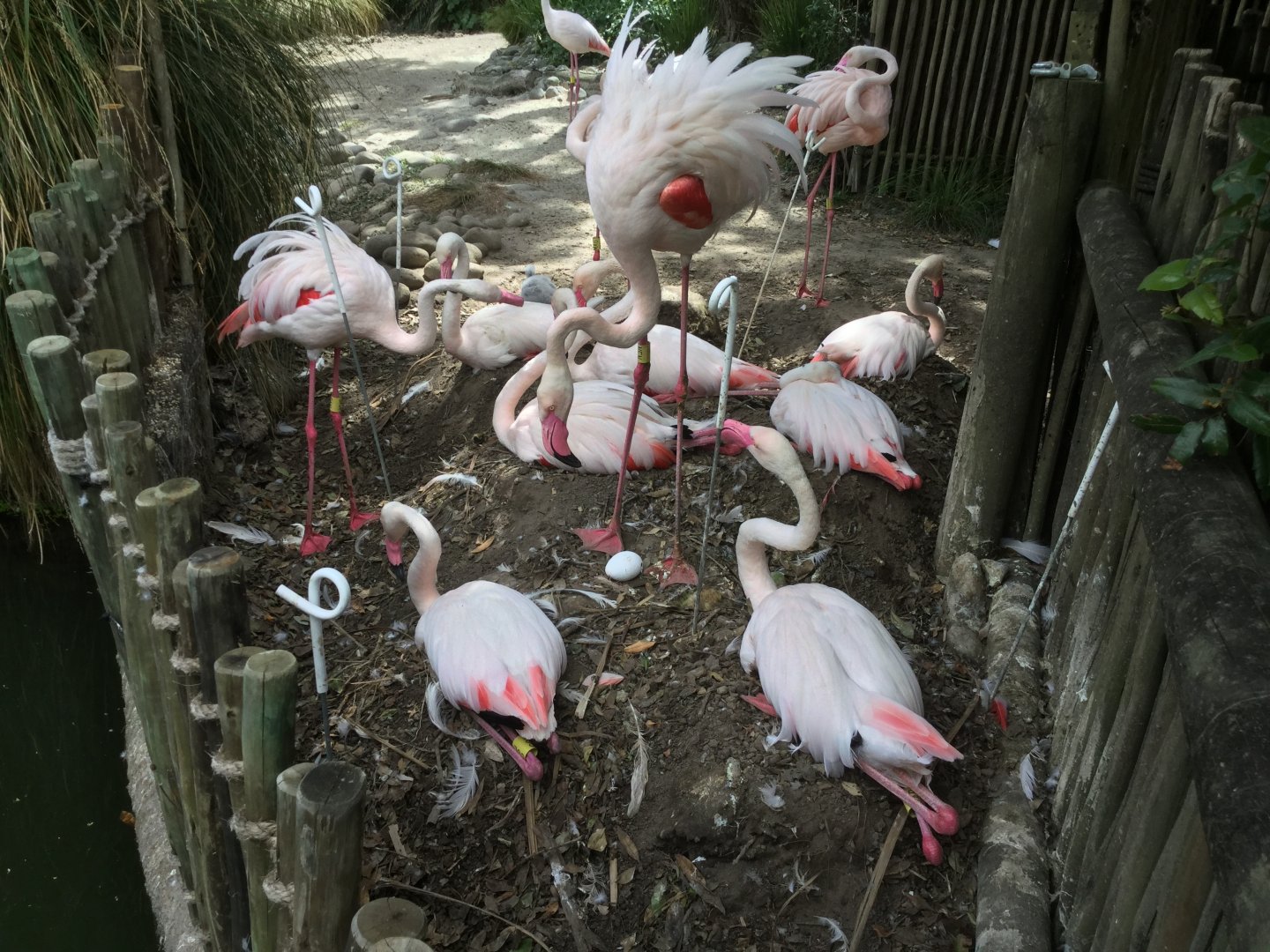
A Greater Flamingo chick has hatched! This chick is currently four days old and is the first chick for the breeding season. What fantastic news for Australasia's only group of flamingos. From their Facebook page:
We’ve some exciting news to share – a flamingo chick has hatched at the zoo!
This four-day-old chick is the first to hatch this breeding season and is the offspring of parents Neil and Cheviot, who our birds team leader Carl describes as being amazing, attentive parents.This wee chick is currently getting all of the nutrients it needs from the crop milk its’ parents provide, which is extremely high in protein and fat. This bright red milk is a secretion from the lining of the crop that is then regurgitated to the chick. If you wait till the end of the video, you can see the chick starting to test its legs by standing up for the first time! We won’t know the sex of the chick until it is much older, so please stay tuned for updates. In the next few days the chick will start to walk around, so you may catch a glimpse of the chick on your next visit.
Log into Facebook | Facebook

Source: Auckland Zoo's Facebook page
 
A Greater Flamingo chick has hatched! This chick is currently four days old and is the first chick for the breeding season. What fantastic news for Australasia's only group of flamingos. From their Facebook page:

Log into Facebook | Facebook

Source: Auckland Zoo's Facebook page

It’s great to see the zoo experience success with their flock - three years after the last chicks hatched. The hatching of this chick takes the flock to 23.

This is the third chick of parents Cheviot (male) and Neil (female), who previously produced chicks in 2017 and 2018. Their 2018 chick was the first parent reared chick in the flock.

This will hopefully be Auckland Zoo’s seventh successful chick:

Richard (January 2014) Male
Cole (January 2017) Male
Otis (January 2017) Female
Willoughby (February 2017) Gender Unknown
Sullivan (January 2018) Gender Unknown
Eleanor (January 2018) Gender Unknown
Unnamed (January 2021) Gender Unknown
 
A Greater Flamingo chick has hatched! This chick is currently four days old and is the first chick for the breeding season. What fantastic news for Australasia's only group of flamingos. From their Facebook page:

Log into Facebook | Facebook

Source: Auckland Zoo's Facebook page
The Greater Flamingo chick has reached the two-week mark and is still going strong. Keepers are doing daily checks on the chick and as of this morning it weighed 608 grams:

Source: Auckland Zoo's Facebook page
Log into Facebook | Facebook
 
The Greater Flamingo chick has reached the two-week mark and is still going strong. Keepers are doing daily checks on the chick and as of this morning it weighed 608 grams:

Source: Auckland Zoo's Facebook page
Log into Facebook | Facebook

It’s great to see the chick growing well (and being raised by the flock).

The zoo announced this time last year that the flock had laid 14 eggs (unfortunately none successful); and since chicks have hatched as late as February, there might be more chicks to come.

The keeper even says in the video they have one flamingo chick “at the moment.” :)
 
Auckland Zoo currently have 12 Orange-fronted Kakariki chicks and have hatched a total of 22 chicks this season so far. Ten of these chicks are already at the Isaac Conservation and Wildlife Trust in preparation for their release:
These 3-week-old kākāriki karaka (orange fronted parakeet) chicks are receiving their first health checks! So far we’ve had great success this breeding season, hatching 22 of these critically endangered birds over the past few months. Currently 12 chicks are being cared for at the zoo who will soon join the 10 birds that are at The Isaac Conservation and Wildlife Trust on their way to being released into the wild. Even more chicks could be joining them with two eggs being incubated by their parents in our special back of house facilities and the potential for these birds to lay another clutch (group of eggs) before summer is over. These birds were once widely spread throughout Aotearoa but introduced predators as well as the destruction of their habitat, have reduced their wild population to just 100-300 birds. The birds we’re able to breed for release with Department of Conservation add valuable genetics to wild populations and also increase the numbers of young, healthy birds that are able to go on to have chicks of their own. Your zoo visits and donations help us to continue crucial Wild Work like this every year. If you’d like to donate to further our efforts, find out more here – www.aucklandzoo.co.nz/get-involved/donate-wild-work-aotearoa.
Log into Facebook | Facebook
 
Greater flamingo breeding season update:

I visited Auckland Zoo yesterday and have exciting news regarding the Greater flamingo flock. In addition to the chick that hatched three weeks ago; several eggs have been laid, at least four of which are known to be fertile.

Excitingly, two of the chicks that hatched 2017 (Cole and Willoughby) have paired up and laid one of these eggs. The zoo removes the eggs after laying; replaces them with a decoy; and then returns them to the flock prior to hatching.

Lizzie, who previously reared two chicks with Richard (the first zoo’s successful flamingo chick) has now paired with a male named Nelson. I was excited to see the egg they were incubating had begun hatching on my visit (as was their keeper). It had a crack in it as the chick slowly began to emerge.

Fingers crossed for more successful chicks this season!


Greater flamingo breeding season update:

I visited Auckland Zoo yesterday and have exciting news regarding the Greater flamingo flock. In addition to the chick that hatched three weeks ago; several eggs have been laid, at least four of which are known to be fertile.

Excitingly, two of the chicks that hatched 2017 (Cole and Willoughby) have paired up and laid one of these eggs. The zoo removes the eggs after laying; replaces them with a decoy; and then returns them to the flock prior to hatching.

Lizzie, who previously reared two chicks with Richard (the first zoo’s successful flamingo chick) has now paired with a male named Nelson. I was excited to see the egg they were incubating had begun hatching on my visit (as was their keeper). It had a crack in it as the chick slowly began to emerge.

Fingers crossed for more successful chicks this season!


Outstanding news indeed. Hope for constant updates on this flock :D
 
I assume all the birds (including the young born at the zoo) are pinioned?

Yes they are. A flamingo aviary was in the 2014 masterplan, which would theoretically allow flight; though I understand flamingo are unable to do so in such aviaries as they don’t have the running space to get airborne. That said, with the elephants leaving - the zoo will soon have the space to build one of the largest flamingo aviaries in the world (if it’s their desire to do so).
 
News from my Visit (23/01/2021)

Plains zebra stallion, Carlo (2007), has been retired to Gibbs Farm. His mother, Itika (1992-2020) died last year. This leaves the zoo with two mares, Layla (2011) and Eve (2018); and Layla’s newborn colt (see post above). The zoo will presumably bring in a new stallion once Layla’s colt is older/has been transferred in a year or two.

The new Brolga exhibit holds the pair from Hamilton Zoo. They were both hatched at Auckland Zoo and are named Iraga (2005) and Kirra (2014). Their father occupies the old Brolga exhibit (near the Tasmanian devil) and is named Bolga (1982).

I asked a number of staff where the elephants are likely to go and was told by each of them it hasn’t been decided yet. They’re still scheduled to leave in the second half of 2021, so I made the most of seeing them on my visit.

There was similarly no updates on the Sumatran tiger and Bornean orangutan imports, which will hopefully happen this year.

The orangutans have access to the high ropes and are enjoying the freedom. The towers have internal ladders and as they shinny up and down, they’re only centimetres away from you. The grating has tiny holes, and although the view isn’t adequate enough to take photos, you can still see them through it. Melur has been making the most of the aerial ropes; which has encouraged Charlie, who likes to keep an eye on her.

I saw four Lowland nyala calves on my visit and the herd is looking sizeable. Some exports to Australia may be needed in the near future. They share the exhibit with the Waterbuck and the Southern white rhinoceros.

The rhinos are currently held in two groups. Inkosi (2002) was outside in the morning; the family group of Zambezi (1991), Jamila (2012) and Nyah (2020) in the afternoon.
 
Excitingly, two of the chicks that hatched 2017 (Cole and Willoughby) have paired up and laid one of these eggs. The zoo removes the eggs after laying; replaces them with a decoy; and then returns them to the flock prior to hatching.

Lizzie, who previously reared two chicks with Richard (the first zoo’s successful flamingo chick) has now paired with a male named Nelson. I was excited to see the egg they were incubating had begun hatching on my visit (as was their keeper). It had a crack in it as the chick slowly began to emerge.
The zoo has now officially announced the hatching of this second Greater Flamingo chick to Lizzie and Nelson. The chick is doing well:

"We've got more exciting news - a second healthy flamingo chick hatched five days ago to parents Lizzy & Nelson, and you can help us to care for them! In our latest in a series of Trade Me auctions raising funds for conservation, we’re giving one lucky bidder the chance to spend a morning with one of Auckland Zoo’s bird keepers and flamingo experts. Here, you’ll get to experience the care and science that goes into looking after a flock of flamingos. You and up to two friends or family will venture into our flamingo habitat one morning to help our bird keepers complete one of the regular weigh-ins and health checks of our young chick and learn more about these incredibly special birds. You’ll also get to hear more about the diverse range of species we look after at the zoo, finishing off with a guided walk of our Te Wao Nui Forest aviary. Auckland Zoo is a not-for-profit organisation, and conservation is at the heart of everything we do. All of the funds raised in these VIP auctions go directly to the Auckland Zoo Conservation Fund, enabling us to continue to make a difference for wildlife and wild places in Aotearoa and around the world."
Log into Facebook | Facebook

 
Yes they are.
This seems to be incorrect. Skimming through the videos of the flamingos the zoo has released over the past few years, it would appear that they are leaving their house bred birds full winged. An excellent move on the zoos behalf in the long run; as these full winged birds age (especially the males), there will likely be an increase in egg fertility as time goes on! Regardless of that, fingers crossed all remaining fertile eggs this year hatch, and all the chicks survive and grow well!
 
Auckland Zoo has received a female Tasmanian Devil from Wellington Zoo. Her name is Dash and is currently three years old: Log into Facebook | Facebook

Breeding purposes?

I suspect it’s more about Wellington downsizing their colony. They’re about to start construction on the walk through lemur exhibit (on the site of the old baboon exhibit); and this is right next to the Tasmanian devils. Whether they need to decrease the Tasmanian devil exhibit space, or keep them off display I don’t know; but either way, they will likely appreciate Auckland Zoo taking on this female.

While I think it’d be an excellent idea from an insurance population perspective, I believe Australia only export devils to New Zealand with the intention of them being ambassadors/non breeding animals.
 
While I think it’d be an excellent idea from an insurance population perspective, I believe Australia only export devils to New Zealand with the intention of them being ambassadors/non breeding animals.

Devils in Australian zoos are part of a very active conservation breeding program. Lots are bred here every year (Zoos Victoria for example maintains a colony of around 60 I recall). So there is a definite need for a place to retire non-breeders to free up space for more breeding.

If foreign zoos were to engage in the breeding program proper, overseas-born devils would need to be shipped back to Australia to be paired etc. This would be expensive: flights, crate training, pre and post export quarantine etc. All unnecessary expenses for a very real and hands-on conservation program here in Australia. Much more efficient is a one-way journey for overseas devils and an agreement that when those individuals die, more will be sent. There is no shortage of surplus non-breeders looking for a home. Overseas export is a win-win for everyone: Overseas zoos get devils for display, the captive population in Australia doesn't get bogged down pouring resources into a retirement village.
 
Back
Top