You are using an out of date browser. It may not display this or other websites correctly.
You should upgrade or use an alternative browser.
You should upgrade or use an alternative browser.
Best way to get orangutans to climb
- Thread starter tigris115
- Start date


Mixing orangutans with terrestrial mammals like tapirs or otters has proven to be effective at encouraging them to climb; staying up high gives them some space away from there sometimes gutsy exhibit-mates. Simply providing a high density of climbing structures with extra verticality often does the trick as well - see Chester, Apenheul, Auckland, Saint Louis, or Woodland Park. For what not to do, see Phoenix. 

Another trick is to feed them up high, either through the mesh in closed settings or by having feedijg stations (preferably with tool use required) high in the climbing frames.
The prerequisite is of course that you need plenty of climbing options, both swinging and fixed logs, to make full use of the vertical space...
The prerequisite is of course that you need plenty of climbing options, both swinging and fixed logs, to make full use of the vertical space...

Auckland Zoo’s Bornean orangutans have 2km of aerial pathway (25m in height) that traverses part of the zoo (including a lake). They rotate use of the aerial pathway with Siamang and when it’s the orangutan’s turn, they never hesitate to use it.
It’s been a thrill to see the orangutans living an arboreal lifestyle since the opening of this part of the precinct in 2020; especially considering they were often sedentary in the previous exhibit.
Photo from one of my visits:

It’s been a thrill to see the orangutans living an arboreal lifestyle since the opening of this part of the precinct in 2020; especially considering they were often sedentary in the previous exhibit.
Photo from one of my visits:
Attachments

Whatever Indianapolis is doing... 

Mixed exhibit with Tigers

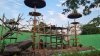
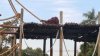
Hello. This year, BioParque do Rio, formerly known as RioZoo, built two tree-like platforms to stimulate the arboreal habits of Else and Xuxorango, its two female Sumatran orangutans. I believe the results were positive, as they spend a lot more time up there than near the ground.


(These two pictures are not mine, they were taken by a friend.)
(These two pictures are not mine, they were taken by a friend.)
Attachments
It would be interesting if there is a difference about the time orangs are climbing in enclosures with artificial climbing structures and real trees. For me only Singapure comes to mind with trees, are there other examples, where they can use for instance some big oaks or beeches too?

There is a big oak tree in one of the Sumatran orang enclosures beside the Monsoon Forest at Chester. It could have been felled when the Islands section was constructed, but it was decided to leave it as enrichment for the orangs. It has suffered some damage over the years and it may not survive in the long term, but it is wonderful to see the orangs among the leaves.It would be interesting if there is a difference about the time orangs are climbing in enclosures with artificial climbing structures and real trees. For me only Singapure comes to mind with trees, are there other examples, where they can use for instance some big oaks or beeches too?
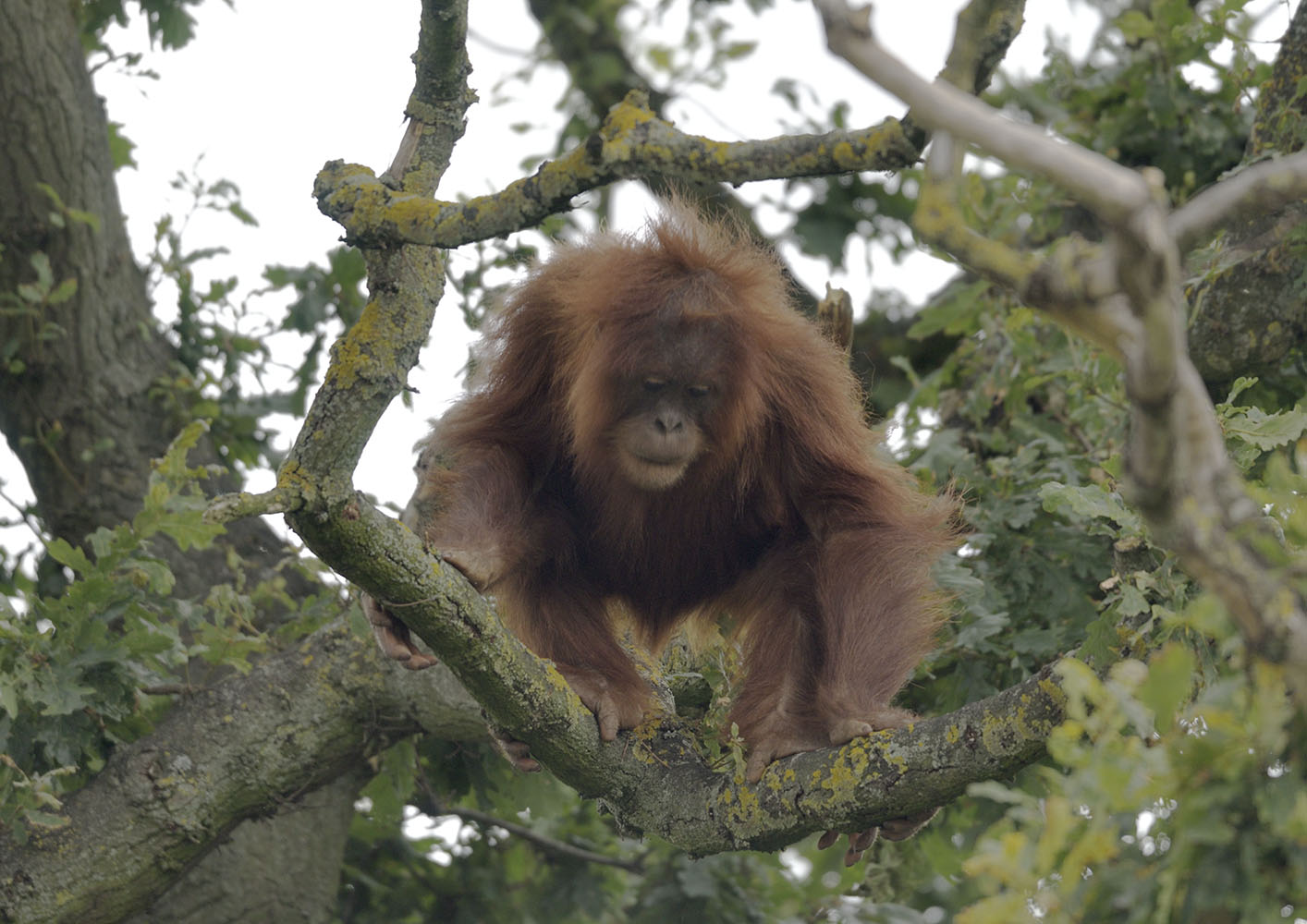
Tuti in the oak tree (looking down)
Monsoon Forest, oak tree enclosure, Chester, 13th August 2017.
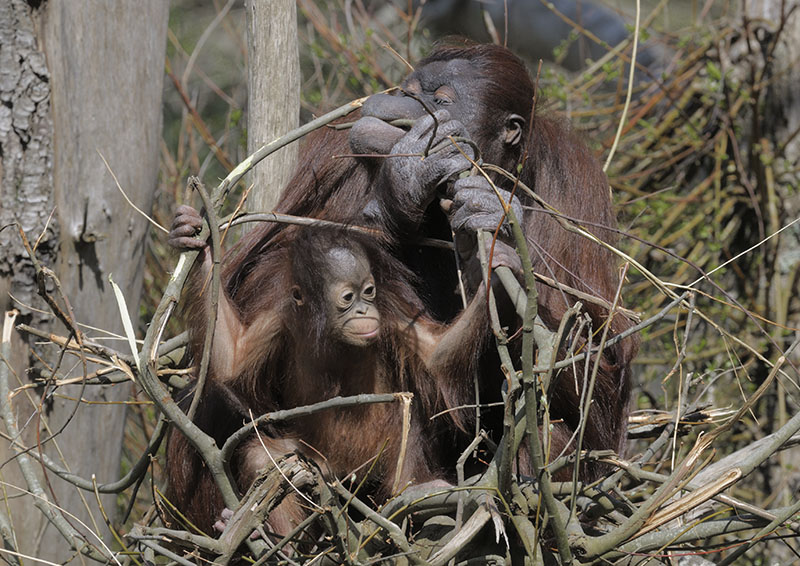
Bornean orang utans 'Chinta' & 'Natalia'
Adult female and 16-month old infant, feeding on willow buds. Large orang island, Paignton, 18th...
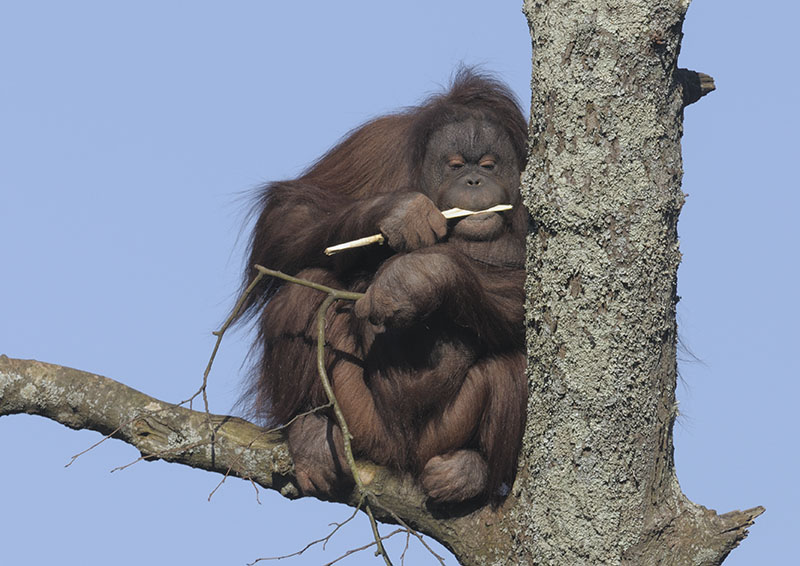
Chinta eating bark
Female Bornean orang utan on her favourite branch, with a light snack she climbed down to...
I' ve sometimes wondered why the Sumatrans at Chester don't seem to have damaged that oak tree to any extent, at least so far anyway. While over some years the Borneans at Paignton destroyed the willow trees, mostly by breaking the branches, so that they died and were eventually cut down to stumps. For a while until the damage took effect, the sight of Mali & Demo climbing in those trees presented a very natural spectacle.There is a big oak tree in one of the Sumatran orang enclosures beside the Monsoon Forest at Chester. It could have been felled when the Islands section was constructed, but it was decided to leave it as enrichment for the orangs. It has suffered some damage over the years and it may not survive in the long term, but it is wonderful to see the orangs among the leaves.
On the other hand, the Bornean orangs at Paignton have systematically destroyed all the mature trees, mostly willows, on the big island there. The trees have resprouted to cover the island with thick shrubbery, but there are only a few stumps left which give little opportunity for climbing.Tuti in the oak tree (looking down)
Monsoon Forest, oak tree enclosure, Chester, 13th August 2017.
Bornean orang utans 'Chinta' & 'Natalia'
Adult female and 16-month old infant, feeding on willow buds. Large orang island, Paignton, 18th...Chinta eating bark
Female Bornean orang utan on her favourite branch, with a light snack she climbed down to...
As mentioned before, the original Orangs at Paignton Zoo, which arrived from London, Bulu, Senja and to a lesser extent, Chinta, hardly ventured far from the building and rarely if ever(?) used the trees though I saw the younger Nakal exploring occassionally.
I was tempted to say, in answer to the original title of the thread- 'keep Sumatrans'- as being so much more active they are also keener climbers, given the opportunity.
Last edited:
Important is also how complex and interesting is the climbing structure. For example, introduce thinner ropes, hoses or artificial lianas in addition to thick beams.
Also, apes seem to dislike strong sun and like shade.
It is best if zoos check publications how wild orangutans actually move on trees, and make climbing structures which allow the same types of movements.
Several zoos made swaying poles, which mimic how orangutans sway trees forward and backward to move between them. Orangutans apparently like them very much.
Also, apes seem to dislike strong sun and like shade.
It is best if zoos check publications how wild orangutans actually move on trees, and make climbing structures which allow the same types of movements.
Several zoos made swaying poles, which mimic how orangutans sway trees forward and backward to move between them. Orangutans apparently like them very much.
While I know this example is slightly different, I feel as though it is relevant. One of the areas my research team at the Buffalo Zoo focuses on is space use by zoo animals. The gorillas at the Buffalo Zoo tend to spend a lot of time in alcoves near the back of the exhibit where they are out of view, and some of our recent analyses have looked at whether or not there is a pattern for when they are in-view versus out-of-view. The results are fairly simple: the time that the gorillas are in-view most regularly is in the time directly after a food throw, that is when the zoo keepers throw food into the exhibits. Like gorillas, I suspect that orangutans would also be food-motivated. If a zoo feeds their orangutans on the ground, clearly they'll spend a lot of time there as that's where the food is. But if a zoo feeds their orangutans at taller spots in the exhibit, I suspect that you'll start seeing a lot more time spent climbing and foraging up high.
Strathmorezoo
Well-Known Member
Clearly, a very good point if you want arboreal animals to behave naturally then give them the incentive to do so. Place feeding stations higherWhile I know this example is slightly different, I feel as though it is relevant. One of the areas my research team at the Buffalo Zoo focuses on is space use by zoo animals. The gorillas at the Buffalo Zoo tend to spend a lot of time in alcoves near the back of the exhibit where they are out of view, and some of our recent analyses have looked at whether or not there is a pattern for when they are in-view versus out-of-view. The results are fairly simple: the time that the gorillas are in-view most regularly is in the time directly after a food throw, that is when the zoo keepers throw food into the exhibits. Like gorillas, I suspect that orangutans would also be food-motivated. If a zoo feeds their orangutans on the ground, clearly they'll spend a lot of time there as that's where the food is. But if a zoo feeds their orangutans at taller spots in the exhibit, I suspect that you'll start seeing a lot more time spent climbing and foraging up high.

Indeed one would think being a rainforest you'd think zoo people would know how important shade is necessary. I'd often wondered why Lincoln Park's family gorilla troop preferred be indoors than out in full sun. This notion of shade provisions should be a given but its not factored in exhibit design or function.Important is also how complex and interesting is the climbing structure. For example, introduce thinner ropes, hoses or artificial lianas in addition to thick beams.
Also, apes seem to dislike strong sun and like shade.
It is best if zoos check publications how wild orangutans actually move on trees, and make climbing structures which allow the same types of movements.
Several zoos made swaying poles, which mimic how orangutans sway trees forward and backward to move between them. Orangutans apparently like them very much.
Great apes like shade and cover over their heads. So by choice, and also influenced by additional factors such as wind, rain, temperature etc, they spend far more time indoors in zoo enclosures than outside. It mimics their lives spent essentially in woodland/forest with overhead cover. But despite that, for various reasons largely associated with display, many zoos still choose to build their new exhibits with huge, mostly open outdoor areas and smaller indoor areas.Indeed one would think being a rainforest you'd think zoo people would know how important shade is necessary. I'd often wondered why Lincoln Park's family gorilla troop preferred be indoors than out in full sun. This notion of shade provisions should be a given but its not factored in exhibit design or function.
Last edited:

I will just bring this to show what you probably should avoid.
I know this thread hasn't been active for more than 6 months but I just felt like this has to be known here.
Now I am not a person who thinks unnatural=bad or natural=obligatory, which is why I don't have hard feelings towards the Scutes family galley or Indiana zoo's orangutan center. But Asahiyama zoo's orangutan indoor exhibit is pretty concerning. Just imagine trying to sit on a wall in a region in long winter. There's also the chance of facing the golden shower. The outdoor exhibit isn't any better. They do have an interesting jungle gym connected to their cage but the apes cannot get on the ground when they go to the jungle gym.
I wouldn't be surprised if anyone here has an aneurism after seeing this enclosure.

equidae
Well-Known Member
I know that feeding location is frequently recommended as a method to encourage animals to use different areas of their enclosure or to encourage them to stay in-view. So, like Neil chace says, I’m sure it would encourage climbing as well. Building a positive association with an area can only ever help.
Off-topic but is the implication here that the gorillas are actively trying to stay out out-of-view / dislike being in-view?While I know this example is slightly different, I feel as though it is relevant. One of the areas my research team at the Buffalo Zoo focuses on is space use by zoo animals. The gorillas at the Buffalo Zoo tend to spend a lot of time in alcoves near the back of the exhibit where they are out of view, and some of our recent analyses have looked at whether or not there is a pattern for when they are in-view versus out-of-view. The results are fairly simple: the time that the gorillas are in-view most regularly is in the time directly after a food throw, that is when the zoo keepers throw food into the exhibits. Like gorillas, I suspect that orangutans would also be food-motivated. If a zoo feeds their orangutans on the ground, clearly they'll spend a lot of time there as that's where the food is. But if a zoo feeds their orangutans at taller spots in the exhibit, I suspect that you'll start seeing a lot more time spent climbing and foraging up high.
I suppose that is one possible interpretation, however like any behavioral monitoring/observational research it can be very difficult (and not advisable) to draw too many inferences. There could be another reason the gorillas prefer those alcoves, such as the alcoves being closer to the holding areas, some sort of affinity with the alcoves (instead of disliking other parts of the exhibit) or as a visual barrier between themselves and another gorilla. I will say research by team members during COVID found there was not significant behavioral differences between when visitors were and were not present, so I don't think them "disliking being in-view" is the most probable explanation, but it shouldn't be discounted either.Off-topic but is the implication here that the gorillas are actively trying to stay out out-of-view / dislike being in-view?
equidae
Well-Known Member
Interesting, thank you. Is any of this research available online? I’d love to read more if possible.I suppose that is one possible interpretation, however like any behavioral monitoring/observational research it can be very difficult (and not advisable) to draw too many inferences. There could be another reason the gorillas prefer those alcoves, such as the alcoves being closer to the holding areas, some sort of affinity with the alcoves (instead of disliking other parts of the exhibit) or as a visual barrier between themselves and another gorilla. I will say research by team members during COVID found there was not significant behavioral differences between when visitors were and were not present, so I don't think them "disliking being in-view" is the most probable explanation, but it shouldn't be discounted either.
Here's the COVID paper I was referring to: Does the Absence of Zoo Visitors during the COVID-19 Pandemic Impact Gorilla Behavior?Interesting, thank you. Is any of this research available online? I’d love to read more if possible.