Brookfield Zoo Brookfield Zoo poster-map (Curtis Wright Maps)

StoppableSan

Well-Known Member
5+ year member
map_2023-06-10_28.62x22.91_inv005121-scaled.jpg


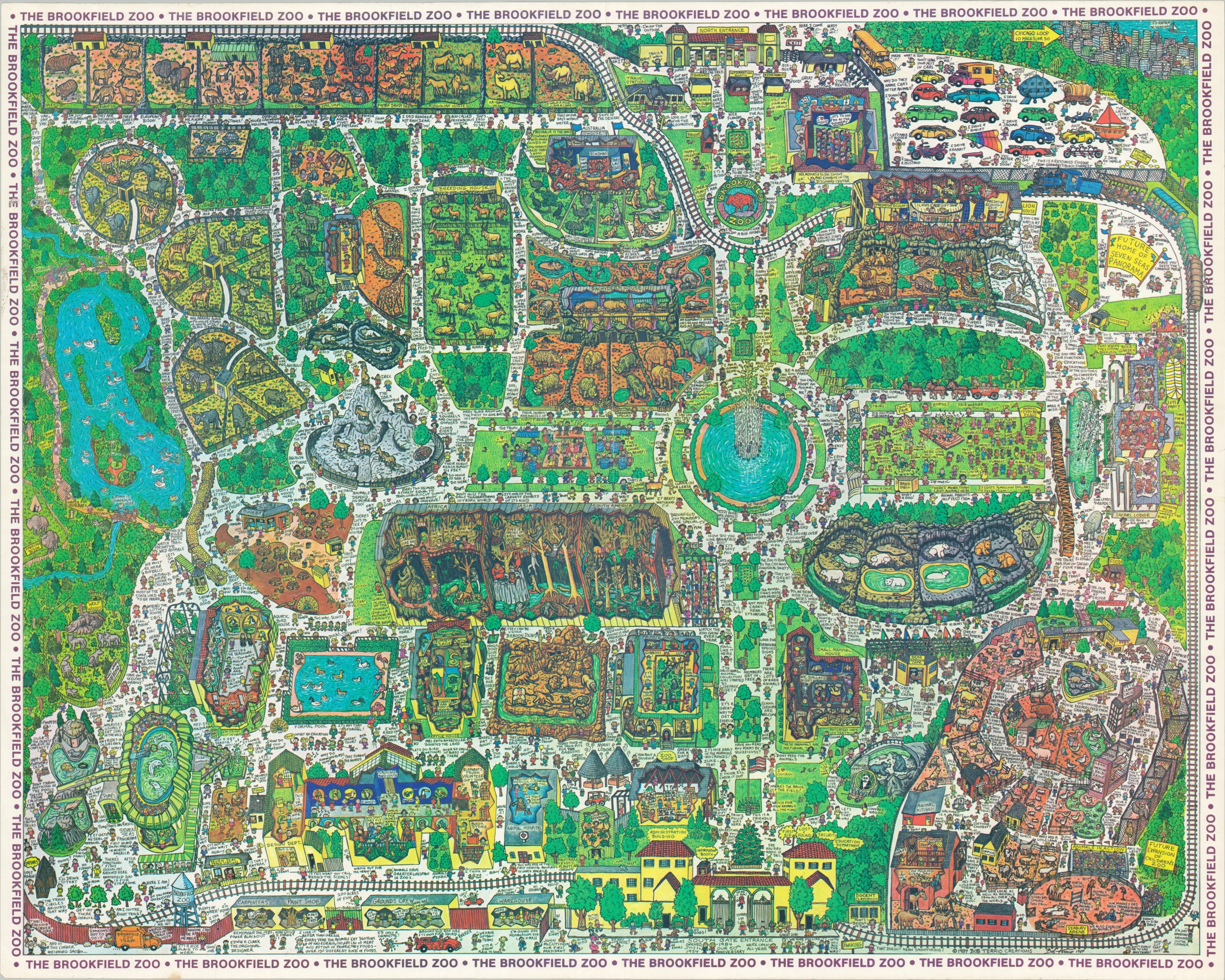
I don't know if this is newsworthy, but it's moreso an interesting look at Brookfield Zoo's history (from Curtis Wright Maps, there's some genuine artistry here!). Here are some highlights, although this may just be me discovering stuff about the zoo's history for myself, hopefully I'm not preaching to the choir.
  • This map is *packed* with commentary, alongside some tidbits here and there either about the zoo's collection in general or fun facts about the animals that Brookfield had at the time.
    • Side tidbit for Tropic World - I love how one person says "gorillas are shy" even though you could absolutely walk all the way around the gorilla exhibit in Tropic World. :D
  • The map also shows the layout of the old Primate House (before its conversion into the Swamp) as well as the old Reptile House, and even showcases Baboon Island seemingly in its prime.
    • Did they have Hamadryas baboons at some point? I know the last three baboons the zoo had were guinea baboons - past that, the enclosure at this point in history was a mixed species exhibit (as confirmed by other accounts) for meerkats *as pointed out by one of the guests* alongside what looks like rock hyrax?
  • This map confirms accounts of the Predator Ecology exhibit (now Desert's Edge/Clouded Leopard Rainforest) being a one-way path rather than two separate loops, even allowing guests to look inside the Lion House after you exited Predator Ecology! (I also love how both Lincoln Park and Brookfield had gift shops *inside* their respective Lion Houses.
  • Jaguars were where the sloth bears are now, and based on footage from the 1990s, the jaguars actually were displayed in an open-fronted habitat! Seems like a legitimate rarity to display jaguars in that manner, as valuable as mesh and glass is - well you know my stance on moats in zoos. :p
  • This shows a pretty solid layout of the old Seven Seas area for Olga the walrus, the zoo's dolphins and the old California sea lion exhibit.
  • Penguins were originally on display in the old Aquatic Bird House (now Feathers and Scales) and that exhibit even had underwater viewing! Which does seem a bit strange that The Living Coast doesn't for the main penguin exhibit, although apparently geriatric penguins are housed in the Open Ocean tank).
  • They actually had wisent in the old hoofstock yards! Alongside eland (giant eland?), beisa oryx, ostrich, Pere David's deer, American bison, yaks and Przewalski's horses alongside the other remaining animals within the hoofstock yards.
  • Hamill Family Play Zoo was originally the zoo's Small Mammal House, and there's a little otter exhibit to the side of that building.
  • When did Brookfield Zoo have so many polar bears and okapi? I'm wondering if the groups of polar bears were in separate grottoes or if they were all interconnected at some point, the okapi I get given the zoo's a breeding powerhouse for okapi.
    • Speaking of bears - what looks like American black bears in the zoo's old giant panda enclosure.
If there's anything I missed, feel free to let me know!
 
map_2023-06-10_28.62x22.91_inv005121-scaled.jpg


I don't know if this is newsworthy, but it's moreso an interesting look at Brookfield Zoo's history (from Curtis Wright Maps, there's some genuine artistry here!). Here are some highlights, although this may just be me discovering stuff about the zoo's history for myself, hopefully I'm not preaching to the choir.
  • This map is *packed* with commentary, alongside some tidbits here and there either about the zoo's collection in general or fun facts about the animals that Brookfield had at the time.
    • Side tidbit for Tropic World - I love how one person says "gorillas are shy" even though you could absolutely walk all the way around the gorilla exhibit in Tropic World. :D
  • The map also shows the layout of the old Primate House (before its conversion into the Swamp) as well as the old Reptile House, and even showcases Baboon Island seemingly in its prime.
    • Did they have Hamadryas baboons at some point? I know the last three baboons the zoo had were guinea baboons - past that, the enclosure at this point in history was a mixed species exhibit (as confirmed by other accounts) for meerkats *as pointed out by one of the guests* alongside what looks like rock hyrax?
  • This map confirms accounts of the Predator Ecology exhibit (now Desert's Edge/Clouded Leopard Rainforest) being a one-way path rather than two separate loops, even allowing guests to look inside the Lion House after you exited Predator Ecology! (I also love how both Lincoln Park and Brookfield had gift shops *inside* their respective Lion Houses.
  • Jaguars were where the sloth bears are now, and based on footage from the 1990s, the jaguars actually were displayed in an open-fronted habitat! Seems like a legitimate rarity to display jaguars in that manner, as valuable as mesh and glass is - well you know my stance on moats in zoos. :p
  • This shows a pretty solid layout of the old Seven Seas area for Olga the walrus, the zoo's dolphins and the old California sea lion exhibit.
  • Penguins were originally on display in the old Aquatic Bird House (now Feathers and Scales) and that exhibit even had underwater viewing! Which does seem a bit strange that The Living Coast doesn't for the main penguin exhibit, although apparently geriatric penguins are housed in the Open Ocean tank).
  • They actually had wisent in the old hoofstock yards! Alongside eland (giant eland?), beisa oryx, ostrich, Pere David's deer, American bison, yaks and Przewalski's horses alongside the other remaining animals within the hoofstock yards.
  • Hamill Family Play Zoo was originally the zoo's Small Mammal House, and there's a little otter exhibit to the side of that building.
  • When did Brookfield Zoo have so many polar bears and okapi? I'm wondering if the groups of polar bears were in separate grottoes or if they were all interconnected at some point, the okapi I get given the zoo's a breeding powerhouse for okapi.
    • Speaking of bears - what looks like American black bears in the zoo's old giant panda enclosure.
If there's anything I missed, feel free to let me know!
What really stands out to me here is how much more space used to be utilized! There is a lot of empty space by Habitat Africa! The Forest now, but it looks like that used to be mostly hoofstock yards and even a tortoise enclosure.

Also, very notably, there used to be bison in between the river and Swan Lake? Is there even space for that there? This may be relevant to the speculation thread, as there seemed to be some hints that some new enclosures would be in this area. I'm still confused as to where there actually is space for a bison enclosure next to the salt creek.
 
Thanks for uploading that map @StoppableSan as it's a real gem. At first, it looks like one of those 'Where's Waldo?' picture books for young kids, but in fact it's an intricately detailed zoo map. I love it. The image certainly shows the zoo being absolutely packed with animals...and in its prime!
 
What really stands out to me here is how much more space used to be utilized! There is a lot of empty space by Habitat Africa! The Forest now, but it looks like that used to be mostly hoofstock yards and even a tortoise enclosure.

Also, very notably, there used to be bison in between the river and Swan Lake? Is there even space for that there? This may be relevant to the speculation thread, as there seemed to be some hints that some new enclosures would be in this area. I'm still confused as to where there actually is space for a bison enclosure next to the salt creek.
I had the exact same thought. That area around the top left with the tortoise pen and circular hoofstock yards is just vacant space right now, which is a result of the original plans for Habitat Africa never fully coming to fruition. Luckily that means it's likely a viable piece of land for the future Africa development. I know there was some discussion recently about the zoo's plan to expand west and utilize some undeveloped forest for new exhibits and the fact they actually had bison out on the salt creek trail suggests that enclosures could be built there. With that said, I have no clue how on earth they managed to fit a bison paddock back there with the river running so close to the main path.

One other thing I notice from this incredibly detailed map is that the area behind the old Perching Bird House (current Reptiles & Birds) was publicly accessible. Now it's a large service/back-of-house area.
 
For a measly $200 U.S. ($269 Canadian for me!) one can buy the Brookfield Zoo 'poster map' being discussed here. I was surprised to find out that it wasn't published until 1984:

The Brookfield Zoo | Curtis Wright Maps

There are some really neat zoo maps on that site, which includes Brookfield, Bronx and San Diego.

Shop 2 | Curtis Wright Maps
 
For a measly $200 U.S. ($269 Canadian for me!) one can buy the Brookfield Zoo 'poster map' being discussed here. I was surprised to find out that it wasn't published until 1984:

The Brookfield Zoo | Curtis Wright Maps

There are some really neat zoo maps on that site, which includes Brookfield, Bronx and San Diego.

Shop 2 | Curtis Wright Maps
I really should add that I was taken aback by just how detailed this map is and equally shocked I haven't seen it before. From showing the interior layouts of every animal house, having even the most obscure species labeled, and the hundreds of little visitors walking around talking about the zoo and the animals, the level of detail is almost overwhelming. Nice find @StoppableSan, they don't em' like they used to!
 
This is an incredible find! This is the most detailed rendering of the old Children's Zoo I've ever seen. I have very fond memories of going to the zoo on Groundhog Day and waiting on the outside of that cement pit. Also walking across the stones in the duck pond. I remember it all so vividly now!
  • Penguins were originally on display in the old Aquatic Bird House (now Feathers and Scales) and that exhibit even had underwater viewing! Which does seem a bit strange that The Living Coast doesn't for the main penguin exhibit, although apparently geriatric penguins are housed in the Open Ocean tank)
The entire exhibit was essentially just sloped mock rock filled 3/4 with water. It was really just built into the wall with no additional space or construction as to what is currently in there.
  • When did Brookfield Zoo have so many polar bears and okapi? I'm wondering if the groups of polar bears were in separate grottoes or if they were all interconnected at some point
Someone else can correct me on this, but I believe it was initially two connected polar bear exhibits. At the end, two were connected and one was solo.
I had the exact same thought. That area around the top left with the tortoise pen and circular hoofstock yards is just vacant space right now, which is a result of the original plans for Habitat Africa never fully coming to fruition. Luckily that means it's likely a viable piece of land for the future Africa development. I know there was some discussion recently about the zoo's plan to expand west and utilize some undeveloped forest for new exhibits and the fact they actually had bison out on the salt creek trail suggests that enclosures could be built there.

From what I remember, before Habitat Africa: The Forest, there were okapi in the very last hoofstock yard in the northwest corner of the zoo. I believe it stretched beyond publicly accessible service road so it may have been strictly for breeding. But there definitely is so much more space than we think!
 
Wow, I absolutely adore that map! What I’d give to have been able to visit the zoo during that era…

Is that island enclosure in the children’s zoo meant to suggest that they kept beavers, skunks, raccoons, opossums, and whatever that fifth one’s supposed to be together? That’s quite the crowd, I wonder how it worked out.

And on a similar note, what’s this little fella in the Australia house supposed to be? My initial assumption was an oddly drawn wombat, but no, that’s clearly them beside this one. Did the zoo previously keep devils? Not a perfect match there either, but I have no idea otherwise.

FD41360A-BFBF-4D18-AF7F-C65EB5A8B5DE.jpeg
 

Attachments

  • FD41360A-BFBF-4D18-AF7F-C65EB5A8B5DE.jpeg
    FD41360A-BFBF-4D18-AF7F-C65EB5A8B5DE.jpeg
    193.1 KB · Views: 144
map_2023-06-10_28.62x22.91_inv005121-scaled.jpg


I don't know if this is newsworthy, but it's moreso an interesting look at Brookfield Zoo's history (from Curtis Wright Maps, there's some genuine artistry here!). Here are some highlights, although this may just be me discovering stuff about the zoo's history for myself, hopefully I'm not preaching to the choir.
  • This map is *packed* with commentary, alongside some tidbits here and there either about the zoo's collection in general or fun facts about the animals that Brookfield had at the time.
    • Side tidbit for Tropic World - I love how one person says "gorillas are shy" even though you could absolutely walk all the way around the gorilla exhibit in Tropic World. :D
  • The map also shows the layout of the old Primate House (before its conversion into the Swamp) as well as the old Reptile House, and even showcases Baboon Island seemingly in its prime.
    • Did they have Hamadryas baboons at some point? I know the last three baboons the zoo had were guinea baboons - past that, the enclosure at this point in history was a mixed species exhibit (as confirmed by other accounts) for meerkats *as pointed out by one of the guests* alongside what looks like rock hyrax?
  • This map confirms accounts of the Predator Ecology exhibit (now Desert's Edge/Clouded Leopard Rainforest) being a one-way path rather than two separate loops, even allowing guests to look inside the Lion House after you exited Predator Ecology! (I also love how both Lincoln Park and Brookfield had gift shops *inside* their respective Lion Houses.
  • Jaguars were where the sloth bears are now, and based on footage from the 1990s, the jaguars actually were displayed in an open-fronted habitat! Seems like a legitimate rarity to display jaguars in that manner, as valuable as mesh and glass is - well you know my stance on moats in zoos. :p
  • This shows a pretty solid layout of the old Seven Seas area for Olga the walrus, the zoo's dolphins and the old California sea lion exhibit.
  • Penguins were originally on display in the old Aquatic Bird House (now Feathers and Scales) and that exhibit even had underwater viewing! Which does seem a bit strange that The Living Coast doesn't for the main penguin exhibit, although apparently geriatric penguins are housed in the Open Ocean tank).
  • They actually had wisent in the old hoofstock yards! Alongside eland (giant eland?), beisa oryx, ostrich, Pere David's deer, American bison, yaks and Przewalski's horses alongside the other remaining animals within the hoofstock yards.
  • Hamill Family Play Zoo was originally the zoo's Small Mammal House, and there's a little otter exhibit to the side of that building.
  • When did Brookfield Zoo have so many polar bears and okapi? I'm wondering if the groups of polar bears were in separate grottoes or if they were all interconnected at some point, the okapi I get given the zoo's a breeding powerhouse for okapi.
    • Speaking of bears - what looks like American black bears in the zoo's old giant panda enclosure.
If there's anything I missed, feel free to let me know!
So many pictures of Nile Hippos on the map makes me even more disappointed that they no longer have them despite their bad enclosure. Similar story for me happens when it comes to their elephants.
 
Can't vouch for anything before the mid/late 90's, but it was just groundhogs at the end.

Racoons were definitely there until the tail end as well, I remember them distinctly. Perhaps they rotated? Never knew so many North American mammals shared that enclosure until now.
And on a similar note, what’s this little fella in the Australia house supposed to be? My initial assumption was an oddly drawn wombat, but no, that’s clearly them beside this one. Did the zoo previously keep devils? Not a perfect match there either, but I have no idea otherwise.
I think that is supposed to be a Tassie devil, which the zoo in fact did keep around this time.
I think I finally understand why people are so nostalgic for old Brookfield.
If I had a time machine, the very first thing I would do is visit the zoo during this era. Brookfield was once a a zoo that rivaled the likes of Bronx and San Diego as one of the very best and most prestigious collections in the US. Objectively speaking, the zoo is better for the animals now than it was back then, but compared to other US zoos it has fallen behind significantly. The map above depicts a zoo that was bustling with an overwhelming amount of things to see, but nowadays it's a far different story. However, I'm extremely hopeful the zoo will be restored to its former glory in the coming years and perhaps even ascend to new heights.
 
map_2023-06-10_28.62x22.91_inv005121-scaled.jpg


I don't know if this is newsworthy, but it's moreso an interesting look at Brookfield Zoo's history (from Curtis Wright Maps, there's some genuine artistry here!). Here are some highlights, although this may just be me discovering stuff about the zoo's history for myself, hopefully I'm not preaching to the choir.
  • This map is *packed* with commentary, alongside some tidbits here and there either about the zoo's collection in general or fun facts about the animals that Brookfield had at the time.
    • Side tidbit for Tropic World - I love how one person says "gorillas are shy" even though you could absolutely walk all the way around the gorilla exhibit in Tropic World. :D
  • The map also shows the layout of the old Primate House (before its conversion into the Swamp) as well as the old Reptile House, and even showcases Baboon Island seemingly in its prime.
    • Did they have Hamadryas baboons at some point? I know the last three baboons the zoo had were guinea baboons - past that, the enclosure at this point in history was a mixed species exhibit (as confirmed by other accounts) for meerkats *as pointed out by one of the guests* alongside what looks like rock hyrax?
  • This map confirms accounts of the Predator Ecology exhibit (now Desert's Edge/Clouded Leopard Rainforest) being a one-way path rather than two separate loops, even allowing guests to look inside the Lion House after you exited Predator Ecology! (I also love how both Lincoln Park and Brookfield had gift shops *inside* their respective Lion Houses.
  • Jaguars were where the sloth bears are now, and based on footage from the 1990s, the jaguars actually were displayed in an open-fronted habitat! Seems like a legitimate rarity to display jaguars in that manner, as valuable as mesh and glass is - well you know my stance on moats in zoos. :p
  • This shows a pretty solid layout of the old Seven Seas area for Olga the walrus, the zoo's dolphins and the old California sea lion exhibit.
  • Penguins were originally on display in the old Aquatic Bird House (now Feathers and Scales) and that exhibit even had underwater viewing! Which does seem a bit strange that The Living Coast doesn't for the main penguin exhibit, although apparently geriatric penguins are housed in the Open Ocean tank).
  • They actually had wisent in the old hoofstock yards! Alongside eland (giant eland?), beisa oryx, ostrich, Pere David's deer, American bison, yaks and Przewalski's horses alongside the other remaining animals within the hoofstock yards.
  • Hamill Family Play Zoo was originally the zoo's Small Mammal House, and there's a little otter exhibit to the side of that building.
  • When did Brookfield Zoo have so many polar bears and okapi? I'm wondering if the groups of polar bears were in separate grottoes or if they were all interconnected at some point, the okapi I get given the zoo's a breeding powerhouse for okapi.
    • Speaking of bears - what looks like American black bears in the zoo's old giant panda enclosure.
If there's anything I missed, feel free to let me know!
I've stumbled upon this map once before some years ago - and dismissed it as an artist interpretation, but with later research, it's shocking to realize just how closely it follows the actual layouts of the buildings as I remember and as reported. Would make a great basis for a digital recreation.
  • As far as my research, no confirmation the zoo has ever held Hamadryas baboon, though it is certainly possible. Multiple references suggest the zoo first held Guinea baboon at the exhibit in 1936 so if they ever did, they co-existed. The meerkat were introduced from 1978 until the Fragile Desert opened. I believe the hyrax identification is correct but unsure when they left; possibly the same time. The drawings sure look like Hamadryas though!
  • Total news to me Predator Ecology was a separate exhibit inside Lion House as a greater building - fascinating.
  • Yes! Brookfield actually won awards for their work with wisent, beisa oryx, and less certain on the eland and deer in the eighties. Such a shame none of these programs persisted.
  • Those definitely look to be black bears; by my childhood, Andean bears were held in the former panda grotto, although I had no clue of that grotto's history until well after it was torn down.
It's almost overwhelming to try to connect some of my childhood memories to these layouts. I really wonder if there is an even higher-quality version of this out there... what a valuable historical resource.

Also, very notably, there used to be bison in between the river and Swan Lake? Is there even space for that there? This may be relevant to the speculation thread, as there seemed to be some hints that some new enclosures would be in this area. I'm still confused as to where there actually is space for a bison enclosure next to the salt creek.
According to anecdote, the bison were actually only visible from the Brookfield Zoo train, which was dismantled and discontinued shortly after this map was published to make room for the new Seven Seas exhibit. I don't believe they had an enclosure viewable from any path - this might be why it appears there was no such space for them at the time. I've also heard legend there is an enclosure for white stork over there? I've actually only ventured through the Salt Creek Wilderness once or twice.

By my childhood, the bison were part of the 31st Street Hoofstock Yards.

For a measly $200 U.S. ($269 Canadian for me!) one can buy the Brookfield Zoo 'poster map' being discussed here. I was surprised to find out that it wasn't published until 1984:

The Brookfield Zoo | Curtis Wright Maps

There are some really neat zoo maps on that site, which includes Brookfield, Bronx and San Diego.

Shop 2 | Curtis Wright Maps
Local advantage here obviously, but for me guessing the date based on the co-existence of Tropic World and the old Seven Seas - the former exhibit was fully open by 1984 and the new Seven Seas opened in 1987.

Someone else can correct me on this, but I believe it was initially two connected polar bear exhibits. At the end, two were connected and one was solo.

From what I remember, before Habitat Africa: The Forest, there were okapi in the very last hoofstock yard in the northwest corner of the zoo. I believe it stretched beyond publicly accessible service road so it may have been strictly for breeding. But there definitely is so much more space than we think!
The polar bear arrangement sounds correct to me. I remember on my first visit as a kid to the bear grottos being surprised to see polar bears active in two habitats and signed in a third. It's an odd contrast that the old bear grottos used to seem extremely active and often with breeding cubs, but I usually reach Great Bear Wilderness by the time the animals are sleeping and there's been no breeding to date.

I do remember okapi being kept in the last hoofstock yard in childhood as well after the Forest opened, as well as a Congo buffalo at one point, so this arrangement persisted for a while.

Is that island enclosure in the children’s zoo meant to suggest that they kept beavers, skunks, raccoons, opossums, and whatever that fifth one’s supposed to be together? That’s quite the crowd, I wonder how it worked out.
I distinctly remember that island enclosure from childhood, watching a skunk and a raccoon interacting there and finding it absolutely delightful. I didn't fully embrace the Children's Zoo at the time so I spent a lot of time by the island exhibit when I did visit. It was a lot of fun. Beavers were definitely gone by then.
 
As far as my research, no confirmation the zoo has ever held Hamadryas baboon, though it is certainly possible. Multiple references suggest the zoo first held Guinea baboon at the exhibit in 1936 so if they ever did, they co-existed. The meerkat were introduced from 1978 until the Fragile Desert opened. I believe the hyrax identification is correct but unsure when they left; possibly the same time. The drawings sure look like Hamadryas though!
Hamadryas baboons were kept in the old primate house at some point, but never at baboon island.
 
Thanks for sharing that map, @StoppableSan! While I don't have the same nostalgia towards it as the locals do, it's absolutely insane the level of detail on there! The more I look at it, the more I find some real gems in the writing or in the details (e.g., a witch saying frogs don't give you warts). Really really neat find, however certainly not the most effective map from a navigational point of view.
 
If I had a time machine, the very first thing I would do is visit the zoo during this era. Brookfield was once a a zoo that rivaled the likes of Bronx and San Diego as one of the very best and most prestigious collections in the US. Objectively speaking, the zoo is better for the animals now than it was back then, but compared to other US zoos it has fallen behind significantly. The map above depicts a zoo that was bustling with an overwhelming amount of things to see, but nowadays it's a far different story. However, I'm extremely hopeful the zoo will be restored to its former glory in the coming years and perhaps even ascend to new heights.
Personally, I think Brookfield is still a zoo bustling with things to see, it has just shifted its focus on smaller species for the most part, with losses only in larger mammals. I don't see that as a bad thing and I really like Brookfield as it is now. I pretty much just wish Tropic World was back to its old, full-of-life self.
 
Personally, I think Brookfield is still a zoo bustling with things to see, it has just shifted its focus on smaller species for the most part, with losses only in larger mammals. I don't see that as a bad thing and I really like Brookfield as it is now. I pretty much just wish Tropic World was back to its old, full-of-life self.
Don't get me wrong, the collection is still immensely impressive especially when it comes to birds, herps and smaller mammals and Brookfield is still very much a full day zoo. However, when we compare the map above to the zoo’s current state, it's clear to see that there's a lot less activity than there once was. The nine hoofstock yards along the 31st street now only hold three species between them, only five of the nine pachyderm house yards are currently occupied, the bear grottos have sat empty for nearly 14 years, the old reptile house is now a staff building, and baboon island was demolished and replaced by an area that originally didn't have any animal exhibits. Tropic World is nowhere near what it once was of course, but its actually gotten better over the last year with the return of both capuchins and cotton-top tamarins.

With all that said, I realize many of these areas were badly outdated and needed to be replaced. The reptile house was deemed to no longer be appropriate for animals and its conversion into the Conservation Leadership Center consolidated staff areas into one building which was good. Baboon island and the bear grottos definitely needed to go as well for obvious reasons. Individually these aren't bad changes, but it all adds up to a significant chunk of the zoo that no longer features animals in any capacity or isn't being utilized to the fullest extent. Combine that with the number of vacant lawns and picnic areas dotted across the grounds and there's a lot of space that isn't being effectively used. Brookfield is still a terrific zoo, just one I feel has never reached its full potential.
 
Don't get me wrong, the collection is still immensely impressive especially when it comes to birds, herps and smaller mammals and Brookfield is still very much a full day zoo. However, when we compare the map above to the zoo’s current state, it's clear to see that there's a lot less activity than there once was. The nine hoofstock yards along the 31st street now only hold three species between them, only five of the nine pachyderm house yards are currently occupied, the bear grottos have sat empty for nearly 14 years, the old reptile house is now a staff building, and baboon island was demolished and replaced by an area that originally didn't have any animal exhibits. Tropic World is nowhere near what it once was of course, but its actually gotten better over the last year with the return of both capuchins and cotton-top tamarins.

With all that said, I realize many of these areas were badly outdated and needed to be replaced. The reptile house was deemed to no longer be appropriate for animals and its conversion into the Conservation Leadership Center consolidated staff areas into one building which was good. Baboon island and the bear grottos definitely needed to go as well for obvious reasons. Individually these aren't bad changes, but it all adds up to a significant chunk of the zoo that no longer features animals in any capacity or isn't being utilized to the fullest extent. Combine that with the number of vacant lawns and picnic areas dotted across the grounds and there's a lot of space that isn't being effectively used. Brookfield is still a terrific zoo, just one I feel has never reached its full potential.
Fair enough, but it's hard for me to feel disappointed about Brookfield when so many other major Midwestern zoos (Minnesota, Milwaukee, Detroit, ect) are really struggling far more than Brookfield with all of these same problems, plus issues of their own.
 
  • Like
Reactions: CMP
Fair enough, but it's hard for me to feel disappointed about Brookfield when so many other major Midwestern zoos (Minnesota, Milwaukee, Detroit, ect) are really struggling far more than Brookfield with all of these same problems, plus issues of their own.
This really is a new development; Brookfield was in the same boat as the other three not too long ago, before the exciting news of all the new additions being built. I think this map does provide some insight to what we can expect the full potential of Brookfield to be like.

Brookfield was still good even in its more troubled days of the mid 2010s, and has really been on an upward trajectory since then, adding many very nice smaller animals.
 
Back
Top