Captive breeding Lesser flamingo's

vogelcommando

Well-Known Member
10+ year member
Half of the Flamingo-species are doing very well in captivity ( Greater, Chilean and American ). 2 of the 3 remaining species are hardly kept ( and bred ) anymore anywhere -James and Andean - but the 6th species, the Lesser flamingo is still kept in good numbers in a large number of zoos.
Evenso, breeding-results with this species are still rare and only few collections have had succes with them althrough the situation is improving.
I came across a very intresting article which could improve breeding-results even more and therefor I guess its worth showing this article to fellow ZooChatters :

http://www.flamingo-sg.org/wp-content/uploads/2021/01/paper-13-Ray.pdf
 
Checked Zootierliste and the results sofar are realy not good !
Currently the species is kept at 57 EU-collections and from these only 6 had at least 1 breeding result :
- Santillana del Mar - Spain - bred for the first time 2013
- Timmendorfer Strand - Germany - bred for the first time 2021
- Leipzig - Germany - first breeding 2008 and now breeding regulary
- Karlsruhe - Germany - first breeding 2016 and now breeding regulary
- Berlin Zoo - Germany - first breeding 2012 and also in 2013 and 2014
- Zlin - Czech Republik - first breeding 2015
Zootierliste mention 10 collections from outside the EU keeping the species and from these just 1 collection has bred Lesser flamingo's :
- Slimbridge - UK - bred 2006

Zootierliste also list 3 more collections have bred the species in the past but no longer are keeping Lesser flamingo's :
- Tierpark Berlin - Germany : European first breeding in 1993
- Hillside Bird Oasis Knutsfort - UK : UK-first breeding in 1999 but the park doesn't exist anymore
- National Wetland Centre Llaneli - UK : should have bred the species but don't keep them anymore.
Very poor results for a species kept at such a number of zoos !

Does anyone has information about the situation in the USA ( next to the already mentioned San Diego Zoo Safari Park from post #1 )?
 
Current status of Lesser Flamingo in North America:

Lesser Flamingo (16 holders)

Busch Gardens Tampa
Cleveland
Dallas
Disney’s Animal Kingdom
Fort Worth
Grant’s Farm
Honolulu
Memphis
Minnesota
Oakland
Oregon
San Diego Zoo Safari Park
Safari North Wildlife Park
Safari West
Southwicks
Sylvan Heights Bird Park

And Cleveland may no longer be a holder. I do not know what the breeding success is but I do not think it is good.
 
Hello and this is a great thread. Someone else can probably explain the Fort Worth Zoo's breeding program for Lesser Flamingos better than I can, but here is an article from their website in 2020. The Fort Worth Zoo has been breeding Lesser Flamingos for 19 years and have hatched over 300 chicks. I'm not sure what their survival rate it, but I feel confident that it's been more than 70% over the past ten years based on other articles that I've seen (the Zoo has posted many articles and news releases about their Lesser Flamingos during the past decade). As you've mentioned, they are the exception and not the rule when it comes to breeding this species, but I think zoos are sharing information that should lead to more zoos successfully rearing Lesser Flamingos in the future. Fort Worth's success seems to be a combination of factors including an indoor nesting area with mirrors to make the flock seem larger than it is.

The Fort Worth Zoo is seeing pink!
 
Current status of Lesser Flamingo in North America:

Lesser Flamingo (16 holders)

Busch Gardens Tampa
Cleveland
Dallas
Disney’s Animal Kingdom
Fort Worth
Grant’s Farm
Honolulu
Memphis
Minnesota
Oakland
Oregon
San Diego Zoo Safari Park
Safari North Wildlife Park
Safari West
Southwicks
Sylvan Heights Bird Park

And Cleveland may no longer be a holder. I do not know what the breeding success is but I do not think it is good.
Caldwell and Cameon Park both also hold the species -- I saw them at both this year. ZIMS also lists Wildlife World and Chehaw Park and Zoo as holders as well. It no longer lists Cleveland as housing the species.
 
One of German zoos (Leipzig or Karlsruhe?) had a similar recipe for success with Lesser Flamingos like Fort Worth: they filled the winter exhibit with mud, given much light and raised the temperature very high. They also mixed salt with mud for some reason.

It seems logical that wild breeding Lesser Flamingos experience very high temperature on sun-baked mudflats. It is also possible that in the wild, high concentrations of salt or soda in flamingo breeding lakes act as a natural anti-bacterial and anti-fungi disinfectant.

I also found two interesting papers. One is about early results of breeding at Leipzig:
https://www.eaza.net/assets/Uploads/Zooquaria/Zooquaria-86-LR.pdf
The second seems to conclude that flamingo pools should have soft (sandy or muddy) bottom. Foot wounds are an important welfare problem.
https://sat.gstsvs.ch/fileadmin/media/pdf/archive/2013/09/SAT155090497.pdf
 
I suspect that Lessers are much more cold sensitive than the other flamingo taxa, consequently less likely to attain breeding condition in northern latitudes
 
In South Africa, Lesser flamingos are kept by four collections, 3 of the holders stock originate from abandoned chicks after the Kamfer's dam in the North Cape dried up in 2019.

Montecasino Bird Gardens, 16 individuals (Kamfer's Dam)
National Zoo of South Africa, 55 individuals (Kamfer's Dam)
Johannesburg Zoo, 3 individuals (Kamfer's Dam)
Giraffe House {unsure of amount or origin}

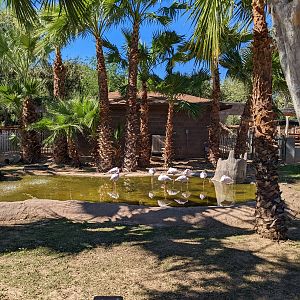
Though I do not know if any of these are actively breeding the species, The national zoo's large flock and muddy enclosure seems a perfect breeding ground for the specie.
 

Attachments

  • IMG_0855.JPG
    IMG_0855.JPG
    315.1 KB · Views: 14
Some zoos tried to encourage flamingos to nest by putting mirrors to fake larger flock. Apparently this never worked. However, it might be interesting what was used for wild birds.

- Not mirrors, but plastic models of flamingos were found to attract wild flamingos. They were even used in a scientific study to prove that wild wading birds follow others to find feeding sites. Appropriately painted dummies were also successfully used to encourage visiting and nesting of wild puffins, Dalmatian pelicans, African penguins and possibly more species.
- Loudspeakers broadcasting mating calls were found to attract a wide variety of wild birds. Possibly, this could be also attractive to encourage zoo flamingos to nest, or synchronize breeding pairs in an exhibit (which was sometimes said to be a problem).
- Decorating fake nesting mounds with some chicken eggshells to fake past breeding was suggested to try to encourage wild greater flamingos to nest on aritificial islands,. I found, however, no mention whether it worked.
 
There is also a huge male bias in captive lesser flamingo's, that is not helping potential breeding. Imports have been mainly males, but I am not sure why. Does anybody have an idea about why mainly males are exported? Do they congregatie in different areas as females or is there already a male bias in the wild?
 
I wondered about it, too. My guess is that males are stronger, so there is a higher mortality of females in transport and substandard zoo keeping. This would explain why there is an excess of males in some other zoo birds, too. Also, male flamingos are visibly larger, longer-necked and longer-legged and better fit the image of a freaky flamingo. So another possibility is that catchers and zoo buyers choose males as more attractive. But they are just guesses.
 
At the Zoo Berlin the last chick had hatched 2014 but this year again saw some possitive results and the first chick has hatched. 2 more pairs are still incubating so maybe more chicks to come :).
 
An new interesting paper on breeding flamingos in zoos:
https://onlinelibrary.wiley.com/doi/full/10.1002/zoo.21753#zoo21753-bib-0030

It turns that a flock of 100 lesser flamingos is needed for 50% probability of breeding.(!)

However, encouragingly, an even proportion of females and moving birds between institutions also stimulates breeding. Additionally, the study did not look at the effect of such things like fully flighted birds, high density of birds per area (rather than the absolute number of birds), high temperature in breeding enclosure, direct sunlight in the exhibit, adding salt to the breeding mud and more general suitable safe place to nest. These may mitigate the low flock size.

I wonder whether zoos coordinate breeding lesser flamingos - e.g. exchange surplus males to bring all females in possible breeding flocks, look individually which pinioned males are capable of mating etc? In Zootierliste there is still awful lot of zoos which keep only a handful of flamingos, too few for breeding.
 
Current status of Lesser Flamingo in North America:

Lesser Flamingo (16 holders)

Busch Gardens Tampa
Cleveland
Dallas
Disney’s Animal Kingdom
Fort Worth
Grant’s Farm
Honolulu
Memphis
Minnesota
Oakland
Oregon
San Diego Zoo Safari Park
Safari North Wildlife Park
Safari West
Southwicks
Sylvan Heights Bird Park

And Cleveland may no longer be a holder. I do not know what the breeding success is but I do not think it is good.

Wildlife World (Litchfield Park AZ) holds lesser.
 
Birds of Eden has welcomed 4 lesser flamingos from Lory Park Zoo in Midrand.
These were among the animals rescued after the Kamfer’s dam dried up.

Mystic Monkeys and feathers Wildlife park has also received Lesser flamingos for a new flamingo habitat. I am unsure of their origin.
 
Back
Top